
Apply for this course
Please select when you would like to start:
If you're a UK applicant wanting to study full-time starting in September, you must apply via UCAS unless otherwise specified. If you're an international applicant wanting to study full-time, you can choose to apply via UCAS or directly to the University.
If you're applying for part-time study, you should apply directly to the University. If you require a Student visa, please be aware that you will not be able to study as a part-time student at undergraduate level.
If you're applying for a degree starting in January/February, you can apply directly to the University.
Why study this course?
The Accounting and Finance (including foundation year) BA (Hons) is a four-year programme ideal if you're returning to education after some time away, feeling unsure about your next steps, or taking this course as a required part of your degree pathway. The foundation year focuses on building your academic skills, exploring big ideas, and preparing you for university life with the support of experienced staff and a close-knit learning community.
On successful completion of this four-year degree, you'll become a part-qualified accountant, eligible for professional exemptions from accounting. Find out more on our Accounting and Finance BSc course page.
81% student satisfaction
Our accounting and finance courses scored 81% for student satisfaction in the Complete University Guide 2025
Accredited by ACCA, CIMA, IFA and more
This course is accredited by a wide range of accounting bodies including the Association of Chartered Certified Accountants (ACCA), the Chartered Institute of Management Accountants (CIMA) and the Institute of Financial Accountants (IFA)
Learn the skills you need to reach your full potential
This four-year degree course includes an intensive foundation year (Year 0), which will provide you with the skills required for your subsequent three years of study
Course modules
The modules listed below are for the academic year 2025/26 and represent the course modules at this time. Modules and module details (including, but not limited to, location and time) are subject to change over time.
Year* 0 modules
Year 1 modules
Year 2 modules
Year 3 modules
Foundation Year Programme
This module currently runs:all year (September start) - Monday
all year (September start) - Tuesday
all year (September start) - Wednesday
all year (September start) - Thursday morning
all year (January start) - Monday
all year (January start) - Tuesday
all year (January start) - Thursday afternoon
(core, 120 credits)
In this module you will explore a broad range of social science and current affairs issues. You’ll reflect on the qualities needed to be a successful student in Higher Education and identify your own strengths and areas for development. You’ll be guided to investigate and conduct research on a topic of interest to you in greater depth.
1. You will learn to access sources, recognise and analyse arguments, and critically engage with source material.
2. You will explore some principles of research and develop research skills.
3. You will develop digital and academic communication skills, including integrating source materials with your own voice into written work.
4. You will develop oral, written and visual communication skills to produce work in a range of formats.
5. You will critically engage with current, social, and ethical issues, in the context of the Education for Social Justice Framework and your subject area
6. You will contribute to building a sense of belonging, and a respectful learning community, where students collaborate, share knowledge and ideas and work effectively as a team.
7. You will be encouraged to explore and build on prior knowledge and experiences to prepare you for further study in your subject area, professional behaviours and your chosen career
8. You will reflect on your learning journey, build your confidence, and take ownership of your motivation.
Business Law and Ethics
This module currently runs:autumn semester - Wednesday morning
autumn semester - Tuesday morning
(core, 15 credits)
You will initially be introduced to the foundations of English Law. Some of the key issues here include: the importance of Law in society and the sources of Law. You will also learn about Statute Law, Common Law, Criminal Law, Civil Law and other types of Law.
The second part of the module aims to integrate the legal rules with business situations.
This part also deals with the relative advantages of being an employee verses self-employed. Thus from the outset, students would be able to distinguish clearly between these two routes of earning a living in future. In the past, most students have enjoyed this part of the module.
The third part deals with how the English Courts handle real-life business disputes. You will be able to bring into seminar discussions your own experiences (or family/friends’ experiences) with the Law. Some of these scenarios include: what to do if shops refuse to give out refunds, or if goods purchased are of unsatisfactory quality
The fourth part of the module aims to examine the relevance of ethics in business and the accountancy professions. You will learn some of the most recent ethical standards which are required in commercial activities.
Throughout the semester, you will also be acquiring some skills of the legal profession such as how to read and understand Law cases and Statutes. You will be able identify the important elements in cases and statutes for use in university assessments or in later life. You will be able to connect, albeit indirectly, the knowledge and skills acquired in this module with your other modules in the Business School. And you will understand your other modules from a different dimension which gives you a wider world view.
Read full detailsData Science, Research and Analysis
This module currently runs:spring semester - Wednesday morning
spring semester - Monday morning
(core, 15 credits)
This module offers a fundamental understanding of data science and computer software, specifically focusing on how they facilitate the collection, analysis, and presentation of accounting data. Designed to prepare you for careers in accounting, economics, finance, and related fields, this module emphasises developing crucial academic and practical skills, particularly in research and the application of AI. Students will gain proficiency in analysing data, interpreting, and effectively communicating both qualitative and quantitative results.
A key aspect of this module is its focus on the collection, analysis, interpretation, and presentation of accounting and financial data through measuring variable changes and associations. Learners will acquire essential skills in gathering and comprehending financial and non-financial information, building a comprehensive understanding of client businesses and their operating environments. This knowledge will be vital for preparing robust business plans and advising on their implementation. Ultimately, this module hones students' data science and research abilities to provide innovative solutions to challenges within the accounting and finance sectors, with a strong emphasis on leveraging AI.
Read full detailsFinancial Accounting
This module currently runs:autumn semester - Monday morning
autumn semester - Friday morning
autumn semester - Wednesday morning
spring semestermorning
(core, 15 credits)
AC4052 is a 15-credit core module which is designed to lay the foundation for understanding the accounting requirements of business organisations for internal and external reporting and decision making. It examines the financial accounting techniques for sole traders and limited companies. The module is considered as the fundamental basis for the accounting specialism and the advanced accounting modules that students will study in levels 5 and 6. The main focus of the module is the financial accounting and reporting cycle, its underlying concepts and principles, its implementation steps, and the interpretation of its outputs. This is in addition to explaining the main depreciation methods of firms’ assets, which is a critical issue within the accounting cycle. The module starts with setting the basics of the double entry system, until reaching the four financial statements, i.e. Profit/Loss statement, Owners’ Equity Statement, Statement of Financial Position, and the Cash Flow Statement, at the end of the cycle. Moreover, the module enable students to translate the data disclosed in the financial statements into implications for practices required by different users and decision makers.
This module aims to:
1. Enable students to understand the underlying principles of the financial accounting processes and to prepare/construct relevant accounting statements.
2. Enable students to evaluate the strengths and weaknesses of accounting information. systems and how they relate to the decision-making aspects of financial accounting statements 3. Enable students to analyse and interpret the financial accounting statements of a limited company.
4. Enable students to understand the context of the professional accountancy framework and to enhance their employability skills.
Introduction to Financial Markets and Institutions
This module currently runs:autumn semester - Tuesday afternoon
autumn semester - Monday afternoon
(core, 15 credits)
The module focuses on the organisation, structure and functions of financial markets and market participants. It provides the theoretical and practical framework for understanding the operation of financial markets and institutions.
Read full detailsLearning through Organisation
(core, 15 credits)This Professional Practice module will enhance the students’ understanding of what it means to be a business professional. This module will support the preparation for their future career by encouraging them to develop, put into practice and evidence the skills and behaviours that
employers want to see. The ‘Professional Practice’ approach ensures that as a developing
professional the students understand how to learn effectively and efficiently either in the
workplace or in a simulated context. They also learn how to use all the resources available to
reflect on their progress. This module involves planning, conducting and reflecting on their own ‘performance episodes*’ and a more general reflection on their overall professional development
to date.
You will be introduced to the “Gateway to Success” learning tool to further your professional development.
The written reports and reflections become part of their growth and productivity E-portfolio** which they will maintain throughout their programme. In addition, they will have the opportunity to test, review and evidence their skills development via the on-line resources provided throughout the programme, which support the general skills required by employers.
As such this module aims to,
1. Build understanding of the expected workplace knowledge, skills, competencies and attitudes so that they become intrinsic performance and growth motivators.
2. Ensure the adoption of skills, attitudes and behaviours that improve self-awareness to aid reflective practice.
*A performance episode is defined as a reflective initiative that the students take, made up of tasks, which develops their skills, and which involves both selecting knowledge from the programme and interacting with others. It must be measurable so that they are able to reflect on their professional skills development.
** The growth and productivity E-portfolio is a digital internet-based tool within which they will store all evidence of their Weekly via learning log, feedback from stakeholders, their reflections. It allows them to share their journey with others and to organise elements of it to help them progress further.
Read full detailsManagement Accounting Fundamentals
This module currently runs:spring semester - Monday afternoon
spring semester - Friday morning
spring semester - Wednesday afternoon
summer studiesmorning
(core, 15 credits)
The concepts and methods of management accounting are introduced to students in this module, with a focus on employability, digital literacy (including artificial intelligence), ethical awareness, and teamwork—all of which are essential skills for business analysts and professional accountants.
The module aims to establish a foundation for students to grasp the essential knowledge and techniques that form the basis of management accounting.
You will cover the following key areas of management accounting:
• Cost classification and behaviour
• Tools and techniques for planning, control, and decision-making
• Techniques for short-term decision-making
• Capital investment appraisal methods
The module has the following aims:
1. You will explain the function of management accounting and how costs are classified based on output, activity level, and decision-making.
2. You will prepare overhead cost statements to determine the total costs of products, services, and activities.
3. You will apply break-even analysis in short-term decision-making.
4. You will understand the short-term decision-making techniques such as Make or Buy, Shutdown, Accept/Reject, and Pricing.
5. You will calculate simple variances for effective cost control.
6. You will develop essential analytical skills to evaluate financial information and make informed management decisions.
Management Information Systems
This module currently runs:autumn semester - Wednesday afternoon
(core, 15 credits)
This Management Information Systems (MIS) module introduces students to the dynamic landscape of modern accounting information systems, relevant to both general management and specialised accounting domains. The module will explore how integrated information systems, increasingly supported by foundational Artificial Intelligence (AI) applications, can enhance various business functions and contribute to an organisation's competitiveness.
A core focus will be on the functions and theoretical underpinnings of financial accounting within a computerised environment. Students will gain practical experience in applying key methods and developing essential skills for processing and interpreting financial data. The module will also explore into relevant information systems techniques, enabling students to explain system functions, interpret data flows, and apply theoretical knowledge to practical financial accounting methods within a broader systemic context. Crucially, it will examine how these systems support effective decision-making and introduce the concept of inherent biases that can influence outcomes.
Read full detailsUnderstanding the Business and Economic Environment
This module currently runs:spring semester - Monday afternoon
spring semester - Wednesday afternoon
spring semester - Friday morning
summer studies - Wednesday morning
summer studies - Thursday afternoon
(core, 15 credits)
The focus of this module is to equip you to understand organisations in contexts past, present and future, and enable you to analyse the macro, micro, internal and external business and economic environments in which they operate. An understanding of the environments will facilitate the interpretation of situations and enable decisions that add value for businesses. The focus of the module is on the external and internal influences on organizations and the effect these have on business practices.
The module is designed to be used by Level 4 undergraduate students on a range of programmes. Examples, illustrations and case studies will be drawn from chosen industry sectors such as advertising, aviation, events, finance, marketing, transport, tourism, and applied to reinforce basic concepts. This will enhance your ability to understand particular business problems and aspects of the business and economic environment. Topics and case studies will cover business issues that are contemporary and relevant to the real world.
Read full detailsCompany and Business Law
This module currently runs:autumn semester - Thursday afternoon
(core, 15 credits)
First, the Company and Business Law module aims to expose students to the advantages and costs of forming limited liability companies. The delivery will be from both a contemporary and a historical perspective. Many of the business difficulties during the industrial revolution in the nineteenth century which led to the emergence of Company Law as distinct area of Law will be discussed. You will initially be given a refresher session on the relative advantages of being a self-employed verses being an employee. Following this, you will then be able to appreciate what may be considered a higher level of self-employment – the Limited Liability Company.
Second, the module empowers students to analyse and appreciate the regulatory framework around company activity. You will be able to understand the key statutes in Company Law such as the Insolvency Act 1986, the Companies Act 2006 and recent legislation. As well as these, you will learn about actual cases in the courts.
Third, students will be able to analyse most company activity from the point of view of shareholders, auditors and creditors, especially during insolvency.
Fourth, the module deals with aspects of Employment Law such as the duties of the Employer and the Duties of the employee.
Accordingly, students’ knowledge and analytical skills in the area of Company and Business Law will be enhanced. You will then be able to understand and appreciate the linkages between this module and some of your other modules such as Accounting, Finance, Auditing, Economics and Marketing, and then view your degree as one whole body of knowledge and skills.
Read full detailsPerformance Management
(core, 15 credits)This module builds on the foundation laid in Level 4’s Management Accounting Fundamentals. It is designed to help students to develop a sound understanding of the principles and techniques used by managers in planning, control, decision making and performance measurement. Students will also able to understand the principles applied in job and service costing using both traditional absorption costing and the more recent activity-based costing.
The module is directed at core accounting and finance students who intend to specialise in the field of accounting and finance after their degree. It is aimed that the module should provide them with the skills they need in the world of work when solving different business problems. Students’ skills in cost accounting will be developed through the module to enable them to plan, control, evaluate and measure performance.
The module aims to develop students’ skills in the following areas:
- application of knowledge and data presentation
- communication skills including oral presentation
- Interpersonal skills including working with others to achieve desired objectives.
- Numeracy and interpreting management accounting information.
Principles of Finance
This module currently runs:autumn semester - Tuesday afternoon
(core, 15 credits)
The module is designed to introduce students to the basic theory of finance and to apply the theory to the selection and management of financial and investments portfolio. The module will help students to understand theories of finance to develop the skills of valuing investments and critically evaluate the frameworks for pricing securities, risks and reward relationships.
These are core module aims to prepare students as follows
1. You will be equipped with a solid grounding in the core principles and theories of finance.
2. You will develop analytical and modelling skills for informed financial decision‑making using industry‑standard tools.
3. You will learn and develop a clear and professional communication skills of financial analysis and recommendations.
4. You will acquire ethical awareness, responsible behaviour, and employability skills valued in finance profession
Problem Solving: Methods and Analysis
This module currently runs:spring semester - Friday afternoon
spring semester - Thursday afternoon
(core, 15 credits)
This module aims to develop students’ ability to understand and apply problem solving methods and analysis in relation to issues that may arise in business and management subject areas. It seeks to enhance students’ knowledge and understanding of the business environment and develop their data management and data analysis skills using IT packages as appropriate.
The module provides the quantitative and qualitative data analysis skills that underpin the success of an empirical research project. This module helps to build the sound foundation required to undertake the final year dissertation modules.
You will have an opportunity to collect, present, analyse and interpret qualitative and quantitative data from a variety of data sources such as ONS and other sources.
Read full detailsTaxation - Income Tax
This module currently runs:autumn semester - Friday morning
(core, 15 credits)
Module AC 5064 introduces the UK tax system. Structure of the HM Revenue and Customs and Administration of the tax system. It will cover income from employment and self-employment, rental income and income from savings and interest and the allowances available against this income for individuals and partnerships.
This module aims to:
1. Give student an understanding of the UK income tax system.
2. Administration of the tax system
3. Taxation of individuals with income from a variety of sources including trading profits, savings and investments, rent and employment.
4. Preparation income tax computations for individuals and unincorporated businesses
Creating a Winning Business 1
This module currently runs:autumn semester - Thursday
autumn semester - Friday
spring semester - Thursday
spring semester - Friday
(alternative core, 15 credits)
Why do some companies succeed while others fail? Are some business ideas fundamentally better than others? How can you tell which ideas and/or solutions are worth investing time and money in and which are not?
This module is a key introduction to identifying, critically assessing and developing new business opportunities. The approaches and processes covered can be applied equally to new commercial ideas, social enterprises or new ventures within an existing business.
The foundation of the module is a live client brief with a real organisation, where you will develop your own solutions leading to a presentation and designing a consultancy type. At each stage you will learn the concepts covered in the module by applying them to the brief.
This module will be delivered through weekly lecture/seminars. The sessions will consist of a combination of theoretical input and problem-based tasks, supported by multimedia, including videos, case studies and student-centred discussions. You absolutely need to attend regularly each week to keep up.
Students will be able to receive support from the work placement team at the University for how to identify a relevant business for the assessment tasks.
The Student Enterprise at London Met will provide guidance to any student considering setting up their own business or wishing to utilise their knowledge to work as a freelancer.
The module is particularly relevant to anyone engaged in business or working at setting up his/her own business. Those considering starting their own business, working for an SME or taking on an intrapreneurial role within a large organisation will find application and a plethora of take-aways.
Please note:
● International students on a Student Visa must ensure their placement meets UKVI monitoring requirements. This includes:
• Prior approval of consultancy dates and hours by the Module Leader and the University Visa Compliance Team.
• Submission of timesheets signed by a line manager/supervisor.
Empowering London: Working within the community
(alternative core, 15 credits)This unique module will provide insight into key urban issues affecting London (which are additionally relevant to other large cities around the UK and the wider world) before applying your academic knowledge in a practical setting.
You will undertake 50 hours of hands-on work experience with a London community focused organisation, tackling real-world challenges such as inequality, crime, health disparities, and climate change. Along the way, you’ll develop professional skills and reflect on your personal and professional growth to assist you to reach your graduate career goals.
Support is provided to help secure suitable placements which can be remote or in-person.
The module supports the University’s Empowering London initiative and promotes inclusive, ethical practice.
The module aims to enable you to:
● Effectively express and understand your current skills and abilities in relation to your career values and goals
● Practically apply the knowledge gained through your course programme to a work/neighbourhood environment
● Make a positive contribution to the challenges of current social and economic issues facing the University’s local communities and consider these from national and global perspectives
● Gaining unique insight of current challenges facing cities in the areas of social wealth; the environment; discrimination; health; poverty and deprivation and crime and partner with community institution to design potential solutions
● Gain understanding and direct experience of the graduate level skills, knowledge and insights required for inclusive practice and problem resolution within institutions to enable you to become an inclusive leader in society
● Recognise your personal and professional development through your work based practice and how to apply the experience and knowledge gain to your future goals
Please note:
● Students will be contacted prior to the semester to provide support in securing a Placement in good time.
● Students are responsible for applying for opportunities and to engage with the Module Team/Employer Engagement and Placements Team to assist them.
● The suitability of any opportunities will be assessed by the Module Team/Employer Engagement and Placements Team and all placements must meet Health and Safety requirements for Higher Education Placements.
● Students on a Student Visa must ensure their placement meets UKVI monitoring requirements. This includes:
• Prior approval of placement dates and hours by the Module Leader.
• Submission of timesheets signed by a line manager/supervisor.
• Ongoing engagement with the Module Leader and the International Student Support Team.
Empowering London: Working within the community
(alternative core, 15 credits)This unique module will provide insight into key urban issues affecting London (which are additionally relevant to other large cities around the UK and the wider world) before applying your academic knowledge in a practical setting.
You will undertake 50 hours of hands-on work experience with a London community focused organisation, tackling real-world challenges such as inequality, crime, health disparities, and climate change. Along the way, you’ll develop professional skills and reflect on your personal and professional growth to assist you to reach your graduate career goals.
Support is provided to help secure suitable placements which can be remote or in-person.
The module supports the University’s Empowering London initiative and promotes inclusive, ethical practice.
The module aims to enable you to:
● Effectively express and understand your current skills and abilities in relation to your career values and goals
● Practically apply the knowledge gained through your course programme to a work/neighbourhood environment
● Make a positive contribution to the challenges of current social and economic issues facing the University’s local communities and consider these from national and global perspectives
● Gaining unique insight of current challenges facing cities in the areas of social wealth; the environment; discrimination; health; poverty and deprivation and crime and partner with community institution to design potential solutions
● Gain understanding and direct experience of the graduate level skills, knowledge and insights required for inclusive practice and problem resolution within institutions to enable you to become an inclusive leader in society
● Recognise your personal and professional development through your work based practice and how to apply the experience and knowledge gain to your future goals
Please note:
● Students will be contacted prior to the semester to provide support in securing a Placement in good time.
● Students are responsible for applying for opportunities and to engage with the Module Team/Employer Engagement and Placements Team to assist them.
● The suitability of any opportunities will be assessed by the Module Team/Employer Engagement and Placements Team and all placements must meet Health and Safety requirements for Higher Education Placements.
● Students on a Student Visa must ensure their placement meets UKVI monitoring requirements. This includes:
• Prior approval of placement dates and hours by the Module Leader.
• Submission of timesheets signed by a line manager/supervisor.
• Ongoing engagement with the Module Leader and the International Student Support Team.
Learning through Work
This module currently runs:autumn semester - Wednesday morning
autumn semester - Thursday afternoon
spring semester - Wednesday morning
spring semester - Thursday afternoon
(alternative core, 15 credits)
This Work Based Learning module enables students to undertake a short period of professional activity either: part-time/vacation employment; work placement; not-for-profit sector volunteering or a professional/employer led project.
Work Based Learning modules are designed to enhance students’ personal and professional development and assist in preparing students for their future careers. The module aims to facilitate application and progression of knowledge and skills gained via the learner’s studies and wider life experience. Students will be introduced to a range of professional skills and techniques, including: reflective self-assessment; preparation for employment; being a critical employee and developing approaches for co-operative and collaborative working.
• Students will be contacted prior to the semester to provide support in securing work based activity in good time.
• It is a student's responsibility to apply for opportunities and to engage with the Work Based Learning team to assist them.
• The suitability of any opportunities will be assessed by the Module Team and all roles must meet the Health and Safety requirements for Higher Education Work Placements.
• Learners may be able to utilise existing employment, providing they can demonstrate it is personally developmental and involves a relevant level of responsibility.
• In addition, students may be able to complete the Work Based Learning hours during the summer prior to the academic year a student is taking the module.
• Tier 4 International students will be required to submit weekly timesheets for the hours undertaken for the work based learning activity to meet the requirements of their visa. These will need to be signed by their line manager/supervisor.
The module aims to enable students to:
• Effectively express and understand their current skills and abilities in relation to their career values and goals.
• Practically apply the knowledge gained through their course programme to a work environment.
• Gain an in-depth insight of a work environment
• Make a positive contribution to the employing organisation and demonstrate inclusive workplace practice.
• Recognise their personal and professional development learning and apply to their future goals.
Please note:
● Students will be contacted prior to the semester to provide support in securing a Placement in good time.
● Students are responsible for applying for opportunities and to engage with the Module Team/Employer Engagement and Placements Team to assist them.
● The suitability of any opportunities sourced by the student will be assessed by the Module Team/Employer Engagement and Placements Team and all placements must meet Health and Safety requirements for Higher Education Placements.
● Students on a Student Visa must ensure their placement meets UKVI monitoring requirements. This includes:
• Prior approval of placement dates and hours by the Module Leader.
• Submission of timesheets signed by a line manager/supervisor.
• Ongoing engagement with the Module Leader and the International Student Support Team.
Auditing
(option, 15 credits)The overall aim of the module is to enable students to understand and think critically about the role of auditing in society.
You will understand the theoretical and practical issues of auditing, including the audit process and applicable techniques.
You will be exposed to numerous case studies that help to illustrate and apply concepts.
You will be introduced to the wider literature and contemporary debates.
You will understand and critically evaluate the impact of AI on Auditing.
Relevant accounting software and external resource persons will be utilised on the module to enhance students’ employability.
Transferrable Skills
• Critical thinking
• Technical auditing skills
• Analytical writing skills
• Evaluation and interpretation skills
• Legal and Regulatory knowledge
Fundamentals of Project Management
This module currently runs:spring semester - Monday afternoon
spring semester - Friday afternoon
spring semester - Thursday afternoon
spring semester - Wednesday afternoon
(option, 15 credits)
Projects come in many shapes and forms, from small to large, familiar to unfamiliar, simple to complex, urgent to non-urgent and widely supported to strongly resisted. Anyone undertaking the sponsorship, governance or management of a project needs to recognise that there are risks to its completion on time, to budget and to the customer’s satisfaction. They should therefore know that it may be unsuccessful in some way, or even fail completely.
It is easy to find examples of such failures; the current Crossrail project, the delayed opening of the Berlin International Airport, the chaos when Heathrow Terminal 5 opened, the government’s failure to meet its targets for Corona Virus testing, and the countless software development projects that have been late, failed to meet user needs or been riddled with bugs.
There are various bodies of knowledge specific to managing Programmes, Projects and Portfolios of Projects that seek to provide the methods and tools to manage projects successfully. These are necessary but not sufficient; they do however go a long way towards improving project success rates. Organisations like the Association for Project Management and the Project Management Institute continue to work to improve the status and competency of project managers, as well as the competency of organisations.
This module introduces students to the role of the project manager, the nature of projects and how to manage them successfully, focusing on the linear project in which the project output is clearly defined at the commencement of the project. Such projects are typical in the construction industry but can be found widely in business organisations. You will also look at the way Agile projects change the approach to project delivery to deal with uncertainty in the product to be delivered and to accept changes in requirements or circumstances.
The module aims to enable students to:
- assess projects to determine the approach most likely to succeed
- contribute to the design and development of effective project organisations that provide governance, assurance, support and direction to the project team
- plan and manage simple projects using both linear and agile methods
- prepare key project documents
- create project plans using project management software including the use of Gantt charts
- communicate project management plans, risks and issues effectively.
Sustainability in Practice
(option, 15 credits)This module provides a comprehensive exploration of sustainability in contemporary organisational contexts, advancing beyond foundational concepts to critically examine global frameworks, ethical principles, and strategic applications. Designed for students aspiring to specialise in sustainability management, corporate social responsibility, environmental consultancy, or related fields, the module equips you with the analytical depth and practical expertise required to navigate complex sustainability challenges and foster long-term organisational value.
Through a structured engagement with global sustainability standards (e.g., SDGs, TCFD, CSRD), advanced ethical theories, and sophisticated performance measurement tools, you will develop the capacity to evaluate, design, and lead strategic sustainability initiatives. Emphasis is placed on applying ethical reasoning to real-world dilemmas—such as greenwashing, AI ethics, and data privacy—while managing organisational reputation in an increasingly transparent and stakeholder-driven environment.
The module fosters advanced research skills by guiding you through the collection, analysis, and synthesis of both quantitative and qualitative data, with a particular focus on ESG performance. You will learn to use digital platforms and analytical tools to track and visualise sustainability impacts, interpret complex datasets, and translate findings into actionable insights that inform innovation and resilience strategies.
Crucially, you will gain the ability to critically appraise and communicate sustainability reports aligned with leading international standards, assess assurance processes, and understand the strategic importance of credibility, materiality, and stakeholder trust. You will also examine how transparent communication and authentic engagement can mitigate reputational risk and contribute to sustainable value creation.
By the end of the module, you will be able to:
• Critically evaluate global sustainability frameworks and ethical theories, linking them to strategic decision-making and organisational reputation.
• Apply advanced methodological tools to analyse sustainability performance and drive strategic innovation and resilience.
• Conduct independent, data-driven research into sustainability reporting and assurance, drawing on digital and analytical technologies.
• Effectively communicate complex findings and address ethical considerations in stakeholder engagement, data management, and sustainable innovation.
Ultimately, this module hones your ability to provide critical insight and innovative solutions to complex sustainability issues. It prepares you to lead ethically, think systemically, and act strategically in advancing organisational sustainability and managing reputational capital in an era of heightened environmental and social accountability.
Advanced Financial Reporting
This module currently runs:autumn semester - Monday afternoon
(core, 15 credits)
The purpose of this module is to provide students with knowledge and skills generally expected of a graduate in accounting. The module will build on both the conceptual and applied aspects of the subject, acquired by students in their prior learning. You will learn how to account for more complex transactions, and to analyse and interpret financial statements. You will learn the techniques required to prepare and present financial statements for business combinations comprising simple groups of companies, which conform to International Financial Reporting Standards.
You will apply contemporary information and current communication technology for the acquisition, analysis and communication of information.
You will understand and critically evaluate the impact of AI on Accounting.
Relevant accounting software and external resource persons will be utilised on the module to enhance students’ employability.
Transferrable Skills
• Communication skills
• Presentation skills
• Data Analysis skills
• Problem solving skills
• Critical thinking
Advanced Financial Reporting
(core, 15 credits)This module focuses on the preparation of financial statements for UK limited companies, the critical assessment of published accounts, with an understanding of the UK regulatory framework. Students will also be exposed to the need and sources of regulation, the purpose of accounting standards and worldwide use of IFRS.
The aims of this module are as follows:
1) You will understand the regulatory framework for corporate reporting.
2) You will understand the need for International Financial Reporting Standards (IFRS)
3) You will understand the application of the relevant regulatory framework and accounting standards.
4) You will be able to prepare financial statements for UK limited companies in a format suitable for publication;
5) You will be able to conduct a critical assessment of company performance.
6) The module also aims to help students in the development of the following skills:
. academic writing;
. researching
. analysis and presentation of financial data;
. communication, including oral presentations;
. interpersonal, including effective team working;
. self-assessment and reflection.
Advanced Management Accounting
This module currently runs:spring semester - Thursday afternoon
(core, 15 credits)
This module focuses on the strategic aspects on management accounting. It will explore and critically evaluate a number of management accounting techniques encountered in levels 4 (Management Accounting Fundamentals) and level 5 (Management Accounting). In addition, it will develop students’ knowledge and understanding of the theoretical models, analytical methods and practical issues of a number of techniques used by managers in planning, performance evaluation and long-term decision making in an ever-changing business environment. The module will also take a view on the role of management accountants in both profit seeking and not-for-profit organisations in the globalised world where businesses operate.
This Accounting module is very relevant for students who intend to follow a career in Management Accounting after their studies.
The module aims to develop students’ skills in the following areas:
- Apply the skills learnt in Levels 4 and 5 in a strategic context that provides a sound foundation for higher studies.
- Develop practical management accounting skills that are transferable into employment; work situations.
- Develop students’ knowledge and critical understanding of the theoretical models, analytical methods and practical aspects of decision making in management accounting in competitive business environments.
- Evaluate financial and non-financial evidence including arguments and assumptions in order to reach objective conclusions.
Audit and Assurance Services
This module currently runs:spring semester - Thursday afternoon
(core, 15 credits)
Through the study of this module, you will learn and apply the main concepts and techniques of assurance services, which both aim at critically evaluating assertions made by reporting firms to their stakeholders. The module will also expose you to a sound understanding of the audit process and the regulatory and ethical landscape within which external audits take place. In addition, the role of the independent external auditor in assessing the internal controls of business entities will be explored, emphasising the importance of that role in the robustness of the audit process. Important areas will include the critical evaluation of the procedures for audit planning, risk assessment, gathering and evaluating audit evidence, and the issuance of the appropriate audit report.
The Module aims to:
1. Provide an understanding of the concept of audit and assurance engagements incorporating the functions of audit, within the context to corporate governance, codes of ethics and professional conduct knowledge, including internal and external audit review and reporting functions.
2. Critically appraise and evaluate the audit process which demonstrate how the auditors understand and address the audit engagements, consisting of the entity and its environment, appropriate techniques and judgments in relation to the performance and reporting of financial statement (including the risk of material misstatement – arising from fraud or other externalities or internalities) while performing audit and assurance services.
3. Develop advanced skills in forming judgements and opinions whilst exercising an appropriate degree of professional scepticism in audit and assurance engagements. This includes the description and evaluation of the internal controls, processes, techniques, audit tests, further incorporating IT systems in identification and communication process to control risk and the potential consequences of making effective recommendations. The description of the scope, role and the function of internal audit is also included.
4. Understand the application of updated versions of international standards on auditing, Corporate Governance Codes, and other guides relevant to the audit and assurance profession; clarify the differences between an external and an internal audit.
5. Demonstrate employability and technological skills, identifying the techniques employed by auditors to collect sufficient evidence that can inform auditors’ opinion about entities’ reported assertions, and being able to decide on the type of the audit report that is appropriate to the auditor’s opinion.
Read full detailsDissertation
This module currently runs:spring semester - Tuesday afternoon
(core, 15 credits)
The FE6P04S Dissertation module, in conjunction with FE6P04A Dissertation, enables you to complete a research-focused dissertation on a chosen topic relevant to the subject area of your undergraduate degree.
In this module, you will focus on collecting and analysing data, interpreting your findings, and drawing conclusions based on your empirical research.
You will be required to reflect critically on your data collection process, analytical techniques, research findings, and their implications in an independent approach. The module aims to develop your analytical, critical thinking, data interpretation, and academic writing skills, supporting you to independently complete and report on your dissertation.
You will additionally be required to consider how your personal development and career plans.
Read full detailsDissertation
This module currently runs:autumn semester - Tuesday morning
(core, 15 credits)
The FE6P04A Dissertation module, in conjunction with FE6P04S Dissertation, enables you to complete a research-focused dissertation on a chosen topic or issue appropriate to the subject area of your undergraduate degree.
In this module, you will focus on developing your research topic, conducting a comprehensive literature review, designing appropriate methodologies, and planning your research.
You will be required to reflect critically on your research questions, theoretical concepts or hypotheses, prior literature, ethical considerations, and research methodologies in an independent and disciplined manner. The module aims to develop your analytical, critical thinking, referencing, and time management skills, supporting you to independently undertake and report on your research project.
You will additionally be required to consider how your personal development and career plans
Read full detailsFinancial Management
This module currently runs:autumn semester - Thursday afternoon
(core, 15 credits)
The purpose of the module is to develop students' critical thinking and knowledge of financial management. It will also examine theoretical frameworks, analytical techniques, and real-world applications of corporate investment and financial decision-making in a dynamic capital market and competitive business environment and to prepare students for employability.
The principal aims of this module are as follows:
1. You will learn an integrated understanding of corporate finance theory and contemporary practice, including valuation, M&A, takeovers, and venture capital.
2. You will develop the technical modelling and analytical skills expected of graduate analysts incorporate development, investment-banking, private-equity and FP&A roles.
3. You will acquire the ethical norms, professional conduct, and communication styles that propel early career success and employability.
4. You will be prepared to analyse finances with honesty, precision, and openness.
Artificial Intelligence and Big Data in Business
This module currently runs:spring semester - Friday afternoon
spring semester - Thursday afternoon
(option, 15 credits)
The business world is currently undergoing profound technological change. Digitalisation has reached new heights, and new technologies are helping tackle ever more tasks that are complex. This trend is driven by the availability of large quantities of data – big data (BD) – and by the improved opportunities for using this data through artificial intelligence (AI). The relevance of AI is growing as technology, companies, and consumers interact. First, current technological progress facilitates the extensive and practical use of AI. Second, companies are increasingly relying on data and the value they extract from it to optimise their business models and processes.
Third, consumer behaviour is increasingly shaped by digital applications, which in turn boosts the generation and availability of data. As such this module focuses on the relevance and management of AI in the business context. This module also focuses on how to lead successful AI initiatives by prioritising the right opportunities, building a diverse team, shaping the strategies and strategic experiments and continuously managing business solutions to benefit the organisations.
Read full detailsFinancial Engineering
This module currently runs:spring semester - Monday afternoon
(option, 15 credits)
The aims of this module are to provide students with the use of a wide range and in-depth knowledge of the major exchange-traded and over-the-counter traded financial instruments to construct financial products and manage financial risk.
The module discusses the characteristics, pricing and valuation, terminologies and application of financial innovation to create the structured products in derivative markets.
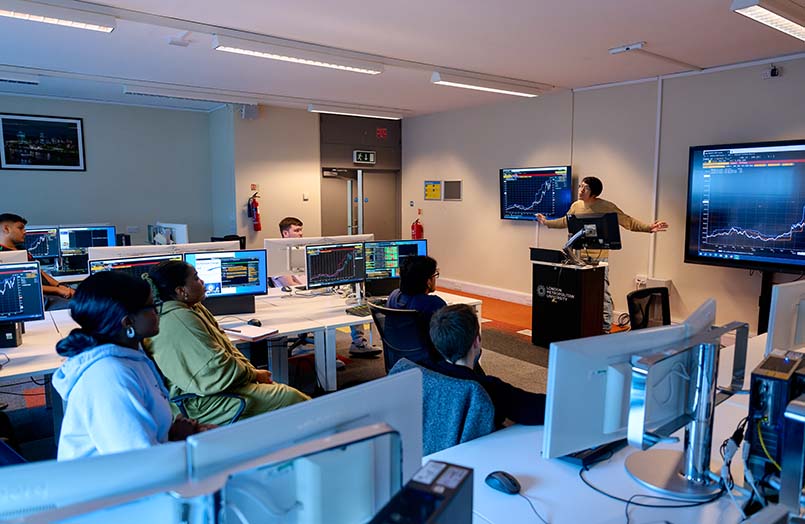
Students will further develop an understanding of the use of the financial instruments as investment vehicles, hedging tools, arbitrage mechanisms, and speculative instruments. Students will further develop skills for data collection and analysis utilising software systems such as Bloomberg and spreadsheets.
A blended teaching and learning approach includes the use of websites, videos, guest talks from industry and support for employability enhancing classroom activities.
Bloomberg may be used to deliver teaching sessions.
Financial Instruments
This module currently runs:autumn semester - Wednesday morning
(option, 15 credits)
This module aims to provide students with a knowledge of the trading of the major exchange-traded and over-the-counter traded financial products and develop an understanding of their use as investment vehicles, hedging tools, engineered products, arbitrage mechanisms, and speculative instruments.
The module discusses the characteristics, pricing and valuation of the fundamental instruments, terminologies and contract specifications for the trading of those financial instruments in both cash markets and derivative markets. The module evaluates the relationship between cash instruments and financial instruments, identifies the risk exposure on investments and explores the use of financial derivatives for risk hedging.
Students will also develop skills for data collection and analysis which may include the use of Bloomberg and MS Excel spreadsheets.
A blended teaching and learning approach includes the use of websites, videos, guest talks from industry and support for employability enhancing classroom activities.
The financial market Lab Bloomberg may be used to deliver teaching seminar sessions.
Read full detailsInternational Banking
This module currently runs:spring semester - Tuesday afternoon
(option, 15 credits)
The module aims to provide an in-depth understanding of theoretical and applied issues in relation to the activities of international banks. The module focuses on main theories of banking and provides an overview of the crucial operations in the context of international banking. It also seeks to provide students with a critical awareness of different approaches of assessing bank risk and performance and how they are used in practice by shareholders, investors and financial and banking experts.
Read full detailsInternational Trade and Finance
(option, 15 credits)This module introduces students to the fundamental aspects of the theories of international trade and finance, policy analysis and the controversies that surround these activities. It will examine the costs and benefits of these two fundamental activities in the global economy and consider the extent to which government policies in these areas can improve economic outcomes. The module will draw on up-to-date analyses and empirical studies and will examine theoretical and contemporary policy issues in this regard in the international economy.
The module also aims to develop a number of transferable skills of students, e.g. oral and written communication skills, research, quantitative, analytical and problem-solving skills.
Read full detailsPersonal Finance
This module currently runs:spring semester - Wednesday afternoon
(option, 15 credits)
This module has been nationally promoted by the UK financial regulator the Financial Services Authority (FSA), [now Financial Conduct Authority (FCA)], as a ‘unique idea’ in their ‘National Strategy for Financial Capability in Higher Education’ (2009), and disseminated to all universities as an exemplar for raising student interest, expertise and enthusiasm in personal finance. FSA refers to London Metropolitan University as one of only four universities awarded the FSA Curriculum Development Grant for “unique ideas” put forward for the creation of a financial capability module, the unique idea for this University being the innovative Competency Based Action Learning (CoBAL) curriculum which is the outcome of doctoral level research conducted in collaboration with real-world organisations such as the National Institute of Adult Continuing Education (NIACE), the FSA, and the National Research and Development Centre for adult literacy and numeracy (NRDC).
The module underlines the role personal judgement plays in personal finance, and the many perspectives that inform personal judgement, enabling the student to formulate and employ Action Learning strategies for the development of knowledge, skill and attitudinal competencies in personal finance, and for increased ability and confidence in dealing with the complexities of making financial decisions in the five domains of financial capability identified by the FSA.
This is an option for all GSBL courses, and is also an Extension of Knowledge (EoK) module which any student on any course in the University is able to take as an option module subject to their course incorporating a relevant slot in their course structure. The module’s EOK status recognises the need for students of all subjects to have a good grasp of Personal Finance.
Read full detailsProfessional Experience Year Placement
(option, 30 credits)A Year in Industry (‘sandwich placement’) module is often one of the most effective ways to secure a professional career following graduation.
This module provides an additional 30 credits between Levels 5 and 6, offering a four-year course programme. It is specifically designed to enhance your employability and improve your future prospects by undertaking a minimum of 44 weeks of full-time, professional-level employment related to your graduate career goals.
Pre-placement preparation workshops and one-to-one support will assist you in your search for a suitable placement. Year-long placements are advertised by a wide range of organisations, and we will support you in accessing these opportunities.
During the placement year, you will be supported by a Placement Tutor who will provide guidance on all aspects of your workplace experience and module assessments.
Placement employers will be asked to complete a feedback form evaluating your performance in the role.
The module aims to enable you to:
• Apply the knowledge gained through your course and any previous employment in a practical, professional work environment.
• Gain in-depth insight into a particular industry, including analysing work-based problems and proposing solutions.
• Develop industry-focused, graduate-level employability skills.
• Make a positive contribution to the employing organisation and demonstrate inclusive workplace practices.
• Articulate industry-specific and transferable skills to support your future career—whether through recruitment processes, self-employment, or further professional/postgraduate study.
Please note:
• You will receive support well in advance of the placement year to help secure a suitable placement in good time.
• You are responsible for applying for appropriate opportunities and engaging with the Module and Placements Team for assistance.
• The suitability of any placement will be assessed by the Module and Placements Team, and all placements must meet Health and Safety requirements for Higher Education placements.
• Students on a Student Visa must ensure their placement meets UKVI monitoring requirements. This includes:
• Prior approval of placement dates and hours.
• Submission of timesheets signed by a line manager or supervisor.






.jpg)