An evaluation of the Syrian and Afghan resettlement programmes delivered in Islington: using comparative and longitudinal approaches
This three-year evaluation project (January 2023 – January 2026) was developed by the Global Diversities and Inequalities Research Centre with Islington Council (London).
The study
This project aimed to evaluate the resettlement programmes in Islington by comparing the experiences of resettlement of the previous wave of Syrians and recently arrived Afghans. This study enabled us to collect information and analyse Syrian refugees’ views on the support provided by Islington Council and resettlement agencies during the last five years. Moreover, we tracked the progress that Afghans, resettled in the borough, made across key indicators over the life of the project.
This project fits well with the Centre's focus on how diversity and inequality are negotiated in everyday life. This project also builds on the interest in developing existing and future collaborations between London Met and key stakeholders, especially within our local borough.
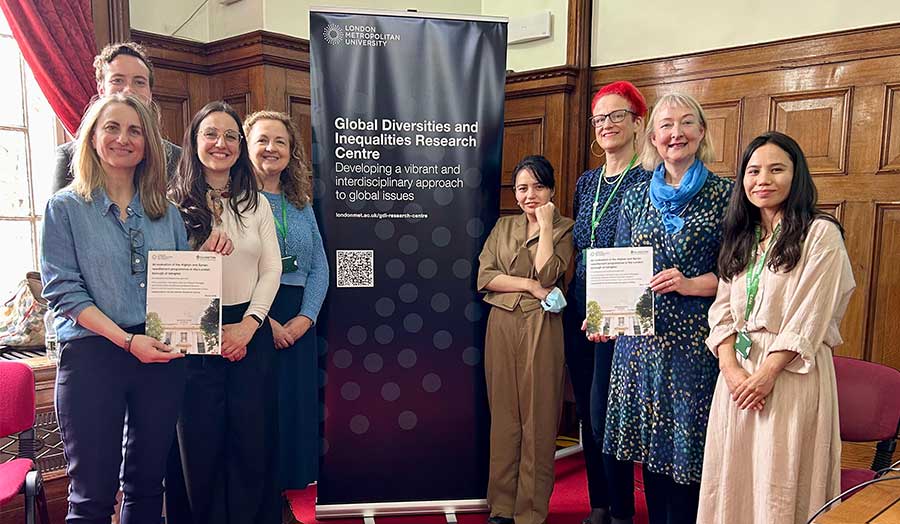
Image: launching the report at Islington Town Hall, March 2026
Project team:
More information
This project team at London Met is led by Professors Louise Ryan and María López, director and deputy director of the Global Diversities and Inequalities Research Centre respectively, and the PhD candidate Alessia Dalceggio as a research assistant. Additional research assistance was provided by Farzana Adell and Mohammad Ibrahim Muzamil, former students at London Metropolitan University.
The team brings together research expertise in qualitative social research techniques with migrant groups and ethnic minority communities, as well as in engaging with partner organisations across previous projects. For example, our project with Afghan migrants and refugees sought to understand the challenges of integration in the context of increasing anti-immigration hostility, particularly in accessing housing, employment and basic material resources, as well as emotional support, in London. Some of our findings can be found in this report on Afghan migrants and in the following publications:
- López, M., & Ryan, L. (2023). “What are you doing here?”: Narratives of border crossings among diverse Afghans going to the UK at different times. Frontiers in sociology, 8, 1087030.
- Ryan, L., Lopez, M., & Dalceggio, A. (2024). Encountering the hostile environment: Recently arrived Afghan migrants in London. Critical Social Policy, 44(2), 242-262.
- Ryan, L., Lopez, M., & Rasa, M. (2024). ‘It hurts my heart’: Afghan women in London negotiating family relationships and (im) mobility regimes across borders. Population, Space and Place, 30(8), e2814.
- Ryan, L., López, M., Dalceggio, A., & Adell, F. (2025). ‘You Need a Network’: How Highly Skilled Refugees Build Social Networks to Convert Cultural Capital and Reclaim Professional Identities. Sociology, 00380385251363897.
We are mindful of sensitivities in undertaking such research and are committed to working closely with our partners to ensure good ethical practice.
The Syrian civil war started in March 2011, creating the largest refugee crisis of our time. Over 21,000 Syrians have been resettled in the UK between 2010 and 2021 (The Migration Observatory, 2021). Meanwhile, in August 2021, the British Army evacuated around 15,000 Afghans from Kabul airport, mainly those who worked with the government, their families and other vulnerable people, after the Taliban’s takeover of power (UNOCHA, 2022).
Islington council is proud of how they are conducting under the various resettlement schemes for Syrians and Afghans. Yet, they are aware of specific challenges facing this communities and thus were keen to work with the London Met research team to evaluate the resettlement process within the borough.
We undertook a multi-method study. Original data collection comprised of desk-based research, interviews and follow-up interviews with Syrian and Afghan residents in London, as well as interviews with key stakeholders. A comparative and longitudinal analysis enabled us to evaluate the service provision as well as service take up and suitability for purpose. We also used visual mapping techniques to analyse social networks within these new local spaces and beyond.
The findings have been written up into a detailed report and a short executive summary, both of which are available to download and read:
The findings were also disseminated at an event organised in partnership between Islington council and London Metropolitan University.
The findings have also been included in several conference presentations and papers in top academic journals.
.jpg)