
Abi Snasdell, Senior Lecturer in Forensic Science, specialises in firearms and ballistics
Date: 28 October 2026
New research from London Metropolitan University academics has highlighted emerging methods of tracing 3D-printed firearms which are often seen as "untraceable".
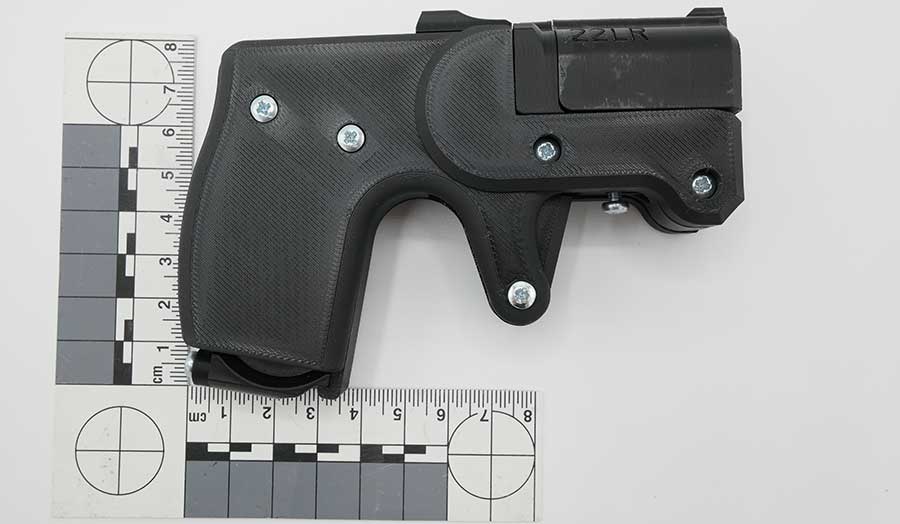
Unlike conventional guns, firearms manufactured using 3D-printers are becoming increasingly accessible and can be produced with basic equipment, limited technical expertise, and minimal oversight.
In a new paper, London Met researchers said: “This ease of production allows individuals to circumvent existing regulatory frameworks, raising profound safety and legal concerns.
“The proliferation of these so-called ‘ghost guns’, unserialized, and potentially untraceable weapons, poses significant challenges not only for public safety but also for forensic science, law enforcement, and policymakers.”
Data from the National Crime Agency showed the number of 3D-printed firearms seized by police rose from three in 2021 to 17 in 2022 and 25 in 2023 – a 733 per cent increase over a two-year period.
A 'complex and nuanced' picture
The paper, published in WIREs Forensic Science, warned that conventional firearm examination techniques are often unsuitable. Researchers concluded that establishing where a 3D-printed firearm came from, and linking it to a particular source, is “feasible but complex”.
Lead author Abi Snasdell, Senior Lecturer in Forensic Science at London Met, said: “3D-printed firearms are often portrayed as completely untraceable weapons, but the reality is more nuanced.
“Our review shows that while these firearms present significant challenges for forensic science, a growing number of promising approaches may help investigators identify links between a recovered firearm, a specific printer, or a crime scene.
“As 3D-printing technology becomes more accessible and designs become increasingly sophisticated, forensic science must evolve alongside it. Much of the current research is still in its early stages, but studies have already demonstrated the potential value of examining manufacturing marks left during printing, trace polymer evidence, and other unconventional forensic signatures.
“Our findings highlight the importance of continuing to develop and validate techniques specifically designed for these emerging technologies. As the number of recovered 3D-printed firearms increases, forensic practitioners need tools and protocols that allow them to recognise and interpret the unique evidence these weapons may leave behind.”
The research also involved London Met’s Dr Bhaven Patel, Dr Daniel Sykes, and Dr Brunso Sil dos Santos, along with Dr Chris Shepherd of the University of Kent.
In response to the research gaps identified in this review, London Met researchers are developing a programme of research focused on the forensic value of manufacturing marks, trace polymer evidence, gunshot residue and firing marks associated with 3D-printed firearms.
The team hopes to generate the empirical evidence needed to support reliable attribution methods and equip practitioners with validated tools for investigating this emerging threat.
Abi Snasdell, Senior Lecturer in Forensic Science at London Met, was the Lead author on the new paper.
She has past experience as a Senior Forensic Scientist, specialising in firearms and ballistics, and as a Reporting Officer and Expert Witness.