
Abi is a Senior Lecturer in Forensic Science at the School of Human Sciences.
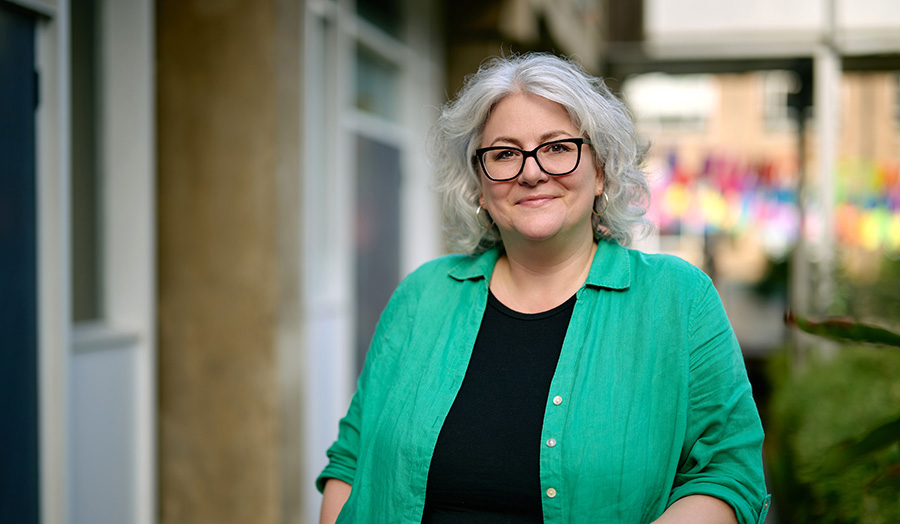
Abi is a Senior Lecturer in Forensic Science, drawing on her past experiences as a Senior Forensic Scientist, specialising in firearms and ballistics, and as a Reporting Officer and Expert Witness.
With collectively over two decades of education, casework and crime scene interpretation expertise, Abi always aims to bring the subject to life in both the lecture theatre and the laboratory to help her students access and thrive in their chosen careers.
Abi has an Experimental Pathology BSc (Hons) degree from the University of St. Andrews, a Forensic Science MSc degree from King’s College, London and a PGCE (M) in Chemistry from the University of Worcester. Abi is currently undertaking a PhD at London Metropolitan University investigating the forensic attribution of 3D-printed firearms. Her research explores how additive manufacturing deposition marks, firing marks generated during discharge, and associated trace evidence can be used to support firearm identification, attribution, and intelligence gathering in cases involving emerging firearm technologies.
Prior to joining London Met, Abi has been a guest lecturer on the Forensic Science degree course since 2007 and a guest lecturer at Kingston and Portsmouth Universities. Abi was employed by the Forensic Science Service (FSS) as a Senior Forensic Scientist specialising in: the examination and classification of firearms, ammunition and related items, firearms identification and comparison microscopy, the interpretation of firearms related damage and gunshot wound interpretation, trajectory analysis, determination of range of firing, attending crime scenes and post mortems for complex firearms related damage and fatal shooting investigations, and delivery of expert witness testimony. Please note that Abi worked as a Forensic Scientist under her maiden name of “Hannam”.
Before joining the gunroom, Abi worked in the Evidence Recovery Unit of the FSS, screening exhibits for body-fluids, identifying and recovering hairs and fibres and conducting footwear and footwear mark comparisons.
Since the closure of the FSS, Abi retrained in secondary education and became the Head of Science and then an Assistant Headteacher with responsibility for the Sixth Form, where attainment, progress measures and student voice improved year on year. Through this experience, Abi has extensive knowledge of the Biology and Chemistry A level specifications, which will ensure that our students are able to transition into their University studies with support and understanding.
- Forensic Science
- Firearms and Ballistics
- Marks and Impression Evidence
- Forensic Biology
- Trace Evidence
- Crime Scene Investigations
- Comparison microscopy of fired cartridge cases and bullets
- Integrity and reproducibility of firing marks from 3D printed firearms
- Casework critical forensic research and development
- Future of crime scene imagery
Snasdell, A., Anyogu, A., Ahmed-Ali, M. Breaking the case: Integrating a blended learning approach in a first-year forensic science module (2026). Science & Justice. Vol 66(3), 101425,
ISSN 1355-0306, https://doi.org/10.1016/j.scijus.2026.101425.
Snasdell, AG. Preparing For Success. (2023). PiXL Insights Article on raising aspirations and attainment in Sixth Form. Published as part of the PiXL Insights series, who partner with schools to stretch and challenge more able learners
Saribey, AY., Hannam, AG.. Homemade heavy caliber rifles - two unusual firearms (2016). J. Forensic Sci. Vol 61(3), 773-774. https://doi.org/10.1111/1556-4029.13024
Saribey, AY., Hannam, AG. A study of the knives used in crime in East Turkey from 2010-2014 (2016). Australian Journal of Forensic Sciences. Vol 48(5), 549-556. https://doi.org/10.1080/00450618.2015.1107130
Saribey, AY., Hannam, AG. Comparison of the class and individual characteristics of Turkish 7.65mm Browning / .32 Automatic calibre self-loading pistols with consecutive serial numbers. (2013). J. Forensic Sci. Vol 58(1), 146-50. https://doi.org/10.1111/j.1556-4029.2012.02213.x
Saribey, AY., Hannam, AG. Shotgun modified after a domestic shooting. (2011). AFTE Journal. Vol 43(1), 92-93.
Hannam, AG. Trends in Converted Firearms in England & Wales as identified by the National Firearms Forensic Intelligence Database (NFFID) between September 2003 and September. (2010). J Forensic Sci. Vol 55(3), 757-766. https://doi.org/10.1111/j.1556-4029.2009.01293.x
Saribey, AY., Hannam, AG. Homemade copies of commercial factory-made self-loading pistols. (2010). AFTE Journal. Vol 42(4), 370-375.
Saribey, AY., Hannam, AG. Turkish mole guns examined between 2006 and 2008. (2010). AFTE Journal. Vol 42(4), 395-396.
Saribey, AY., Hannam, AG, Tarimci, C. An investigation into whether or not the class and individual characteristics of five Turkish manufactured pistols change during extensive firing. (2009). J. Forensic Sci. Vol 54(5), 1068-1072. https://doi.org/10.1111/j.1556-4029.2009.01107.x
Saribey, AY., Hannam, AG. Modified pistol cartridges used in crimes in Turkey between January 2006 – September 2008. (2009). AFTE Journal. Vol 41(4), 374-376.
Saribey, AY., Hannam, AG. Fatal shooting involving a fired shotgun cartridge that had been exposed to fire. (2009). AFTE Journal. Vol 41(4), 387-388.
Saribey, AY., Hannam, AG. Comparison of the class and individual characteristics of Turkish self-loading pistols with consecutive serial numbers. (2009). AFTE Journal. Vol 41(2), 159-166.
Saribey, AY., Hannam, AG. Modified shotguns in Turkey from 2006-2008. (2009). J. Forensic Sci. Vol 54(4), 884-886. https://doi.org/10.1111/J.1556-4029.2009.01078.X
Saribey, AY., Hannam, AG. Shotgun firing pin and extractor altered after a shooting incident. (2009). AFTE Journal. Vol 41(3), 297-298.