
Apply for this course
Please select when you would like to start:
If you're a UK applicant wanting to study full-time starting in September, you must apply via UCAS unless otherwise specified. If you're an international applicant wanting to study full-time, you can choose to apply via UCAS or directly to the University.
If you're applying for part-time study, you should apply directly to the University. If you require a Student visa, please be aware that you will not be able to study as a part-time student at undergraduate level.
Why study this course?
Looking to study a degree that helps people to improve their physical function? This Physiotherapy BSc degree will teach you how to support individuals with a range of circumstances including injury, diseases and the impact of ageing to optimise their movement and function, and to make a good recovery.
This hands-on physiotherapy degree has been developed in collaboration with our highly experienced partners, from a wide variety of health and social care settings, to create a comprehensive and exciting curriculum. You’ll learn about common conditions treated by physiotherapists and develop core skills to provide effective physiotherapy treatments to individuals, groups and populations who have or are at risk of developing long-term health conditions.
You’ll gain invaluable experience through a variety of practice placements opportunities across the NHS, private and third sector to prepare you for a career as a physiotherapist. We’ll also introduce you to the most up-to-date scientific knowledge of the human body, health and disease, research underpinning contemporary physiotherapy theory and practice, and health promotion practice used to promote population health so you’ll be ready to hit the ground running after graduation.
Make use of our amazing facilities
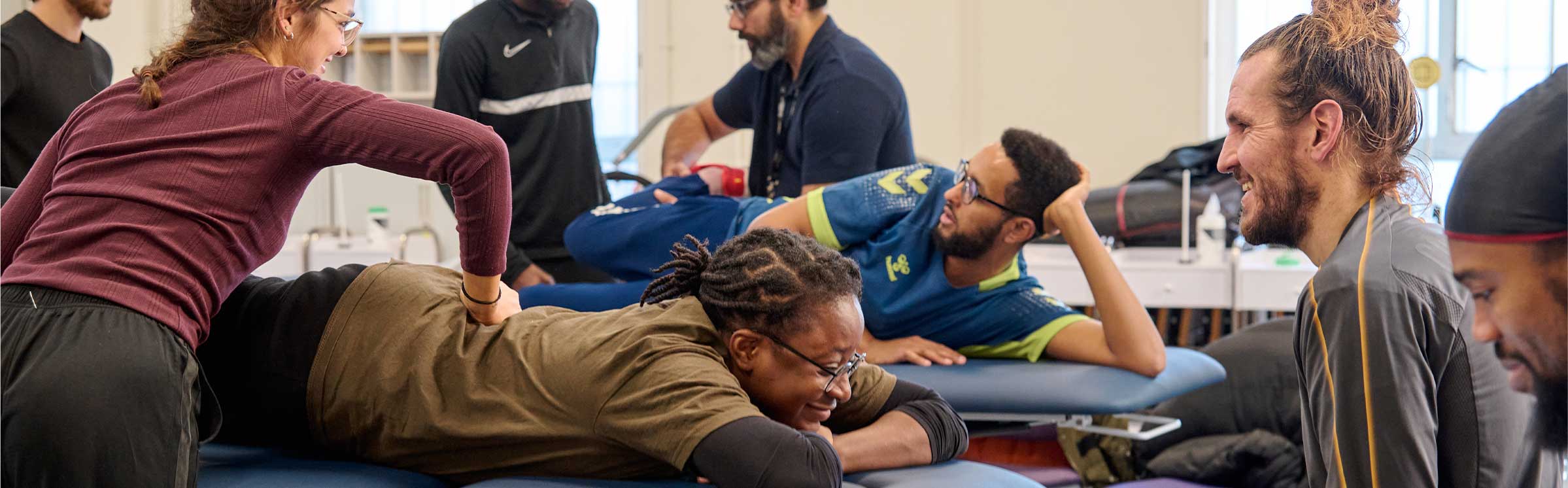
Get hands-on experience in our state-of-the-art physiotherapy teaching laboratory, therapy rooms and clinical simulation suites
Learn from industry experts
We invite experienced guest lecturers, recruited from specialist areas to support the development of both core and enhanced skills for our students
Our staff can help you both inside and outside the classroom
Our internationally-renowned teaching staff are actively involved in physiotherapy practice and research and have great links with employers in London
Course modules
The modules listed below are for the academic year 2026/27 and represent the course modules at this time. Modules and module details (including, but not limited to, location and time) are subject to change over time.
Year 1 modules
Year 2 modules
Year 3 modules
Anatomy & physiology 1 for physiotherapy
This module currently runs:autumn semester - Monday morning
(core, 15 credits)
This module introduces students to the theoretical and practical aspects of human anatomy and physiology in health and disease. It is designed for life-science students with an interest in human biology, but particularly for those wishing to pursue advanced studies in the Biosciences or Forensic Science.
This module aims to provide students, through lectures, tutorials and practical classes, with a sound knowledge of human body structure using appropriate anatomical nomenclature and an in-depth understanding of the physiology of selected body systems. The module will also aim to introduce basic concepts in immunology and pathology.
Read full detailsFundamentals of musculoskeletal anatomy for physiotherapy
This module currently runs:autumn semester - Thursday afternoon
(core, 15 credits)
This module aims to provide an introduction to human anatomy and basic human movement. It is a broadly-based introduction to anatomy of the musculoskeletal system and human movement, and the isolation of specific muscle groups that produce these movements.
You will have the ability to learn and explore the anatomy of the musculoskeletal system and human movement of the lower limb, upper limb and trunk. Thus, among other topics, you will learn to identify and name structures such as bones, joints, muscles, and other relevant soft tissue structures found in the human body using appropriate terminology. You will also learn to describe the function of these structures and understand their relevance to movement and exercise.
The teaching methods include lectures, seminars and practicals. The seminar sessions involve group discussions based on directed learning, which is supported by material available on Weblearn.
Health behaviours for Physiotherapy
This module currently runs:autumn semester - Monday morning
(core, 15 credits)
In this module, you will develop foundational knowledge of the psychological, social and behavioural principles that underpin health behaviour and its relevance to physiotherapy practice, including an introduction to pain science. Aligned with the early expectations of Health Care Professional Council (HCPC) Standards of Proficiency and the Chartered Society of Physiotherapy (CSP) Graduate Attributes, you will explore how behaviour is shaped by capability, opportunity, motivation and wider determinants of health, and how these constructs inform person‑centred care and early therapeutic engagement.
You will be introduced to psychological and the biopsychosocial model, alongside key constructs in motivation, habit formation, health inequalities and cultural influences. You will also develop an introductory understanding of communication, examining approaches such as coaching, supportive dialogue, shared decision‑making and motivational principles that set the foundation for effective therapeutic relationships.
At level 4, your learning focuses on conceptual understanding, analysis and reflection, rather than full applied practice. You will explore how these ideas relate to professional identity, values, ethics and inclusivity, preparing you to recognise the impact of behavioural factors on patient presentation, experience and health outcomes.
This module contributes to the award by establishing essential theoretical building blocks that support your development across later modules in clinical practice, treatment and management formulation, leadership, education and research.
Introduction to cardiorespiratory and neurology physiotherapy practice
This module currently runs:spring semester - Wednesday
(core, 30 credits)
In this module, you will be introduced to the fundamental knowledge, skills, and professional behaviours required for early physiotherapy practice within cardiorespiratory and neurological settings. The module contributes to the wider physiotherapy programme by developing the core assessment, treatment, and clinical reasoning skills that underpin later specialist modules and practice based learning.
You will engage in simulated clinical activities, interactive workshops, case based discussions, and patient educator sessions to support your understanding of the physiotherapist’s role across both acute and rehabilitation pathways within cardiorespiratory and neurological care. These learning experiences are designed to help you integrate theory with practice and begin applying safe, evidence informed, and person centred approaches to physiotherapy assessment and intervention.
You will explore common cardiorespiratory and neurological conditions, examine typical clinical presentations, and develop an awareness of how physiotherapists contribute to multidisciplinary team working. The module also supports your emerging professional identity by fostering confidence in communication, teamwork, and reflective practice. These capabilities will support your progression towards placement based learning and developing competence within real world clinical environments.
By engaging with this module, you will:
1. Develop foundational knowledge of common cardiorespiratory and neurological conditions and understand their impact on movement, function, and wellbeing across acute and rehabilitation contexts.
2. Learn and practise core physiotherapy assessment skills, including respiratory assessment, neurological screening, movement analysis, and functional evaluation, within simulated practice environments.
3. Begin to apply clinical reasoning to identify key problems, prioritise patient needs, and plan safe, appropriate early interventions.
4. Practise fundamental treatment techniques relevant to early physiotherapy practice, such as breathing exercises, positioning, facilitation techniques, early mobilisation, and safe patient handling.
5. Develop professional behaviours and identity, including effective communication, empathy, teamwork, and an understanding of the physiotherapist’s role within multidisciplinary teams and across care pathways.
Introduction to musculoskeletal physiotherapy practice
This module currently runs:spring semester - Tuesday
(core, 30 credits)
This module provides a foundation in the concepts and practices of musculoskeletal (MSK) physiotherapy through the development of core assessment, movement analysis, and intervention skills. It focuses on structured subjective and objective assessment techniques, biomechanical principles, exercise prescription, manual therapy foundations, and patient education approaches.
The module introduces students to systematic safe and effective methods of gathering clinical information and performing physical assessments, progressing from general frameworks to regional joint assessment in the MSK physiotherapy discipline. Teaching emphasises accurate measurement, safe handling, and consistent application of standardised procedures. Biomechanical concepts are explored to support understanding of movement, posture, and load management.
Students are also introduced to fundamental principles of therapeutic exercise, manual therapy, and electrophysical modalities, alongside basic self-management and health education strategies. These skills are contextualised within professional, ethical, and inclusive practice frameworks aligned with the Education for Social Justice Framework.
Learning is delivered through blended methods, including lectures, practical workshops, guided and self-directed practice, and reflective activities. Students are supported to develop professional behaviours, reflective practice, and awareness of scope of practice in preparation for clinical placements. This module provides essential preparation for applied and condition-focused learning at Levels 5 and 6.
Read full detailsPractice Education 1
This module currently runs:all year (September start) - Thursday
(core, 15 credits)
This module enables students to develop a thorough understanding of practice settings and the professional expectations placed upon them within these environments. Students complete mandatory training and develop essential clinical and professional skills required for safe and effective practice-based learning, including professionalism, assessment, clinical reasoning, treatment planning, and accurate documentation. The module supports students in building confidence in applying theoretical knowledge to patient care and in developing reflective and self-directed learning skills. Through participation in a longitudinal placement, students are provided with structured opportunities to integrate academic learning with practice, strengthen professionalism, enhance communication and inter-professional working, and gain insight into the roles and responsibilities of physiotherapists within multidisciplinary teams.
Read full detailsProfessional and core skills for physiotherapy
This module currently runs:autumn semester - Thursday morning
(core, 15 credits)
This module is designed to introduce you to the study of health sciences within higher education at London Metropolitan University, while also helping you develop lifelong skills in organisation and effective application of knowledge through ongoing learning.
This module will develop your transferable skills to enable you to derive maximum benefit from your chosen courses of study. We will provide clear guidance on the University’s teaching, assessment and progression regulations to facilitate smooth progression through your chosen course of study.
The module will introduce you to the learning resources and support facilities available within the University to assist you with your personal and professional development. The development of study skills will include writing laboratory records, scientific reports and essays.
You will be introduced to the development, scope and organisation of your chosen discipline and its associated professional bodies and employment opportunities.
The transferable skills that will be developed will also prepare you for employment.
The module engages you in an exploration of activities that allow skills and knowledge relevant to your field of study to be developed. You will reflect on yourself as a learner, your development in a civic engagement context, as well as a work-based learning and careers context. Additionally, by constructing knowledge as individuals, and as part of a culturally diverse learning community, this module supports your development and achievement, and your ability to communicate effectively in a variety of professional, social and cultural contexts.
Read full detailsApplied science for Physiotherapy
This module currently runs:autumn semester - Wednesday morning
(core, 15 credits)
This applied module builds on Level 4 foundations in behavioural science, early pain psychology and person‑centred communication by integrating advanced scientific and biopsychosocial principles that directly support physiotherapy assessment and rehabilitation. You will deepen your understanding of biomechanics, exercise physiology, neuroscience and pain science, learning how these domains interact to influence movement, function and recovery.
The module emphasises the practical application of scientific knowledge to clinical reasoning. You will explore how the biopsychosocial model can be used to interpret complex patient presentations and guide safe, evidence‑informed decision‑making. Behaviour change theories, including COM‑B, are applied to real clinical contexts to understand factors influencing treatment adherence, motivation and long‑term engagement in rehabilitation.
A specialist focus is placed on advanced pain science, including neurophysiological, cognitive‑affective and behavioural mechanisms, enabling you to differentiate between acute and chronic presentations and tailor physiotherapy interventions accordingly. You will practise integrating pain education, tissue loading principles, graded activity and functional exercise prescription into rehabilitation planning.
Through case‑based learning, simulated practice and practical workshops, you will apply scientific reasoning to movement analysis, outcome interpretation and intervention design. You will develop the ability to justify physiotherapy decisions with reference to applied science, behaviour change and biopsychosocial principles, in line with HCPC Standards of Proficiency and CSP Graduate Attributes. By the end of the module, you will be equipped to design, implement and evaluate physiotherapy interventions across acute and chronic rehabilitation contexts.
Read full detailsIntegrated Physiotherapy clinical practice I
This module currently runs:autumn semester - Monday
(core, 15 credits)
This module provides students with opportunities to apply and further develop the foundational knowledge, skills, and professional behaviours acquired at Level 4 in assessment and treatment of musculoskeletal, neurological, and cardiorespiratory conditions. It focuses on core conditions with relatively stable clinical presentations, enabling students to develop safe and structured approaches to patient management.
The module emphasises understanding basic pathology and typical clinical presentation as a foundation for informed assessment and intervention. Students will learn to select and apply appropriate subjective and objective assessment techniques, screen for red flags and contraindications, and engage in shared problem identification with patients using biopsychosocial principles.
Teaching focuses on the development of early clinical reasoning through structured frameworks that link assessment findings to treatment selection. Students are supported to justify intervention choices using evidence-informed principles, professional guidance, and patient preferences. Throughout the module, inclusive practice, ethical decision-making, and effective communication are embedded in accordance with the Education for Social Justice Framework.
Learning is delivered through blended approaches including lectures, practical workshops, simulation, case-based learning, and guided reflection. Universal Design for Learning principles support accessibility and flexibility.
Read full detailsIntegrated Physiotherapy clinical practice II
This module currently runs:spring semester - Monday
(core, 15 credits)
The module builds on the learning and skills developed in Semester 1 by emphasising the understanding of pathology and clinical presentation of musculoskeletal, neurological, and cardiorespiratory conditions with relatively stable clinical presentations, enabling students to develop safe and structured approaches to patient management.
Emphasis is placed on adapting assessment strategies, monitoring for deterioration, and managing higher-risk presentations safely. Students further develop collaborative problem identification, goal setting, and rehabilitation planning using biopsychosocial principles.
The module supports the development of clinical reasoning, enabling students to justify treatment progression, modify interventions, and plan discharge and long-term self-management. Interdisciplinary working, community-based rehabilitation, and service navigation are embedded.
Throughout the module, inclusive practice, ethical decision-making, and effective communication are embedded in accordance with the Education for Social Justice Framework. Learning is delivered through blended approaches including lectures, practical workshops, simulation, case-based learning, and guided reflection.
Learning is delivered through integrated lectures, practical sessions, multidisciplinary simulations, and placement-linked learning. Inclusive pedagogical approaches support student engagement and wellbeing. This module provides essential preparation for advanced and complex rehabilitation learning in Level 6.
Read full detailsPhysiotherapy research methods
This module currently runs:spring semester - Tuesday afternoon
(core, 15 credits)
In this module, you will develop the core research skills required to design and propose a scientific investigation related to physiotherapy. You will select a project topic that aligns with your academic interests and potential career direction, and use it as a vehicle to explore the principles of research design, literature review, ethics, and data analysis planning.
The focus of the module is on enhancing your ability to ask meaningful research questions, design feasible and ethical studies, and communicate your ideas in a scientifically appropriate format. While the proposed project may not directly lead to your final dissertation, it will provide a structured opportunity to practise the skills of inquiry, critical thinking, and academic writing that underpin successful independent research.
By engaging with this module, you will:
1. Develop your ability to design a scientific research proposal, incorporating research design, ethical considerations, and appropriate data analysis frameworks.
2. Strengthen your skills in sourcing and evaluating academic literature relevant to physiotherapy
3. Communicate your research ideas effectively through a structured and academically rigorous written proposal.
4. Reflect on your academic and professional interests to shape a research question that demonstrates critical thinking and methodological awareness.
Practice Education 2
This module currently runs:autumn semester - Thursday
autumn semester - Wednesday
(core, 15 credits)
Practice Education 2 is the second practice education module and the first of two placement experiences in the second year of the programme. The module is designed to advance students’ professional practice skills while they continue to build theoretical knowledge. It builds on the first- year longitudinal placement model by introducing students to a new practice education environment for two days per week.
The module begins with two weeks of clinical simulation, also delivered two days a week, to prepare students for practice. This simulation period ensures that all mandatory training requirements are completed prior to placement. Following this, students undertake an eight- week longitudinal placement, attending two days a week to achieve a total of 150 practice hours. This consistent and extended exposure to practice supports students’ ongoing professional development and provides supervised opportunities to apply and refine their skills with guidance from practice educators.
Engaging in a placement alongside academic modules enables students to integrate classroom learning with real-life experience. Throughout the module, students will complete mandatory training, develop essential practice-based learning skills, and participate in a longer placement designed to consolidate their knowledge, skills, and attitudes in managing service users with a range of needs. The module also allows students to progress toward the required number of practice hours needed for professional qualification.
Read full detailsPractice Education 3
This module currently runs:spring semester - Thursday afternoon
(core, 15 credits)
Practice Education 3 is the third practice education module within the programme and provides the second of two placement experiences undertaken in the second year. This module is designed to further extend students’ scope and confidence in practice through a block placement, offering an immersive opportunity to consolidate learning and develop competence across a broader range of practice scenarios.
The module prepares and supports students for their block placement by integrating clinical simulation activities that draw on case studies from concurrently running physiotherapy theory and practice modules. Simulation sessions enable students to strengthen their clinical reasoning, assessment, and treatment planning skills before entering the placement environment.
In this module, students will:
1. Develop assessment and management skills through structured clinical simulation sessions using varied case study examples.
2. Attend a block placement that enables further consolidation of theoretical knowledge, clinical skills, and professional attitudes required for effective physiotherapy practice across a range of service user presentations.
3. Engage with clinical governance processes that support the quality assurance of clinical services, enhancing understanding of safe, effective, and accountable practice.
Accumulate additional practice hours necessary for meeting the requirements of professional physiotherapy training and progressing towards qualification.
Read full detailsProfessional practice in Physiotherapy
This module currently runs:autumn semester - Wednesday afternoon
(core, 15 credits)
This Level 5 module develops students’ confidence, capability, and professional identity by deepening their understanding of professional behaviour, communication, and collaborative practice as physiotherapists in training.
Building on the foundational knowledge, professionalism, and communication skills established in Level 4, students now apply HCPC and CSP frameworks with increasing independence and judgement while preparing for more complex multidisciplinary and interprofessional environments.
Students explore how organisational, socio‑political, cultural and ethical factors influence physiotherapy practice, team dynamics, and the delivery of equitable, person‑centred care.
The module strengthens students’ ability to navigate challenging or sensitive communication encounters, support shared decision‑making, manage professional boundaries, address conflict, and raise concerns through appropriate whistleblowing processes.
Through case‑based learning, simulation, reflective practice, and interprofessional learning opportunities, students integrate the biopsychosocial (BPS) model and the International Classification of Functioning (ICF) to inform collaborative clinical reasoning and MDT communication.
The module also supports Level‑5 academic development, including the use of evidence to justify decisions, critical analysis, reflective evaluation, and the synthesis of theory with practice to support progression toward clinical placement readiness.
Read full detailsPublic health for Physiotherapy
This module currently runs:spring semester - Wednesday afternoon
(core, 15 credits)
In this module, you will explore the principles, values, and practices that underpin public health and health promotion within contemporary physiotherapy and wider healthcare settings. The module introduces you to population‑level approaches to health, the social determinants of health, and the role of allied health professionals in promoting wellbeing, preventing illness, and reducing health inequalities. You will examine how public health priorities shape clinical practice, service delivery, and professional responsibility, and you will develop the foundational skills needed to integrate health‑promotion strategies into individual and community‑based physiotherapy practice.
Through lectures, case‑based activities, group work, and reflective tasks, you will analyse current public health challenges and consider evidence‑based approaches to behaviour change, community engagement, and health communication. You will also be introduced to key national and global policies that guide public health strategy and explore how these influence physiotherapy across diverse settings and patient populations. The module contributes to your overall professional development by encouraging you to adopt a preventative, person‑centred perspective that complements your growing clinical skills across the programme.
Specifically in this module you will:
1. Develop an understanding of public health principles and how they apply to physiotherapy practice across clinical and community pathways.
2. Explore the social, environmental, and behavioural determinants of health and their impact on population wellbeing.
3. Explore evidence based health promotion strategies, including behaviour change models and patient centred communication.
4. Develop skills in identifying public health priorities relevant to physiotherapy and proposing appropriate interventions.
5. Reflect on your professional responsibilities in promoting health, preventing illness, and supporting equitable access to services.
6. Begin to integrate public health perspectives into your developing identity as a healthcare professional.
Leadership and service improvement
This module currently runs:spring semester - Monday
(core, 15 credits)
This module prepares final-year BSc Physiotherapy students for their transition to registered professional practice by developing their leadership, service improvement, and self-management capabilities. Building on previous professional practice modules, students will critically explore their own values, emotional intelligence, and leadership styles. Recognising that leadership is a skill all professionals must demonstrate from day one, the module focuses on accountable self-leadership, inclusive team-working, and the safe management of workload and emotional burden. Students will critically apply healthcare service improvement frameworks to evaluate clinical practice and design quality improvement projects. Furthermore, the module bridges the gap between student and registered practitioner by preparing students for preceptorship, developing their employability skills through interview and professional branding preparation, and empowering them to act as role models within multi-disciplinary teams.
Read full detailsManagement of complexity in Physiotherapy practice
This module currently runs:all year (September start) - Wednesday
(core, 30 credits)
This module develops students’ ability to manage complex, high-risk, and unstable clinical presentations across musculoskeletal, neurological, and cardiorespiratory practice. It focuses on critical illness, intensive care rehabilitation, complex cardiac and respiratory conditions, and neurological trauma, including traumatic brain injury and spinal cord injury.
Building on the learning achieved in the Integrated Physiotherapy Clinical Practice I and II, students develop advanced understanding of pathology, disease progression, and multi-system interaction in complex cases. Emphasis is placed on selecting and adapting assessment strategies, monitoring for deterioration, clearing red flags, and managing risk through appropriate escalation and multidisciplinary working.
Students are supported to identify patient problems collaboratively, integrating biopsychosocial, environmental, and service-related factors. Teaching develops advanced clinical reasoning skills to justify assessment choices, treatment priorities, rehabilitation planning and discharge packages in uncertain and time-pressured environments.
Learning is delivered through integrated lectures, practical workshops, simulation, case-based learning, and reflective activities, inclusive pedagogical approaches and Universal Design for Learning principles support accessibility and student engagement. This module prepares students for advanced rehabilitation planning and autonomous practice at graduation.
Read full detailsPhysiotherapy research project
This module currently runs:all year (September start) - Thursday
(core, 30 credits)
This module enables students to undertake an independent research project relevant to physiotherapy practice, under academic supervision. It develops students’ ability to design, conduct, analyse, and present a research study or systematic literature review using appropriate ethical and methodological frameworks.
Building on research literacy and evidence-based practice skills developed at Levels 4 and 5, students develop advanced competencies in critical appraisal, data collection, analysis, and interpretation. Emphasis is placed on ethical research conduct, inclusivity, and the social impact of physiotherapy research in diverse communities.
Students are supported to formulate clinically relevant research questions, select appropriate qualitative, quantitative, or mixed-methods approaches, and apply rigorous analytical techniques. The module also trains students on dissemination skills, enabling them to communicate findings effectively to academic and professional audiences.
Learning is delivered through workshops, supervision meetings, online resources, and peer learning activities. Universal Design for Learning principles ensure accessibility and flexibility.
Read full detailsPractice Education 4
This module currently runs:autumn semester
(core, 15 credits)
Practice Education 4 is the fourth practice education module and the first of three, level 6 placements in the final year. The module will support students’ transition to level 6 placements, consolidate their clinical experience by developing capacity for autonomous practice, and develop their ability to manage caseloads within limits of their own safe and effective clinical practice. Students will have opportunities to do this within another contemporary healthcare setting and increase their mandatory clinical practice hours for graduation. Students will also explore opportunities within this placement to develop appropriate leadership behaviours within their scope of practice and competence. Students will complete a clinical simulation preparatory period in the University including case-based practice sessions and mandatory training before going out on a 5-week placement.
Read full detailsPractice Education 5
This module currently runs:spring semester
(core, 15 credits)
Practice Education 5 is the fifth practice education module and second level 6 placement in the final year. The module will provide opportunities for students to continue the development of their clinical practice through expanding their limits of clinical practice in another contemporary healthcare setting. Students will consolidate their skills for managing larger caseloads as they practice becoming autonomous physiotherapy practitioners.
Students will be allocated to another five-week block placement to practice theoretical knowledge and skills for the management of patients with different clinical conditions. Students will also have opportunities to consolidate their developing professionalism and inter-professional working with other healthcare professionals.
Furthermore, they will have the opportunity to use this placement to demonstrate appropriate leadership behaviours within their scope of practice and competence.
Read full detailsPractice Education 6
This module currently runs:summer studies
(core, 15 credits)
Practice Education 6 is the sixth practice education module and includes the final level 6 placement in the final year.
The module will give students an opportunity to consider their overall practice development and identify a specialist area of practice they would like to experience to extend their limit of practice for their future career aspirations.
Students will be supported to plan, seek, and attend an elective placement in their self-selected specialist area to complement their clinical skills profile to boost their employability after graduation. Placements options such as specialist, leadership, service improvement, public health, etc. will be discussed with students to consider for their elective placement.
Read full details