Unit brief
Complete Topologies: Living Together within Intelligent Ground
"Technology is the answer, but what was the question?" – Cedric Price
Complete Topologies is a speculative design-research studio exploring new forms of collective living on complex terrain in a time of climate emergency. Moving beyond anthropocentric design, the studio understands architecture not as an object placed in the environment, but as an integral part of it – asking how we can live together with each other, with other species and with the land itself.
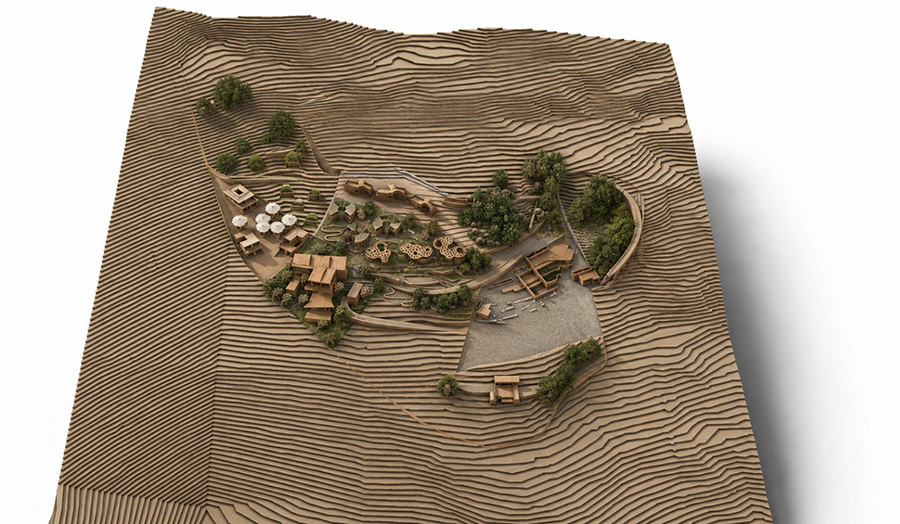
Students design a Commons: a public building at the heart of an off-grid live-work community on [SITE]. Combining a medium- to long-span covered public space with the dwellings, workplaces and landscapes around it, each project must resolve landscape, ground, structure, inhabitation and ecology as one complete topology – targeting a net-positive ecological footprint.
Designing the intelligence. What if the architect stops drawing the building, and designs the intelligence that makes it instead? Is it still your design? We think it is – as long as you ask the questions, judge the answers and take responsibility for what gets built. AI and code run through the whole process, from concept to shape, form, manufacture and construction: generating ideas, scripting parametric, structural and environmental models, and translating them into the files that drive digital manufacture. Every prototype feeds back into the next design.
Structural genealogy. Generative AI is fundamentally non-material. To give it a material logic, students build a genealogy of medium- and long-span structures – frames, shells, trusses, cable nets – and embed these systems directly into prompts and code. Form begins to carry logic from the start, becoming the vocabulary for the public space of the Commons.
The site is surveyed through GIS and drone scanning to build a shared digital twin, developed collaboratively and in first person through game engines and speculative film across 10, 50, 100 and 1000 years.
Fourth year students work collaboratively on the site strategy, structural genealogy and a Commons developed as a proto-architectural system. Fifth year students write their own brief and develop an individual design thesis grounded in cybernetic and AI theory.
Details
| Course | |
|---|---|
| Tutors | Jonas Lundberg and Nate Kolbe |
| Where | Goulston Street |
| When | Monday and Thursday |