
Inaugural Professorial Lecture, 12 March 2025
Between 2019 and 2024, more than 13.4 million undocumented migrants were registered travelling north through Mexico (INM 2024). Most undocumented migrants entering Mexico do so with the aim of reaching the US. Approximately 31% are women and girls (IOM 2024).
While all people are exposed to dynamics of violence during their transit through Mexico, reports show that women face physical and sexual violence, kidnappings, murders and disappearances along the way for reasons related to their gender, most of which go uninvestigated with impunity (Le Clercq Ortega et al. 2023).
Reports show that women also suffer violence and biased treatment by authorities, who are mostly men (López al. 2024; Estévez 2017; Fernández de la Reguera 2020). This, combined with slow and changing bureaucracy, leaves many women hopeless, to the point of making decisions that endanger their lives (López et al. 2024).
In March 2025, Prof. María López presented the progress of her research in her Professorial Inaugural Lecture. Drawing on the concepts of male chauvinism (Castañeda 2020), institutional violence in the region (Pita 2016), feminicidal violence (Lagarde 2006), and interviews with women in a migrant shelter in Mexico City in 2023, she argued that institutional machismo in Mexico operates as a set of exclusionary norms and practices against migrant women that diminish their agency and jeopardise some women's chances of advancing their journey and overcoming learned gender values. Although the narrative of the journey cannot be seen as an emancipatory mechanism, it emerges as an 'embryonic space of resistance' (López et al 2024) from which many women emerge empowered and autonomous.
María presented the data from her research project Women on the run: women, narrative, and violence in Mexico (2023-2025), funded by the Center of US-Mexican Studies, University of San Diego, California (USA).
She felt the support and genuine interest of colleagues, students and family.
Special thanks also went to the migrant women and practitioners who generously shared their stories with us and my team of fieldworkers in Tijuana: Brenda Meneses, José Carlos De De Arcos Zavala, Juan Sebastian Bautista Mena, Humberto Juárez and Manuel Aguilera-Prieto.
Advances of this research have been published in the Canadian Journal of Latin American and Caribbean Studies and the College of Mexico.
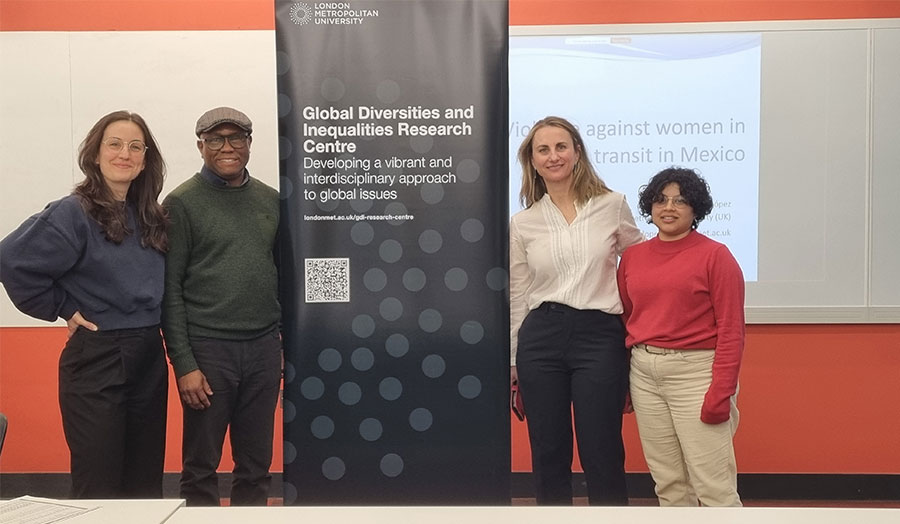
Image: Alessia Dalceggio, Ifeanyi Nwachukwu, Prof. María López, Neha Doshi