
January 2025
Prof. María López has published a chapter book entitled ‘Global Relations and Workers at the Border’ in Brian McDonough and Jane Parry (eds.), Sociology, Work and Organisations: A Global Context, pp. 267-279. London: Routledge.
Prof. López reports:
In the current challenging context of uncertainty, with the return of President Trump in the White House, there is an urgent need to examine the situation of the most precarious workers in the US-Mexico border corridor. This publication is part of a necessary and timely volume Sociology, Work and Organisations: A Global Context, edited by Brian McDonough and Jane Parry, recently published by Routledge (2024).
In her chapter ‘Global Relations and Workers at the Border’, María López examines how, in the profit-driven neoliberal economic context of the US-Mexico border corridor, low salaries, long hours and precarious security conditions limit workers’ opportunities to thrive and break the cycles of violence and inequality that are prevalent in the area.
As the chapter explains, governments on both sides of the border tend to portray international business organisations, such as manufacturing factories, as a source of prosperity. However, this chapter argues that these multinationals operate primarily as a source of production to satisfy the interests of US and European countries, with little or no concern for ensuring that their workers have access to education, rights and health care. It also exacerbates the precarious situation of migrant workers in transit north and Mexicans waiting for Customs and Border Protection appointments to cross the border. It is their very transience that companies use to drive down salaries and exploit them as cheap labour.
This chapter begins with a brief discussion of borders, capitalism and neoliberalism. It then discusses how neoliberalism in the US-Mexico border corridor is exacerbated by US political and economic interests that deprive workers in manufacturing factories (maquiladoras) of their labour rights. Finally, the chapter explains how this situation affects the well-being of poor and working women, limiting their ability to break the cycle of inequality and marginalisation from which they are often fleeing. It concludes with a brief note on the case of women who ‘disappear’ at the border in search of work.
This publication is part of the project Women on the run: Narrative of Violence against Women in transit through Mexico led by María López, who conducted fieldwork in Mexico City and Tijuana with a group of researchers.
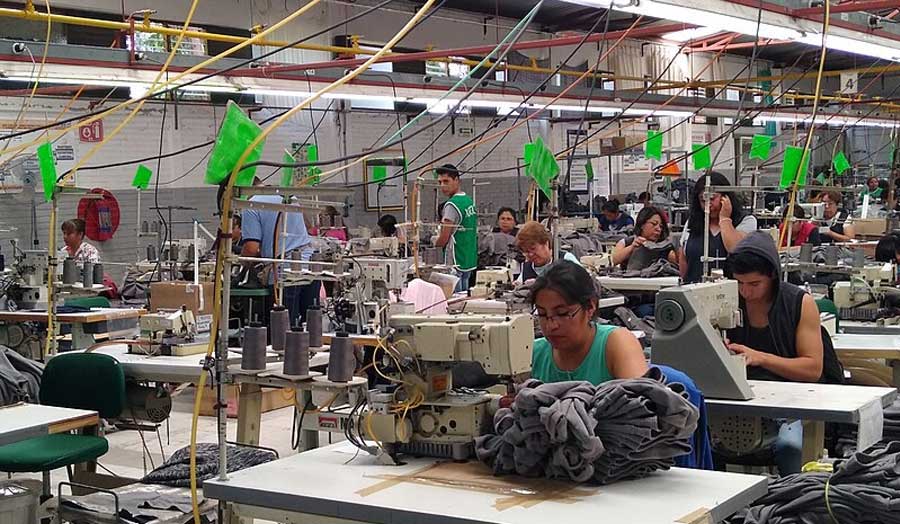
Image: Industria maquiladora en Tlaxcala, 2019
Image credit: Isaac Vásquez