
FICTA 2026 brings together a global community of intelligent computing researchers
8–9 June 2026
Researchers, academics, students and industry professionals from around the world gathered on 8–9 June for the 14th International Conference on Frontiers of Intelligent Computing: Theory and Applications (FICTA 2026).
Hosted by the AI and Data Science Research Group within the School of Computing and Digital Media, and led by Professor Preeti Patel and Dr Maitreyee Dey, the conference provided a platform for sharing research, exchanging ideas and exploring emerging developments in intelligent computing and its real-world applications
Opening the conference, Professor Patel reflected on three themes that have come to define FICTA over its fourteen-year history: continuity, community and collective intelligence.
Fourteen years of continuity
Now in its 14th edition and hosted by London Metropolitan University for the third consecutive year, FICTA continues to grow as an international meeting point for intelligent computing researchers.
Over the years, the conference has attracted contributions from an increasingly diverse range of disciplines, institutions and countries. Just as importantly, it has created lasting academic connections, with many delegates returning year after year to continue conversations, develop collaborations and share new research.
Building an international community
One of the defining strengths of FICTA is the sense of community it has developed over time.
Across the two-day event, delegates connected through presentations, technical sessions, networking opportunities and informal discussions. Bringing together researchers from different countries and disciplines, the conference created space for new perspectives, new partnerships and fresh ways of thinking about complex challenges.
As the conference has evolved, so too has its community. Many attendees are now familiar faces, helping to create an environment that welcomes new participants while strengthening relationships across the wider FICTA network.
The power of collective intelligence
The third theme explored during the opening address was collective intelligence - the idea that innovation often emerges through collaboration rather than individual effort alone.
That theme could be seen throughout the conference programme. Researchers from different specialisms shared insights, challenged assumptions and explored new directions for future work. As is often the case at conferences, some of the most valuable ideas emerged not only during presentations, but also through the conversations and connections that developed around them.
Keynote highlights
FICTA 2026 featured keynote presentations exploring both the foundations and future applications of intelligent technologies.
Mr Aninda Bose, Executive Editor at Springer Nature, delivered a keynote on Elements of Scientific Publishing, offering insights into the publishing process and the importance of communicating research effectively.
Dr Soumya Prakash Rana from the University of Greenwich presented Seeing the Invisible: AI and Ultra-Wideband Radar in Next-Generation Healthcare, demonstrating how emerging technologies are opening new possibilities in healthcare monitoring and diagnosis.
Looking ahead
The conference once again demonstrated the value of bringing together researchers, students and practitioners to exchange knowledge and explore emerging challenges in intelligent computing.
As delegates departed with new ideas, collaborations and research opportunities, FICTA 2026 reinforced its role as more than a conference series. It is an international community built through continuity, strengthened by collaboration and driven by the collective intelligence of its participants.
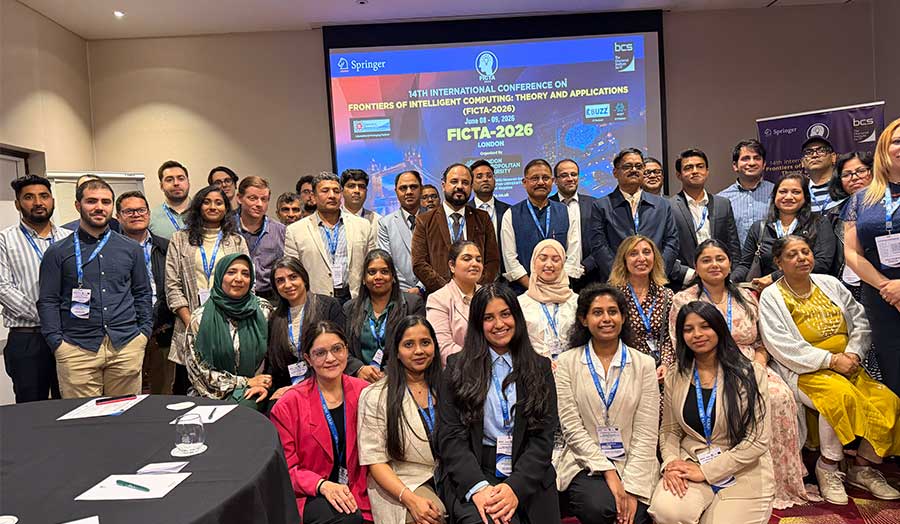
Image: delegates at this year's conference