
Juggling a leadership role at the National Gallery in Prague whilst tackling a PhD is a challenge that Alicja Knast is taking on with clear purpose. She shares her insights here about art, history and the importance of research.
I understand you are the Director of the National Gallery in Prague. Can you tell us more about this position, what’s been most challenging and most enjoyable?
Since 2021, I have had the honour of serving as director of the National Gallery in Prague, which will celebrate its 230th anniversary. The Gallery’s history mirrors that of the Czech lands themselves: marked by empires and independence, reform and resistance, moments of darkness and renewal. Each era left its trace in the works we care for, silent witnesses to what this region has endured, imagined, and created.
People often talk about the resilience of cultural institutions amid shifting paradigms. For me, it’s not about endurance or toughness, it’s about purpose. It’s about knowing why we do what we do and holding on to that, even when everything around us is shifting. Our purpose has always been clear to me: to care for and grow a collection that carries within it so many intertwined histories, shaped by monarchies and republics, by wars and revolutions, by times of censorship and of freedom. Art, in its quiet way, teaches us that continuity is possible, even when the world feels uncertain.
Museums, I keep learning, are fragile places, but beautifully so. Their strength lies precisely in that fragility, in their willingness to stay open to new voices, new questions, and new ways of seeing. On a personal level, it is not different. It is humbling to learn about the past and then realise that we are here on this Earth for a very short period of time, so let’s not waste time.
You mentioned in an interview that “National means common, not nationalistic.” Could you explain your philosophy a little more, especially in today’s political context.
Working in a national institution is never easy. It means engaging with artworks that together shape the idea of “us”, an idea that is fluid, contested, and constantly rewritten. Art itself rarely carries a nationality tag; only in exceptional cases is this a deliberate statement. Most often, art moves freely, crossing borders of language, politics, and ownership, defying any single label. To ask what “national” means is to navigate through history and geography at once. The answer depends on where and when the question is posed, and it will never produce complete agreement. If it were, then the institutions would not be needed. Meaning lives in the tension, not in the compromise.
I understand that you learnt Czech to help you with your role.
It is like getting one more life. I recommend it to everyone. The best moment of learning a new language is to visit the bookshop and to stand in front of a bookshelf looking at the first book to read back to back, or make something like comparative studies, reading one book in two languages.
What made you want to study your PhD at London Met in particular?
The University recognised that I have a professional portfolio, pursued alongside my studies, and that I have rather diverse life experiences. My supervisors and staff members in the School of Art, Architecture and Design are very helpful. But honestly, I need a break from my everyday work to remain sane, as it can get really intense.
Can you tell us about your PhD topic and why you chose this area to focus on?
I am looking at the phenomenon of Polish violin making in the seventeenth and eighteenth centuries and tracing the misleading paths in its historiography. I am also proposing a new dating for those instruments based on archival records and dendrochronology. My predecessors made certain assumptions that led them to conclusions I am challenging.
What do you hope the impact will be of your research?
I hope it will amend the dating of encyclopaedias, shed light on the specificity of lutherie in Central Europe in its design, performance practice, and placement in material history, and revise the canon of violin making, challenging the supremacy of German, Italian, or French lead position in this field.
What’s been most challenging about being a research student?
The cyberattack on the British Library really affected the comfort of my research. I am using obscure books published in the eighteenth to twentieth centuries in Europe, such as lexicons and sales catalogues, and these sources are challenging to find elsewhere in complete form.
How would you describe the culture and community at London Met?
Extremely welcoming, diverse, driven by a need to improve, based on healthy feedback and encouragement. I only wish I could contribute more myself but that does not happen often.
How have you found the professors and teachers?
I have known Lewis Jones since 1997, when we met at a conference, and have been in touch since. In 2004, I was an honorary research fellow at London Met and was in touch with the students; I knew the staff, the community, and the library holdings. After my supervisor in Poland passed away, I asked Lewis whether it would be possible to continue, and he kindly agreed. I got acquainted with Harriet McKay before applying, and I consider myself very lucky to have them as my supervisor, as not only do they have the knowledge and experience to lead, but they are enormously supportive and very often know what I need without me telling them.
What drives you?
My answer is very banal: to make a real difference in places where I can contribute with my skills and expertise, or sometimes where someone’s contribution is needed because the area was left unattended.
What are you most proud of in your life so far?
I am glad that I found a way to serve the visual art world while being a musicologist, and by doing so, proving that having a humanist background helps to open any door we want. I am not shy about science projects either, and you can get good not great though at whatever you want. I also have a three-year stint as a research assistant at Plymouth University on a cognitive project. I really enjoyed being a part of the pure science community. Actually, I learned back then that the field you graduate from should never limit you.
Any tips for other students on making your work fit in with your studies?
It is good to fail because it can make one a much better learner. Without failing, we can’t really be excellent at what we do.
Do you have a favourite place within the University and why?
I am rarely at university, mostly attend seminars online, so there is no one place. But I am old fashioned, and I always liked London Met Libraries for their layout. Continental Europe relatively recently began using the concept of designing open space for different learning modes in libraries, but this was first implemented at London Met in early 2000, which was mind opening at the time.
Tell us a little bit about your interests outside of uni and why they are important to you.
I am a runner, and I recommend it, even though I know I won’t be as disciplined a runner as Haruki Murakami, regardless of the five marathons I have completed. It simply helps you to rest the brain from digital fatigue and stress.
What’s your plan when you complete your PhD, and how do you think London Met will help you succeed in this?
I have several book projects that I hope to complete, all of which capitalise on both my academic and professional experience. I am an avid proponent of seeking mechanisms to update the art history canon and to identify underrepresented or misrepresented phenomena in Central Europe that deserve to be part of mainstream art history. I want to produce my own share of evidence that we in Europe should not have divisions and parts As, Bs, and Cs in the way we think and write.
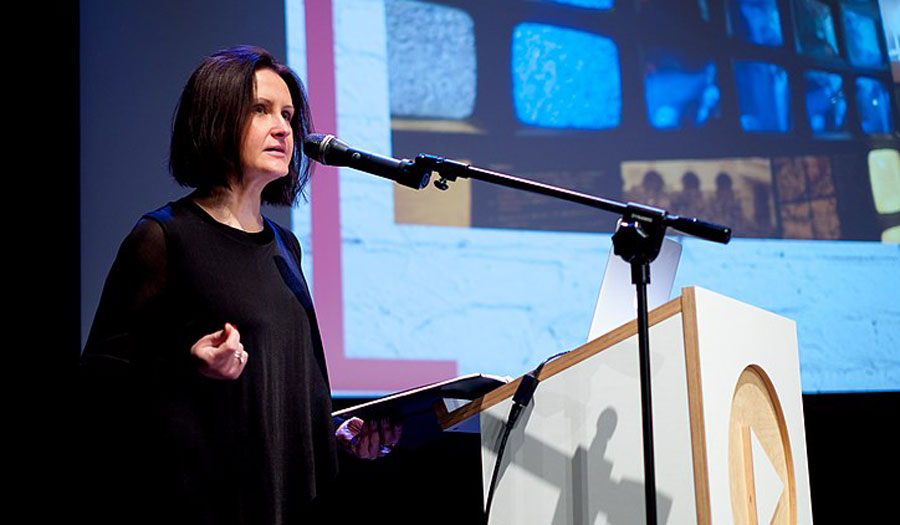
"Art moves freely, crossing borders of language, politics, and ownership, defying any single label."
Find out more about our PhD courses.