
Dr Katrin Bain is part of a group of academics exploring the concept of Playful Learning within higher education
Date: 30 September 2026
A group of London Metropolitan University students began the year with an exciting addition to the timetable – a scavenger hunt around the library.
Dr Katrin Bain, Deputy Head of Department Social Professions (Social Work), is part of a group of leading academics who are researching how to develop the idea of play within higher education teaching.
Playful learning is a teaching strategy that uses the principles of play – freedom, exploration, and experimentation – to promote intellectual development, creativity, and problem-solving.
During Welcome Week, around 60 students from the Social Work master’s and undergraduate programmes took part in an escape room and scavenger hunt around the library of the Holloway campus.
The students were divided into small groups and asked to work together to complete a series of riddles and puzzles which led them around various different parts of the building.
Katrin, a qualified social pedagogue and registered social worker, said: “It's a fun way to basically remind the students of the resources that they're going to use a lot this year.”
The teams had to race to hunt for clues in library shelves, find specific rooms and even hunt down one of the librarians who revealed a hidden word using UV light.
Creating 'social bonds'
Katrin, whose background is in social pedagogy and has 10 years of experience as a facilitator for outdoor and experiential education, added: “We know from learning theories that listening is just not a very effective way of teaching.
“Obviously, lectures have their place, but I wanted them to be familiar with their surroundings. Rather than me telling them that next door we have a library, and there is a subject librarian that can help you, I'd rather take them there so they're familiar with that space and they know where the right resources are.
“They will also know who the subject librarian is and what he looks like, so hopefully it will lower the barriers to them contacting him when they need help.”
Having explored the London Met archives will be particularly useful for these students when it comes time to use this material for their dissertation later this year – but there is also a social element.
“We are bringing them back after a fairly long summer break where they haven't seen each other since May. Having something where they work together in small groups means that there's time to catch up and reconnect with their peers.
“The social bonds formed at this time will be really helpful for the students later in the year when the academic workload increases and they need to rely on each other for support.”
Irene, one of the students from the winning team, said: “It was really helpful because it gives you a guide on how the library works, who you need to speak to in terms of referencing and refreshing the basic skills of research.
“It's quite good to do things that aren't just sitting in a lecture theatre for a bit of a change of learning style because otherwise you're just being talked to, and some people are visual learners.
“Students tend to spend a lot of time just going from home to class without actually learning what the university building looks like. So a lot of students don't really know all the facilities that are available within the university. This way you will learn more about what else the university can offer you.”
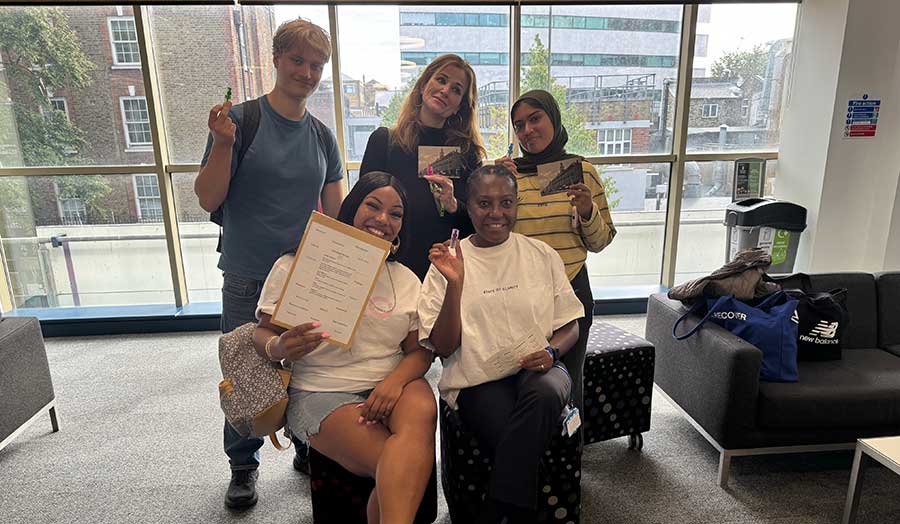
The winning team (left to right): Alex, Jenny, Rachel, Irene, Mahisha