
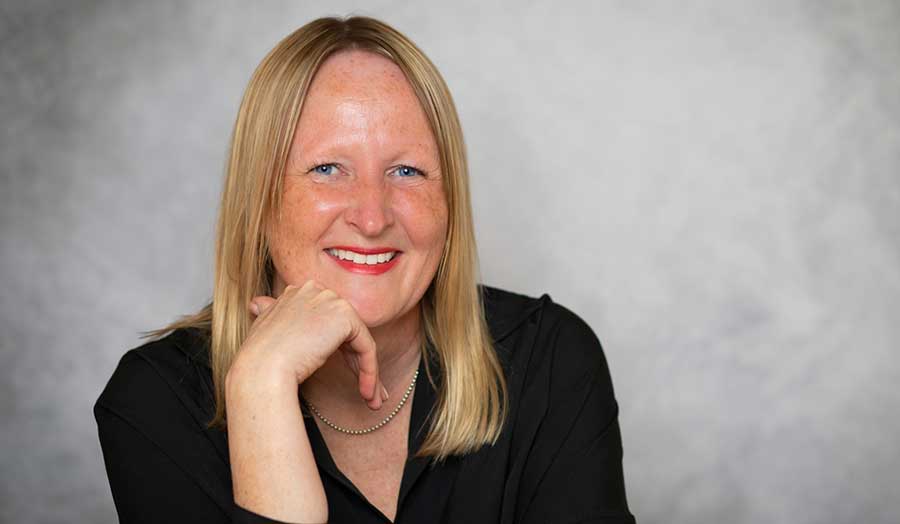
Dr Nicola Sharp-Jeffs OBE is an Emeritus Research Fellow at London Met and has dedicated her career to supporting victims and survivors of economic abuse
Date: 25 November 2026
When Nicola Sharp-Jeffs embarked on her dissertation in 2008, she wanted to address an issue that was seldom discussed – economic abuse.
Little did she know that this one dissertation, as part of her Child and Woman Abuse MA at London Metropolitan University, would lead to a decades-spanning career as the leading voice on this very issue.
“It was the first piece of research in the UK that looked at economic abuse and its impact on women and children,” said Nicola. “I built on that over the years, leading me to set up the charity Surviving Economic Abuse and I continue to work on this issue now internationally. It really shaped my career path moving forward but I didn’t have a clue where it would lead when I first started it.”
Since conducting that first piece of research, Nicola has worked as a research fellow at London Met, received a prestigious Churchill Fellowship to travel and learn overseas and was awarded an OBE in recognition of her impact.
As the Founding CEO of Surviving Economic Abuse, she led the only charity in the UK to raise awareness of economic abuse and transform responses to it.
Since leaving the charity, she has continued her work as an Emeritus Research Fellow at London Met and took her mission global, co-founding the International Coalition Against Economic Abuse. She is currently a publicly appointed member of a UK Home Office board that ensures Domestic Abuse Related Death Reviews meet the necessary standards for publication.
With a tireless passion for demanding justice for victims and survivors, she has worked with countless women over the years to ensure their lived experiences are heard and reflected in policy and law changes.
A life mission of supporting victims and survivors of economic abuse
On what motivates her to continue this vital but often challenging work, Nicola said:
“It’s more of a life mission than a job. In my role now, I read about death every day. That anger fuels your passion and sense of injustice and reminds you why you’re doing this work. it's purposeful and rewarding, but you're also effecting change for all women.
“I’ve spoken to survivors and thought, ‘that could be me.’ The only reason it isn’t me is because I didn’t meet someone who behaved like that. It could happen to any of us.”
Economic abuse and the double taboo
Nicola had been working for the domestic abuse charity Refuge when she first decided to start the Woman and Child Abuse MA back in 2007. She noticed from speaking to victims and survivors while leading policy and parliamentary work in her role that economic abuse was a theme that ran through so many of the testimonies she heard.
Economic abuse can be defined as a form of domestic abuse where an intimate partner, ex-partner, or family member restricts , exploits, or sabotages a person's access to money, property, goods and services.
“When I looked to see if there was research, policy, and practice in this area, there was absolutely nothing.
“If you look at the trajectory of how we've explored domestic abuse, it's started with physical violence and sexual violence, then emotional, then economic. There's no specific crime of economic abuse. It wasn't until there was legislation around coercive and controlling behaviour that we started to see what it looked like in practice.”
Nicola spoke about the “double taboo” of economic abuse. “We don’t talk about abuse, and we don’t talk about money and finances. So, you’re creating a double taboo when you talk about economic abuse.”
Using research to support victims and survivors: how Nicola's work led to law change
After spending many years waiting for the right opportunity to address economic abuse, Nicola secured a Churchill Fellowship in 2016 to study international responses in Australia and America. Inspired by how much further along those countries were, she founded the charity Surviving Economic Abuse in 2017, just as Prime Minister Theresa May announced landmark legislation regarding domestic violence.
Using insights from her fellowship, Nicola successfully recommended that the government officially name and define economic abuse within the new statutory definition of domestic abuse for the Domestic Abuse Bill. Her recommendations were adopted by the government at a time when important changes were also taking place across the financial services sector.
“Something called the vulnerability agenda was starting to develop – a recognition that financial wellbeing is shaped by life events and other vulnerabilities. So that might be things like bereavements, health issues and relationship breakdowns.
“I worked with financial services to develop the understanding that relationship breakdown could include domestic abuse generally, and then economic control specifically when it came to people's financial wellbeing.
“There were two agendas operating in tandem. Although there were many years of waiting and working quietly in the background, when I did stand up and do something – to be the change I wanted to see - it was very much the right time to be having those conversations.”
The Covid-19 pandemic then brought domestic abuse to the top of the political agenda as concerns grew for people’s safety, before the cost-of-living crisis further impacted vulnerable individuals.
In 2020, Nicola was awarded an OBE for her tireless efforts in supporting victim-survivors. This included her work to change legislation and her influence on financial services through the Financial Abuse Code - principles that banks and building societies sign up to that guide how they respond to victims and survivors.
Nicola reflects on this time as a “flurry of activity”, as she went from a team of just one to leading a team of almost 30.
Since leaving the charity, which still works to support victim-survivors of economic abuse in the UK, Nicola has turned her attention to effecting change globally as well as still ensuring standards are met nationally, recently giving evidence to the Lords Committee Inquiry into the Domestic Abuse Act 2021.
Demanding economic justice for women
On looking ahead and how her mission has developed, she said:
“It’s evolved into thinking about economic justice. We’ve named and defined economic abuse now. It’s in legislation and effected in strategies. But that has yet to translate into day-to-day reality for victims and survivors. So how do we recognise the economic loss that victims have experienced and how can this be addressed?’”
Nicola has established the Economic Justice Project which analyses how the controlling and coercive behaviour offence can be used as a mechanism to make compensation orders so that victim-survivors can get some of that money back.
“My focus at the moment is increasing the economic stability of survivors so that they have economic power and are less vulnerable.”
Supported by the internationally renowned Child and Woman Abuse Studies Unit, the master's in Woman and Child Abuse provides a solid grounding in theoretical frameworks, policy and practice approaches.