
Apply for this course
Please select when you would like to start:
If you're a UK applicant wanting to study full-time starting in September, you must apply via UCAS unless otherwise specified. If you're an international applicant wanting to study full-time, you can choose to apply via UCAS or directly to the University.
If you're applying for part-time study, you should apply directly to the University. If you require a Student visa, please be aware that you will not be able to study as a part-time student at undergraduate level.
Why study this course?
Our Computer Systems Engineering and Robotics (including foundation year) BEng is a four-year degree that includes a built-in foundation year (Year 0).
The foundation year will introduce you to the key principles of computer systems and engineering, preparing you for the next three years of your course. You’ll graduate with all the applied knowledge you’ll need to work in the computing and engineering industries.
First in the UK for student satisfaction
Our electrical and electronic engineering courses are ranked first in the UK for student satisfaction in the Complete University Guide 2025
Benefit from specialist facilities
Gain access to our specialist laboratories for computer-aided design (CAD), electronics, microwave and satellite communications, embedded systems and digital systems and optoelectronics
Learn the skills you need to reach your full potential
This four-year degree course includes an intensive foundation year (Year 0), which will provide you with the skills required for your subsequent three years of study
Course modules
The modules listed below are for the academic year 2025/26 and represent the course modules at this time. Modules and module details (including, but not limited to, location and time) are subject to change over time.
Year* 0 modules
Year 1 modules
Year 2 modules
Year 3 modules
Cyber Security Fundamentals
This module currently runs:all year (September start) - Wednesday morning
(core, 30 credits)
In this module students will learn the fundamental knowledge concerning computer security, basic cyber threats and the corresponding detection and defence techniques. Core security concepts, terminology, technologies and professional cyber security skills will be introduced via case studies and laboratory experiments.
Read full detailsIntroduction to Robotics and Internet of Things
This module currently runs:all year (September start) - Wednesday morning
(core, 30 credits)
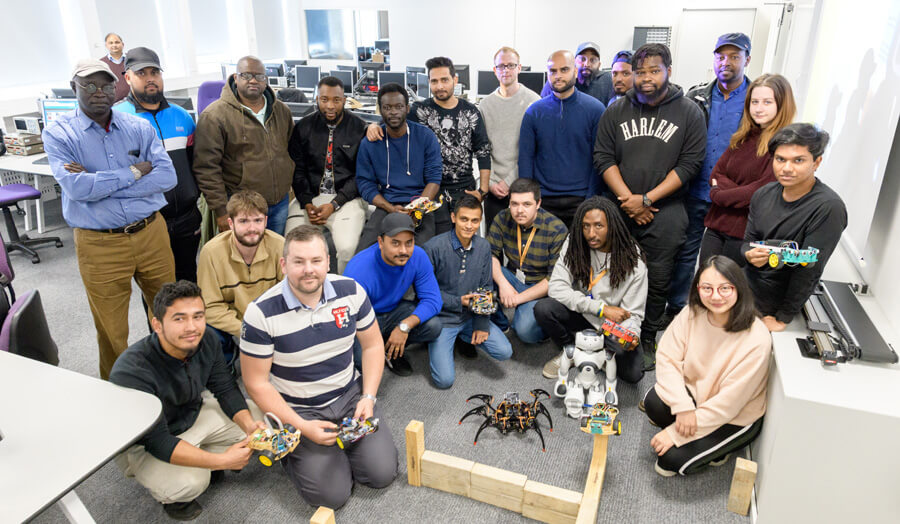
This module aims to introduce foundational knowledge of hardware and software elements relevant to robotics and internet of things (IoT) at foundation level (level 3). In particular, the module is designed to provide students with an introductory overview and practical experience in design and development of a simple system involving elements of robotics and IoT.
The module covers the necessary principles and theory through formal lectures/seminars followed by comprehensive laboratory practice involving workshop-based exercises and a case study.
Read full detailsMathematics
This module currently runs:all year (September start) - Monday morning
(core, 30 credits)
This module introduces students to a range of mathematical techniques involving algebraic properties and graphs of the algebraic, logarithm, exponential and trigonometric functions. Furthermore, the module introduces mathematical techniques of differentiation and integration of simple functions.
Read full detailsProgramming
This module currently runs:all year (September start) - Monday afternoon
(core, 30 credits)
The module introduces students to theoretical concepts underpinning computer software design; and to programming using a high-level language concentrating on sequence, selection, iteration (loops) and list processing. Assessment consists of two individual online tests, each carrying equal weight (50%).
It aims to enable the student to use a programming language in a familiar and confident way in a variety of practical situations, and to use an integrated programming development environment competently. It also enables the student to design and write simple programs during workshop time, using the programming language constructs described in the syllabus below.
Read full detailsComputer Hardware and Software Architectures
This module currently runs:all year (September start) - Monday afternoon
(core, 30 credits)
The module introduces students to the basics of Information Technology; past, current and future trend in computer systems. The detailed design of a small-scale Computer Systems is presented where students have the opportunity to build, configure and test a computer system for a given application. Students will identify the basic features of the Windows operating system and its elements. Health Safety issues and the safe disposal of equipment is also covered leading to an understanding and appreciation of social, ethical, environmental and economic issues related to computer’s hardware and software element. The module aims to
1. Introduce students to the fundamental concepts of Information Technology and basic networking,
2. Provide a working technical knowledge of modern computer systems and their respective components,
3. Introduce Operating systems by focusing on Windows products, identifying similarities and differences,
4. Identify the correct approach to preventive maintenance and upgrading and troubleshooting
5. Introducing students to Assembly language and how it interacts with hardware
6. Awareness of social, environmental, commercial and economic aspects of PC technology
Electronics Systems
This module currently runs:all year (September start) - Friday afternoon
(core, 30 credits)
Electronic systems are essential across various industries, enabling automation, communication, and efficient data processing. In consumer electronics, they drive smartphones, laptops, smartwatches, and gaming consoles, ensuring seamless connectivity and fast processing. In healthcare, electronic systems power medical imaging devices, pacemakers, robotic surgical systems, and patient monitoring tools.
This module introduces students to the most used electronic devices and their applications in small-scale electronic systems. It is divided into two main sections: analogue and digital electronics. The module combines formal lectures and seminars with hands-on practical sessions, allowing students to apply theoretical knowledge in a laboratory setting. Through these sessions, students will gain experience in using test and measurement equipment and simulators, developing essential skills in electronics testing and application.
The aims of the module are as follows:
1. To familiarise students with commonly used electronic components, standard laboratory test and measurement equipment and their usage in designing/analysing, building, and testing simple electronic circuits/systems.
2. To introduce students to circuit simulation software and develop an awareness of its strengths and limitations
3. To introduce students to the electronics and measurement techniques through practical approach and provide scope for putting theory into practice and develop investigation/analysis skills that exemplify core electrical and measuring principles relevant to the course.
4. To develop the ability to write a well-structured, concise and thoughtful logbook / report / poster.
5. To develop the ability to work independently as well as in team
Logic and Mathematical Techniques
This module currently runs:all year (September start) - Thursday morning
(core, 30 credits)
This module develops a range of mathematical techniques including set theory, logic, relations and functions, algebra, differentiation and integration. The techniques provide the foundation for further study of mathematics and related applications in Computer Science, Computer Games Programming, Computer Systems Engineering and Robotics and Electronics and Internet of Things.
Read full detailsProgramming
This module currently runs:all year (September start) - Tuesday morning
(core, 30 credits)
This is an introductory programming module, designed to develop interest, ability and confidence in using a programming language. Students will gain the basic knowledge and experience to solve simple programming problems using established techniques in program design, development and documentation. It is expected that on completion of this module, students will be able to design, implement and test object-oriented programs. The student is also expected to develop their confidence needed to program solutions to problems through a series of practical programming exercises.
Read full detailsAdvanced Electronics Systems
This module currently runs:spring semester - Thursday afternoon
(core, 15 credits)
Electronic systems are essential across various industries, enabling automation, communication, and efficient data processing. In consumer electronics, they drive devices such as smartphones, laptops, smartwatches, and gaming consoles, ensuring seamless connectivity and rapid processing. In healthcare, these systems power critical technologies including medical imaging devices, pacemakers, robotic surgical systems, and patient monitoring tools, all of which contribute to improved diagnostics and patient care.
This module builds on the knowledge gained in the first-year module CT4002: Electronic Systems, providing students with hands-on experience in electronic system design through group-based case studies. Students work collaboratively to solve real-world design challenges, applying their skills in analysis, design, and troubleshooting of mixed-signal systems involving both discrete components and integrated circuits (ICs).
The module follows a structured engineering process, incorporating research skills, system-level analysis and design, circuit simulation, PCB prototyping, soldering, and testing, allowing students to gain practical experience with real-world electronic systems. Delivered in a laboratory-based setting, this module promotes a balanced level of autonomy, encouraging personalized learning, creative problem-solving, and the development of transferable skills essential for future engineering careers.
Read full detailsDatabases
This module currently runs:autumn semester - Wednesday morning
(core, 15 credits)
Introduces techniques for analysing, designing and implementing database systems. An understanding of data modelling and design concepts is provided, and database programming language skills are taught. The practical aspect of developing database systems is emphasised, and use is made of a widely used commercial database system (e.g., Oracle) for this purpose.
The module will enable students to introduce the issues governing the design and implementation of database systems. Theoretical aspects of designing sound database systems, as well as the practical aspects of implementing such systems are presented. This therefore allows students to understand, and put into practice, the techniques available for analysing, designing, and developing database systems
Microprocessors & Embedded Systems
This module currently runs:all year (September start) - Tuesday morning
(core, 30 credits)
Microprocessors are essential across various industries, driving automation, data processing, and intelligent decision-making. In healthcare, microprocessors power medical devices such as MRI scanners, ultrasound machines, pacemakers, insulin pumps, and wearable health monitors, enabling accurate diagnostics and real-time patient monitoring. In consumer electronics, microprocessors are integral to smartphones, laptops, tablets, smartwatches, and gaming consoles, ensuring fast computing, seamless connectivity, and efficient data processing. In telecommunications, they are found in network routers, switches, and mobile communication towers, facilitating secure and high-speed data transmission.
This module introduces students to microprocessors and the role that hardware and software play in the functional behaviour of microprocessor systems. Students are then introduced to some of the more common microcontrollers. Interfacing external memories as well as various input/output devices and sensors are also covered. The module enables students to analyse the requirements of a given task, make decisions in selecting an appropriate controller, design and implement prototype hardware/software for a typical embedded systems product. Practical workshops are designed to introduce microprocessor software development, testing and debugging. Workshops provide students with an opportunity to use both ‘C’ and assembly language.
Read full detailsNetwork Operating Systems
This module currently runs:autumn semester - Thursday morning
(core, 15 credits)
Network Operating Systems (NOS) are crucial across various industries, ensuring efficient communication, security, and resource management among networked devices. In corporate and enterprise networks, businesses depend on NOS for file sharing, email servers, cloud computing, and centralized security management, enabling seamless collaboration and data protection across multiple locations. In healthcare, NOS supports hospital networks, electronic health records (EHRs), telemedicine platforms, and medical imaging systems, facilitating secure and efficient data sharing among healthcare professionals. Additionally, they enable real-time patient monitoring and remote diagnostics, ensuring continuous and reliable healthcare services.
This module provides both theoretical and practical knowledge of NOS, introducing students to some of the most widely used NOS platforms. Through a combination of lectures, seminars, and hands-on workshops, students will learn to install, configure, manage, and troubleshoot network operating systems. Practical sessions reinforce theoretical concepts, allowing students to gain real-world experience in network administration and system management.
Read full detailsWork Related Learning
This module currently runs:autumn semester - Wednesday afternoon
spring semester - Wednesday afternoon
(core, 15 credits)
This module consists of a short work placement (or work-related activity) lasting over one semester. This usually translates into 12 to 15 full working days (or the part time equivalent of this) in the framework of 150 hours (15-credit module) considering some time for reflection, research and documentation. The work placement is facilitated by the University’s Work Based Team (WBT) and the Careers and Employability Team. The module enables students to undertake an appropriate short period of professional activity, usually related to their course at level 5 (Intermediate level), with a business or community organization and to gain credit for their achievements. The activity can be a student’s part-time job, a volunteering activity, employment activity, an activity within London Met, an activity related to client’s brief or business start-up activity.
Read full detailsData Structures and Specialist Programming
This module currently runs:all year (September start) - Monday morning
(option, 30 credits)
This module further develops students’ knowledge and skills in developing software applications for solving problems. It focuses on the data structures and algorithms in programming and the software technologies for building standalone and/or networked and Internet applications. The module is designed to enhance employability through the use of current industrial tools and technologies, and familiarisation with the software development life cycle.
The key skills and knowledge to be gained are:
- Provide students with an understanding of theoretical concepts related to the use of data structures, algorithms, programming patterns and software infrastructure in standalone and/or networked and Internet environments.
- Develop students’ analytical skills in the context of processing, generating, storing, retrieving, and presenting data.
- Enhance students’ practical skills using appropriate methods and techniques for designing, programming, and integrating software applications using user interfaces, data structures, and appropriate storage methods.
- Provide students with an understanding of implementation and required programming to be applied as part of the different stages of the software development.
- Enable students to apply analytical and practical skills in solving typical problems in software development.
- Enhance students’ experience and employability through the use of appropriate current technologies, tools, and development environments during software development.
Network Engineering
This module currently runs:all year (September start) - Thursday afternoon
all year (September start) - Monday morning
(option, 30 credits)
This module is based on Networking Essentials (Cisco). It teaches networking based on application, covering networking concepts within the context of network environments students may encounter in their daily lives – from small office and home office (SOHO) networking. Students who complete this course are prepared to begin the CCNA Routing & Switching and IoT curricula.
Students will recognize the significant impact of networking in the world and learn skills needed for entry-level home and small business network installation positions.
The module covers the necessary background through formal lectures/seminars followed by comprehensive hands-on practical workshops.
The module aims:
- To explain the operation of Local Area Network (LAN), and the internet
- To enable students to perform subnetting of IP addresses as well as scaling IP addresses
- To gain an understanding of static and dynamic routing protocols
- To understand Network documentation, security and troubleshooting
- To understand WLANs, and how to configure residential wireless routers in a SOHO environment
Applied Robotics
This module currently runs:autumn semester - Tuesday afternoon
(core, 15 credits)
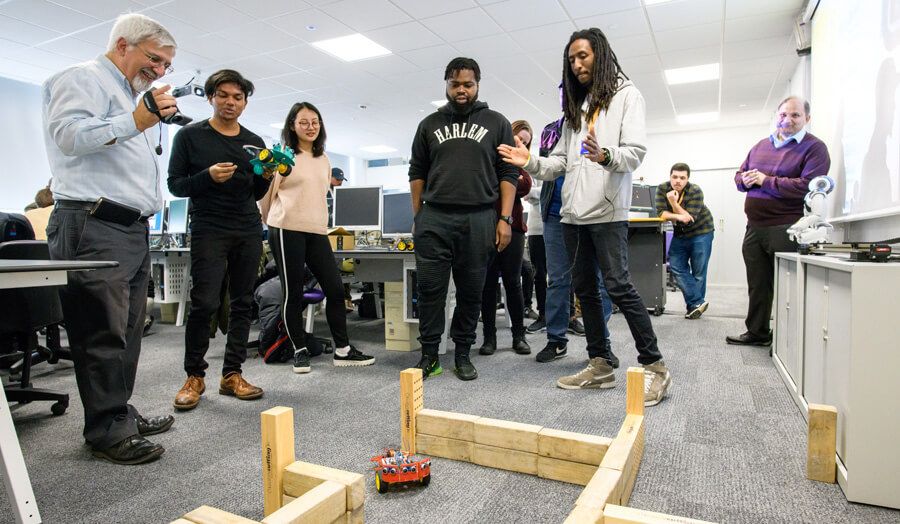
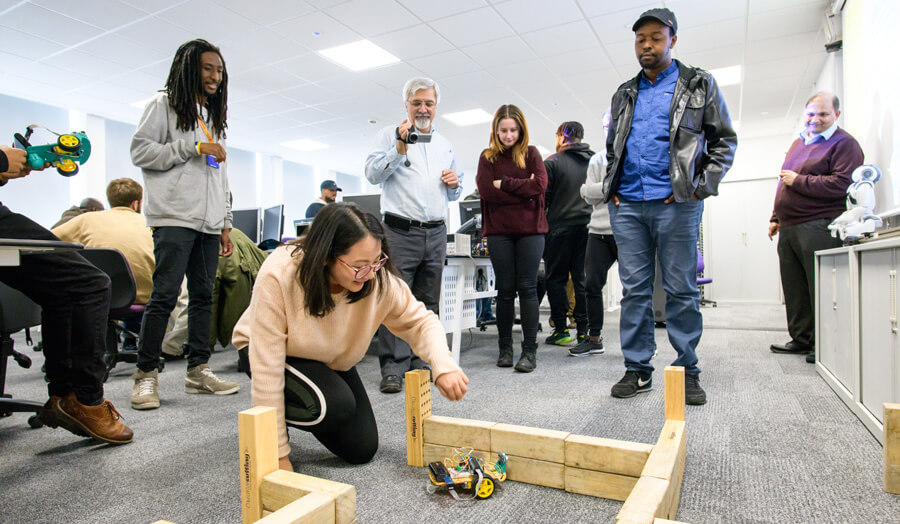
This module aims to provide students with the technical background and skills necessary to design and construct robotic devices. It reviews a selection of sensors and actuators that are commonly used in robotic products and provides students with practical experience in the design, construction and evaluation of relatively simple fixed and mobile robots. It also helps students develop an awareness of legal requirements governing robotics, including personnel, health & safety, intellectual property rights, product safety and liability issues. The module covers the necessary background through formal lectures/seminars followed by comprehensive hands-on practical workshops.
Read full detailsComputer Vision
This module currently runs:spring semester - Wednesday morning
(core, 15 credits)
Computer vision is widely used across industries to automate processes, enhance efficiency, and improve decision-making. In healthcare, it plays a crucial role in medical imaging diagnostics, while in the automotive industry, it powers self-driving cars by enabling object detection and navigation. Manufacturing relies on computer vision for quality control, ensuring consistency and defect detection in production lines, while retail leverages it for cashier-less stores and customer analytics. Additionally, robotics heavily depends on computer vision for navigation, object recognition, and task automation in warehouses, factories, and even space exploration. By enabling intelligent automation and real-time analysis, computer vision continues to transform various industries.
This module aims to equip students with the knowledge and skills to analyse, design, and develop image processing algorithms commonly used in commercial computer vision systems. It covers fundamental principles, mathematical foundations, algorithmic implementations, and practical configurations of computer vision technology. Upon successful completion, students will be able to professionally evaluate the key components of computer vision systems and apply their knowledge to real-world applications.
Read full detailsDigital Systems Applications
This module currently runs:autumn semester - Wednesday morning
(core, 15 credits)
This module extends the digital design techniques learnt at intermediate level to the use of Application Specific Integrated Circuits. It provides an extensive treatment of the use of Virtual Hardware Description Language (VHDL) using the industry's standard (Xilinx/Altera and its associated hardware).
Read full detailsIoT Systems and Security
This module currently runs:spring semester - Tuesday afternoon
(core, 15 credits)
IoT systems and security play a crucial role in various industries, enhancing efficiency, automation, and data-driven decision-making while ensuring protection against cyber threats. In healthcare, IoT is widely used for remote patient monitoring, RFID tracking, and connected medical devices, requiring strong security measures to safeguard sensitive patient data. The retail and supply chain sector relies on IoT for RFID tracking, inventory management, and logistics, where robust security helps prevent theft and fraud. In finance and banking, IoT enhances security through biometric authentication and fraud detection, ensuring the safety of financial transactions.
The module is designed to provide students with technical knowledge and skills on Internet of Things (IoT) technologies. Theoretical material delivered in the lectures is supported by practical lab work to ensure students have a sound grasp of the technical content where students are expected to develop IoT systems. A number of devices, platforms and software tools will be introduced during the course from different vendors. The module is assessed through lab reports and final examination.
Read full detailsProject
This module currently runs:all year (September start) - Wednesday afternoon
(core, 30 credits)
The module enables students to demonstrate their acquired knowledge and skills through a systematic and creative investigation of a project work, either individually or as part of a group, in accordance with their course requirements. The topic of investigation will cover a broad spectrum of various analysis and techniques and will lead to a comprehensive and concise academic/industry-related report. Students will be assisted in exploring areas that may be unfamiliar to them and encouraged to develop innovative ideas and techniques. Students will be able to choose a project that may require the solution to a specific problem, creation of an artefact in a real-world environment or an investigation of innovative ideas and techniques related to an area within their field of study. Collaboration with outside agencies and projects with industrial, business or research partners/ sponsors will be encouraged.
Read full detailsBroadband Systems 1
This module currently runs:autumn semester - Thursday afternoon
(option, 15 credits)
Broadband systems are essential for enabling high-speed communication, data exchange, and automation across a wide range of sectors. In telecommunications, they underpin high-speed internet, mobile networks, and satellite communications, facilitating seamless global connectivity. In healthcare, broadband technology supports telemedicine, remote patient monitoring, and the rapid transmission of medical imaging data—contributing to improved patient care and diagnostics.
This module introduces students to the principles and applications of broadband systems and technologies. It covers system operations, design requirements, and analytical approaches, equipping students with both theoretical understanding and practical design skills. The module also develops teamwork and collaboration abilities through a group-based project.
Read full detailsBroadband Systems 2
This module currently runs:spring semester - Thursday afternoon
(option, 15 credits)
Satellite and optical systems are essential components of broadband technology, supporting various industries. Telecommunications rely on satellite communications for global connectivity, particularly in rural and underserved areas, while optical fibre networks form the backbone of high-speed internet, enabling broadband services, cloud computing, and 5G/6G networks. In healthcare, satellite broadband facilitates telemedicine, remote diagnostics, and emergency communication in remote locations, while optical fibre ensures fast and secure transmission of medical imaging, electronic health records, and real-time patient monitoring, enhancing efficiency in hospitals and research institutions. The module provides students with an understanding and knowledge in the principles and applications of satellite and optical systems broadband systems. It covers the key features of these systems, their operations and design requirements. The module develops analytical and design knowledge and provides experience of team working through a group work.
Read full detailsDistributed, Cloud and IoT Systems
This module currently runs:all year (September start) - Monday afternoon
(option, 30 credits)
This module equips the students with professional knowledge and skills for developing contemporary data processing systems on the desktop, on the move, on the net, in the cloud and at the edge of the computational infrastructure. It systematically introduces the principles and models of functioning of modern data processing systems – distributed, parallel, embedded, portable and wearable. For this purpose, it utilizes the recent advances in infrastructural, technological and methodological support of software development – structured, semi-structured and connected data, wired and wireless communications, containerized and remote tools, cloud and edge platforms, DevOps movements, etc.
Read full detailsEthical Hacking
This module currently runs:spring semester - Thursday morning
(option, 15 credits)
This module is designed to develop understanding, knowledge and skills associated with the various malicious hacking attacks targeting computer systems and the appropriate safeguards needed to minimise such attacks.
The module aims are to:
1. Provide students with knowledge and understanding of the various hacking methods used in attacking computer systems and networks.
2. Enable students to use appropriate tools and techniques to identify, analyse, evaluate and test computer security vulnerabilities prone to hacking attacks, and develop appropriate procedures, solutions and countermeasures to defend and minimise such attacks.
3. To develop students’ awareness of ethical, professional and legal issues connected with hacking.
4. Develop students’ knowledge, transferable skills and confidence in the subject leading to further academic and professional progression in this area.
Read full detailsMobile Applications
This module currently runs:spring semester - Wednesday afternoon
spring semester - Monday morning
(option, 15 credits)
This module introduces a range of specialist programming techniques as applied to mobile platforms. Specific areas of study will include: programming strategies for resource-limited portable devices – including reviewing key components through the development of exemplar applications using an appropriate mobile-based programming platform such as Java ME and Google Android.
The key skills and knowledge to be gained are:
•Understanding theoretical concepts related to the work of software in wireless networks and the use of different protocols, frameworks and tools for building mobile applications
•Learning techniques for programming mobile applications using standard technological frameworks, development tools, mobile device emulators and handsets
•Acquiring practical skills in developing mobile applications which utilize wireless services and mobile Internet
•Applying analytical knowledge and practical skills for building typical mobile applications
•Developing ability to compare protocols, models and paradigms for mobile applications and estimate trade-offs during design using different design patterns, development frameworks and programming techniques
•Building professional competence and increasing the employability through the use of industrial standard technologies and tools for software development
Read full detailsNetwork Security (CISCO)
(option, 30 credits)This module is based on Cisco CCNA Security curriculum delivered through Cisco Networking Academy at the University.
This module provides a next step for individuals who want to enhance their CCNA-level skillset and help meet the growing demand for network security professionals. The curriculum provides an introduction to the core security concepts and skills needed for the installation, troubleshooting, and monitoring of network devices to maintain the integrity, confidentiality, and availability of data and devices. This module helps prepare students for entry-level security career opportunities and the globally recognized Cisco CCNA Security certification.
This module is a hands-on, career-oriented e-learning solution with an emphasis on practical experience to help students develop specialized security skills, along with critical thinking and complex problem solving skills. It offers a blended curriculum with both online and classroom learning. To pass this module with good grades, students are expected to have CCNA-level networking concepts knowledge and skills, along with basic PC and Internet navigation skills. The module aims:
1. To provide a firm understanding of Security Policy design and management.
2. To introduce students to security technologies, products and solutions.
3. To provide students with practical experience of configuring firewalls and router security
4. To discuss VPN implementation using routers and firewalls
5. To introduce concepts of Intrusion Detection
6. To explain the implementation of AAA (Authentication, Authorisation and Accounting)
Wireless Networks (Cisco)
This module currently runs:autumn semester - Friday morning
(option, 15 credits)
This module aims to provide students with the technical background and skills necessary to design and configure and maintain wireless LANs (Local Area Networks) and WANs (Wide Area Networks). Knowledge of LANs and WANs is essential across various industries, enabling secure communication, data management, and operational efficiency. In healthcare, LANs connect medical devices and records within hospitals, while WANs enable secure data exchange, telemedicine, and compliance with regulations. The education sector uses LANs for campus networking and WANs for remote learning and institutional collaboration. In finance and banking, LANs manage transactions and cybersecurity, while WANs link branches and support online banking. Retail and e-commerce rely on LANs for inventory and POS systems, while WANs connect stores, warehouses, and online platforms. Similarly, manufacturing and supply chains use LANs for automation and real-time tracking, while WANs coordinate global logistics.
This module focuses on the design of these networks the devices used and their operation, the planning prior to installation and best practices, the implementation of the network design, security provisions and troubleshooting of Wireless LAN issues. The module covers the necessary background through formal lectures/seminars followed by comprehensive hands-on practical workshops.
Read full details





.jpg)



.jpg)


.jpg)