The Centre for Collaboration in Community Connectedness (C4) is a transformative initiative aimed at building stronger, more resilient communities across the UK. This innovative programme seeks to empower communities by fostering social bonds, improving access to resources, and driving collaborative solutions to societal challenges.
C4 is made up of researchers, practitioners, policy makers, funders and residents gathering evidence on what is needed to build stronger and more resilient communities with the shared goal of improved policymaking and practice.
Our approach is community-led, ensuring that the voices of local people are at the heart of the research programme, and that resources are mobilised to meet local needs.
Five "Community Catapult" sites will engage researchers, residents, and policy makers in place-based collaboration to respond to gaps in evidence, co-produce research, and design and test novel approaches for scaling across contexts and locations.
The research will be carried out in five Community Catapult locations across the UK:
- Darnall (Sheffield)
- Market (Belfast)
- Alloa (Clackmannanshire)
- Brixton (Lambeth)
- Talgarth (Brecon/Aberhonddu)
As London Metropolitan University and The Brixton Project we will test and co-develop innovative strategies that strengthen community ties and drive sustainable change. Through a combination of research and community-led enquiry, the initiative will offer tangible benefits to local residents and opportunities for active participation.
The project will run from December 2024 to December 2029.
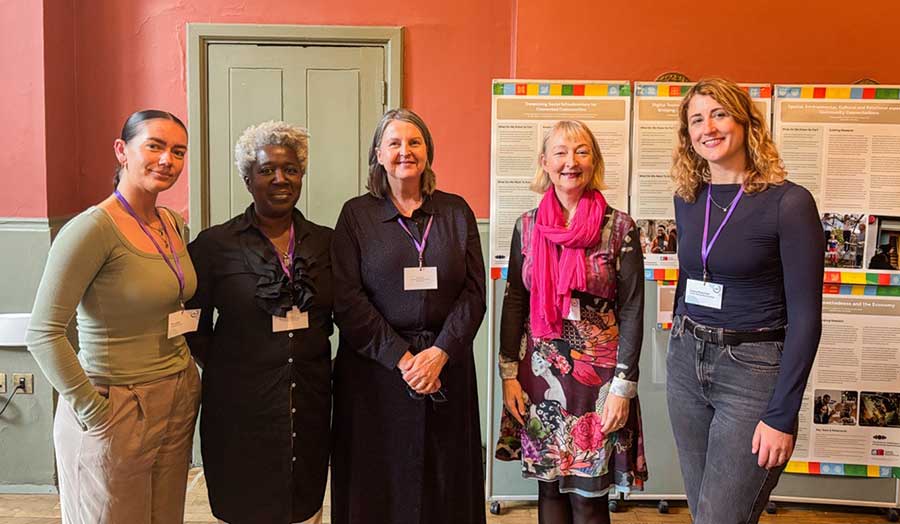
From left to right: Ella Jones and Binki Taylor (The Brixton Project), Prof. Sarah Pearson (Sheffield Hallam University), Prof. Louise Ryan and Franca Roeschert (London Met)
London Metropolitan University Team
The Brixton Project Team
The Centre is funded by UK Research and Innovation (UKRI) as part of its work to create opportunities and improve outcomes.
More information
The UK faces growing socioeconomic divisions, with many people experiencing deep poverty. While a strong social network can mitigate the effects of poverty, there are many communities where poverty weakens social ties, and people lack the opportunities, spaces and resources to enable them to build and sustain relationships to help them thrive.
Voluntary groups, often supported by foundations and funders, have sought to address these problems, and understand the role of community-led activity in supporting connectedness in different forms.
While there is a rich and inspiring landscape of community action in the UK, learning is uneven and often confined to the local area. We lack the evidence base and mechanisms to support investment or scale up effective approaches. This is the challenge that the Centre for Collaboration in Community Connectedness (C4) seeks to address.
C4 draws on three main ideas around community connectedness:
- Community – where people live and their connections with neighbours
- Relationships – social interactions that have meaning for people
- Social capital – the value or resources that people get from their networks and relationships
Together with our local partner, The Brixton Project, the London Met Team will deliver a range of participatory projects into community connectedness and support local residents to develop the skills to carry out research.
C4 is a hub for collaboration across disciplines, sectors and places – rooted in community leadership and designed to transform policy and practice. Through the life of the programme, this partnership will grow and provide more opportunities to test out new ideas and uncover the challenges faced by communities.
Through high-quality evidence, we will inform the design, funding and delivery of effective interventions that are embedded in the lived experiences of local people. The aim is to achieve meaningful community-led change in each of the Catapults and to address power differentials between decision makers and residents.
Locally, the programme will leverage Brixton’s rich cultural heritage and creativity to develop scalable models of connectedness, with the ultimate goal of informing national policy and creating a blueprint for thriving communities.
Project partners