
Dr Maria Garner, Gender-Based Violence Expert at London Metropolitan University's Child and Woman Abuse Studies Unit, discusses the recent reckoning facing the British media industry
Date: 19 November 2026
The conviction of Russell Brand and the recent revelations about David Walliams have prompted familiar questions about the entertainment industry, celebrity culture and the treatment of women. Are we finally confronting the toxic legacy of 1990s and 2000s 'lad culture'? Are powerful men being held accountable in ways they once escaped? And are we witnessing another #MeToo moment?
There is certainly a sense of reckoning in the air, but we have been here before.
The cases of Jimmy Savile, Jeffrey Epstein, Harvey Weinstein, R Kelly and Mohamed Al Fayed have all exposed how powerful men are enabled, protected and shielded from accountability, and each case has prompted for some, outrage and promises of change.
Yet these latest cases demonstrate that the conditions that made their abuse possible have proven remarkably persistent.
At the Child and Woman Abuse Studies Unit, we use the concept of 'conducive contexts' to understand how violence against women and girls (VAWG) is enabled.
Beyond looking at individual perpetrators, we examine the relationships, institutions and power structures that incubate violence against women (VAW). As Brand and Walliams remind us, perpetrators exist within systems that often protect their reputations, silence those who speak out and prioritise institutional interests over women's freedom and safety, allowing abuse to continue.
The allegations surrounding David Walliams are particularly revealing. Women have described experiences of sexual harassment, assault and grooming, including when they were teenagers, and report facing aggressive legal pressure not to speak out. Others were forced to sign NDAs, and Walliams attempted to prevent publication of the allegations in the press through an injunction. Walliams denies the allegations and says he has not broken the law.
These practices raise important questions about the mechanisms available to powerful men to protect themselves. NDAs can have legitimate purposes, but when used to prevent someone from speaking about alleged sexual crimes, they become a tool for maintaining silence.
Similarly, the threat of expensive legal action can have a chilling effect on journalists and victim-survivors. SLAPPs – strategic lawsuits against public participation – demonstrate how legal and financial power can deter scrutiny, creating an enormous imbalance between the powerful with reputations to protect and those trying to tell their stories.
Use of these tactics also raises a bigger question: how much have the contexts that enabled abuse in the 1990s and 2000s really changed? We may now look back on the era's 'lad culture' with condemnation, but the sense of male entitlement has not disappeared: it’s adapted and shaped a new cultural landscape conducive to VAW.
We are seeing the proliferation and seep of the manosphere into the mainstream, online pornography normalises and eroticises violence against women, and technology now affords new ways to abuse women. Alongside this the rise of racial and religious supremacist movements diminishes the rights and freedoms of women and girls, while simultaneously weaponising concerns about violence against women and children to further their own discriminatory causes.
We should be wary of congratulating ourselves when many of the same attitudes remain in a different form, making violence against women possible and real every single day.
We must also ask whose experiences are being heard. While Brand and Walliams have dominated headlines, DJ Tim Westwood is facing and denies 17 charges of sexual offenses, and was in court in the same week but received very little media attention comparatively. That Westwood’s complainants are in the main black women may highlight how inequalities are reflected in responses to sexual violence. There are thousands of other cases which receive little-to-no-attention. Why should one set of allegations command such widespread attention while another struggles to gain the same recognition?
If we are serious about learning the lessons of #MeToo, we also need to look beyond celebrity cases, recognise how wider inequalities, including structural racism, determine who gets to speak and be listened to in both high-profile cases, as well as the everyday.
There are, however, reasons to recognise the significance of this moment. #MeToo was a powerful demonstration of what happens when victim-survivors are able to speak collectively and be heard. Its roots rest with Tarana Burke, a community leader in the US working predominantly with African American young people. In 2006 Burke's campaign set out to raise awareness of and foster support for sexual violence.
These grassroots origins, set the way for the 2017 social media movement, creating space for victim-survivors to share experiences they had often carried privately for years, showing how one woman's testimony can validate another's. The women who came forward in the Brand case, and those speaking out in current investigations, are continuing to challenge cultures of silence, all part of the process of change.
Since its founding, the movement has swelled in size and influence, and exposed many famous men’s abusive behaviours, but the structures which enabled their abuse haven't changed as much as they needed to.
And material change can and does happen, albeit slowly. At CWASU, we've worked with the police to develop the national operating model for how to investigate rape and serious sexual offences. It's now far more victim centred and context led than it ever has been – major progress which could affect material change for those who choose to report sexual violence.
Dr Sukhwant Dhaliwhal, Course Leader for the Women and Child Abuse MA, also completed a groundbreaking knowledge review on sexual abuse of African, Asian and Caribbean children, which has increased understandings of the barriers to reporting minoritised victim-survivors face.
So Britain may be having another #MeToo moment, in terms of the bravery and will of victim-survivors to speak but we should be wary of celebrating a reckoning before true change has come. The questions now are who will we listen to and whether institutions, industries and society are prepared to dismantle the conditions that allow abuse to continue, rather than expressing short-term shock when another powerful, abusive man is finally held to account.
Find out more about the Woman and Child Abuse MA, currently recruiting students for January and September 2027.
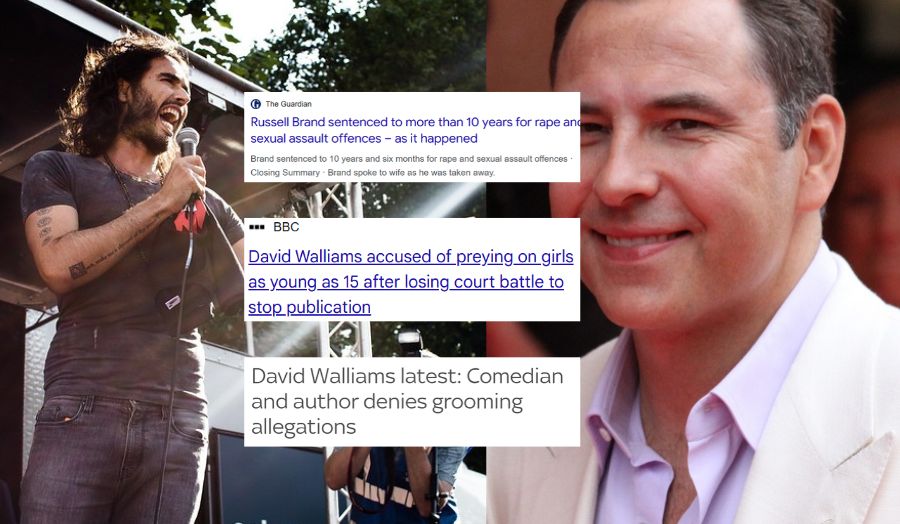
Edited photo using: Russell Brand London Revolution Protest by David B Young, CC BY 2.0 and David Walliams (cropped) by Ana Maria Wiggins, CC BY-SA 4.0.
Find out more about the Woman and Child Abuse MA, currently recruiting students for January and September 2027.