
This PGR-led event in partnership with the Centre for Design History at the University of Brighton Seeing Change: Methodological Approaches to Audio, Visual and Material Cultures in Activist Movements was a focused workshop exploring methodologies for studying the audio, visual and material cultures of activist movements.
Audio-visual and material culture lies at the heart of embodied forms of protest. A strong visual identity not only facilitates the dissemination of ideas across media but also serves as a powerful, dynamic tool for direct action. This workshop asked: What are the best practices for researching and analysing the visual and material production of international activist movements?
Organised by Aurore Damoiseaux (University of Brighton) and Hoyee Tse (London Metropolitan University), this workshop convened academics and postgraduate researchers to share and discuss their work on activism. Participants explored critical issues and diverse methodologies in the study of audio-visual and material cultures across both historical and contemporary social movements.
The event featured a series of presentations followed by a roundtable discussion, offering a platform for attendees to examine research challenges, exchange ideas, and establish best practices for analysing activism through audio, visual and material lenses.
Speakers:
Dr Harriet Atkinson is a design historian based at University of Brighton’s Centre for Design History, where she leads the Design Activism research strand, and is Course Leader for the MA in Curating Collections and Heritage. Harriet's recent research focuses on design for propaganda and protest in Britain, culminating in the book Showing Resistance: propaganda and modernist exhibitions in Britain, 1933-53 (Manchester University Press, 2024) and documentary film Art on the Streets (2023). She is part of the research team for the new project, running 2024-7: ‘Graphic Design Histories for Creative Dissent: Archiving and Ethical Challenges’, focusing on graphic objects of street protest for global movements across Brazil, South Africa and the UK.
Dr Clelia Clini is Senior Lecturer in Postcolonial Media and Culture and Course Leader for the BA in Film and Television Studies and BA in Journalism, Film and Television Studies at London Metropolitan University. She is also Visiting Fellow in Postcolonial Memory at Loughborough University. Clelia is currently working on a British Academy-funded project, on the British Sikhs’ response to the 2020-2021 protest of agriculture workers in India, looking at the meanings the protest acquired in the diasporic imagination, and the role of arts in promoting transnational solidarity. She has published in the field of memories and post-memories of the 1947 Partition of British India; South Asian diasporic literature and cinema; migration and the Indian Punjabi diaspora in Italy; forced displacement, creativity and wellbeing.
Aurore Damoiseaux is a doctoral researcher in the School of Humanities and Social Science at University of Brighton. Her AHRC-Techne funded research project focuses on the use of dress as a political tool at Greenham Common Women’s Peace Camp near Newbury, UK (1981-2000). Aurore investigates dress as fundamental in the creation of non-violent protest actions. This research includes the role of worn garments in the creation of visual identity and the dress object as activist material culture. Aurore is PGR Representative for the Fashion and Textile History strand of University of Brighton’s Centre for Design History.
Hoyee Tse is a doctoral researcher at London Metropolitan University and the recipient of the Vice Chancellor’s Doctoral Scholarship in 2023. Her doctoral research explores the role of visual imagery in Hong Kong social movement in fostering pro-democratic values and identity, examining the extent to which this visual imagery reflects and shapes the identity of Hongkongers. Utilising iconography and iconology theories, she focuses on visual interpretation and meaning-making of glocal visual imagery, particularly iconic visual images adopted locally for the movement. Through systematic evaluation of archival materials, her project will develop a (de)coding system to analyse the symbolic representation and contextual significance of these images.
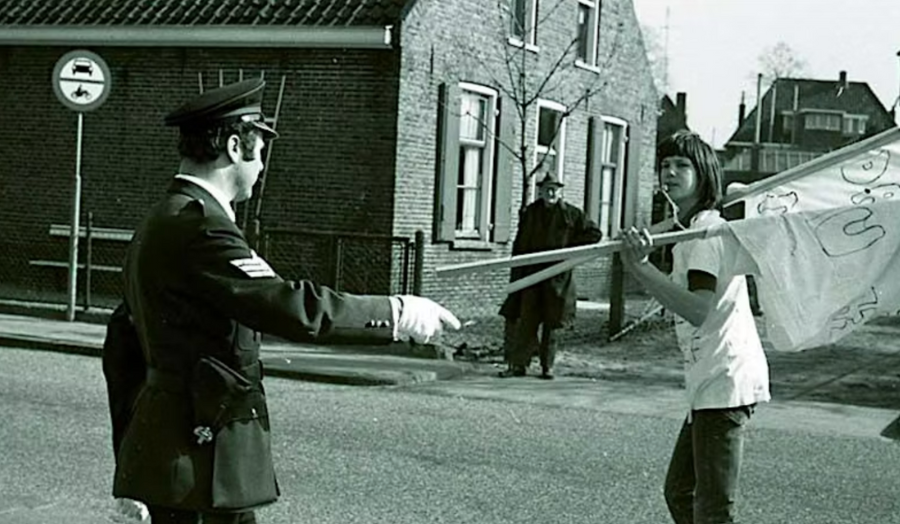
Image: Otting, Cord. Protest bij de opening politiebureau aan de Reeënlaan in Lunteren. Photograph. 1975, Municipal Archives of Ede en Scherpenzeel, Lunteren. ©Cord Otting
Details
| Date/time | Tuesday 11 March 2025 4.00pm - 6.30pm |
|---|---|
| Book ticket | Event ended |
| Location |
Aldgate Campus, CM1-45 Calcutta House |