
Intergenerational Climate Knowledge Transfer for Youth Green Livelihoods
Youth unemployment in North London disproportionately affects young people from Black, Asian and Minority Ethnic backgrounds, working-class households, and communities facing multiple forms of social and economic disadvantage.
At the same time, the UK's transition to a green economy is generating new employment opportunities in nature-based solutions, sustainable enterprise, and environmental management, yet these opportunities are consistently failing to reach the young people who need them most, and who have the most to contribute.
Raíces y Futuros (Roots and Futures) addresses this gap by creating structured green livelihood pathways for unemployed and underemployed young people aged 18 to 30 in North London. The project connects them with indigenous Tzotzil and Tzeltal youth from the communities of Los Altos de Chiapas in southern Mexico, who face parallel barriers to climate-resilient livelihoods in a very different context.
Together, both groups engage in a 9-week Climate Knowledge and Green Skills Summer School, a live Challenge Prize competition, and either a 6-week work placement with a green organisation or an enterprise seed grant to launch their own green business.
The project is grounded in the principle of Two-Eyed Seeing (Etuaptmumk), examining every challenge through both indigenous and community ecological knowledge and contemporary scientific approaches, treating neither as superior. This methodology positions the traditional ecological knowledge held by elder community members in Chiapas as genuine climate expertise, while equipping young people in North London with the skills and networks to enter the green economy on their own terms.
The project aligns with the UN Sustainable Development Goals, particularly:
- SDG 8: Decent Work and Economic Growth
- SDG 10: Reduced Inequalities
- SDG 13: Climate Action
- SDG 17: Partnerships for the Goals
This project is a collaboration between London Metropolitan University and the Universidad Autónoma de Chiapas (UNACH), Mexico.
Get Involved
Applications are now open for the Climate Knowledge and Green Skills Summer School, a free programme for unemployed and underemployed young people aged 18 to 30 in North London. Find out more and apply here.
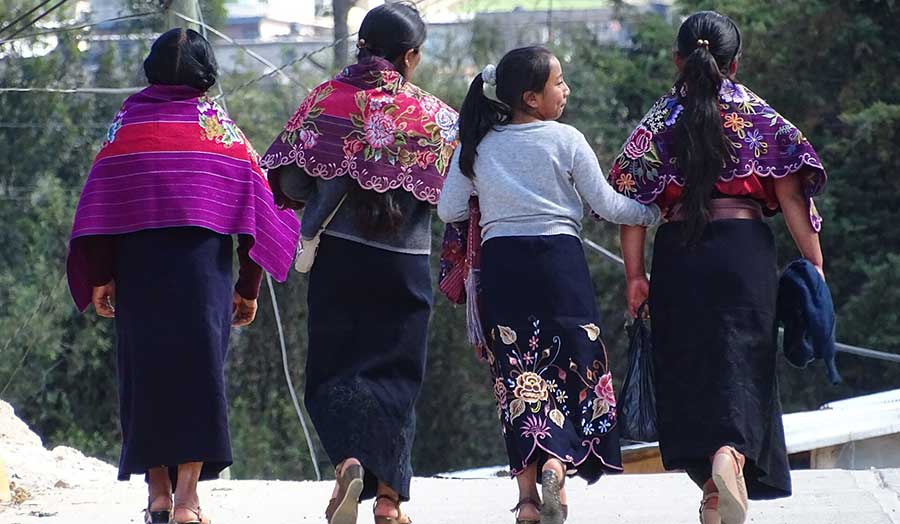
Image: Tzotzil women and girls in Zinacantán, Chiapas, Mexico.
Project Team
Dra Maria Guadalupe Rodriguez Gavan
Associate Prof. Ronke Shoderu
Prof. Doris Schedlitzki
Samuel Isaac Garcia Alonso
The Climate Skills Global Collaboration Grants are a global programme funding international green skills opportunities for young people across the UK, Brazil, India, Indonesia, Mexico and Viet Nam. The Climate Skills programme is a partnership between the British Council and HSBC.
More information
Raíces y Futuros aims to create measurable, sustainable green livelihood outcomes for marginalised young people in the UK and Mexico by:
- Delivering a Climate Knowledge and Green Skills Summer School equipping 15 to 20 young people in North London and 40 to 50 participants in Los Altos de Chiapas with climate skills, green enterprise knowledge, and leadership capabilities.
- Facilitating a live Challenge Prize competition in which mixed UK and Mexico teams collaborate to develop solutions to climate challenges identified by Tzotzil and Tzeltal communities, with winning teams receiving seed funding to implement their solutions.
- Supporting participants into green work placements with social enterprises and environmental organisations or providing individual enterprise seed grants through the Green Incubator to support the launch of participant-owned green businesses.
- Centring intergenerational knowledge exchange by engaging elder knowledge holders from Los Altos de Chiapas as paid expert consultants and co-researchers throughout the programme.
Across the Global North and South, the communities bearing the greatest burden of climate change are often the same communities excluded from decisions about how to respond to it. In North London, young people from BAME, working-class, and disabled backgrounds face compounding structural barriers to entry into the green economy, despite possessing skills, knowledge, and lived experience that the sector urgently needs. In Los Altos de Chiapas, indigenous Tzotzil and Tzeltal youth are custodians of sophisticated ecological knowledge about land, water, forest, and biodiversity, knowledge developed over generations, yet they are rarely recognised as experts in formal climate discussions.
Raíces y Futuros brings these two groups into dialogue and collaboration. Rather than treating the UK as the provider of expertise and Mexico as the recipient, the project is built on the recognition that both communities have something vital to learn from each other. The Two-Eyed Seeing pedagogical approach, developed by Mi'kmaw Elder Albert Marshall, provides the methodological foundation, ensuring that indigenous ecological knowledge and Western scientific knowledge are held in equal regard throughout the programme.
The project builds on the established research partnership between London Metropolitan University and the Universidad Autónoma de Chiapas, and on Dr Mariam Akinlolu's previous British Council-funded work with indigenous communities in Mexico through the Grandmothers of Guacaporito project.
Anticipated outputs from the project include:
- A Climate Knowledge and Green Skills Summer School delivered simultaneously in North London and Los Altos de Chiapas, with a fully co-designed, bilingual curriculum available as an open educational resource.
- A Challenge Prize competition resulting in 2 to 4 funded UK and Mexico solution teams, with seed funding to pilot their climate solutions.
- A minimum of 25 green work placements for participants across both countries, and a Green Incubator supporting 10 to 15 participants to launch green enterprises with individual seed grants.
- An Open Educational Resource (OER): a freely available, adaptable curriculum guide making the project's green skills training methodology available to other universities, training providers, and community organisations worldwide.
- A bilingual Field Guide to Intergenerational Climate Action, documenting the project's methodology and findings for practitioners, educators, and policymakers.
- A sustained Alumni Network connecting participants from both countries for ongoing peer support and collaboration beyond the funded project period.
- Peer-reviewed research outputs documenting the project's approach to epistemic justice, GEDSI-responsive climate skills training, and cross-cultural intergenerational learning.