
Singer, songwriter, composer and cellist Ayanna Witter-Johnson discusses the Rising Star Scholarship, university's impact, her advice for young artists and her upcoming shows.
Date: 4 November 2025
Singer, songwriter, composer and cellist Ayanna Witter-Johnson is a tour de force, shaping culture and creating music for the masses with her unique rhythms and sounds that cross genre boundaries.
She’s toured with world-renowned artists, performed in iconic venues, won prestigious awards, and composed her own records, to name a few highlights, but Ayanna Witter-Johnson isn’t done yet, and believes it’s only the beginning. We don’t doubt it!
During the summer, London Met announced its Rising Star Scholarships, designed to support and empower talented and creative individuals under 21. Each scholarship is named in honour of six notable figures who have contributed to their fields – and Ayanna Witter Johnson is one of them.
London Met sat down with Ayanna to discuss the Rising Star Scholarship and what it means to her, how her studies were a turning point, her advice for young aspiring artists, her upcoming concert and what’s next for her.
What does it mean to you to have your name attached to this scholarship? And what do you hope it gives the students who receive it?
It's an incredible blessing and honour, I feel so privileged to champion an opportunity for somebody else, that is so life changing.
It's a full circle moment as I received a scholarship to study my Masters in New York, and without it, I categorically would not have gone because I wouldn't have been able to afford it. Being in New York changed the course of my career. I took part in a competition called Amateur Night Live at the Apollo Theater in Harlem, and won, and it was the prize money that funded my first EP.
Scholarships are a game changer and it fills me with so much joy to think that something similar can happen for somebody else. It's more than funding, it's an acknowledgement that your dreams are valid, and that with the right support, you can really build something and develop your dreams.
How has where you're from and your upbringing influenced you and your music?
Being a Londoner is one of the greatest gifts I've received. It really is so rich in cultural influences and has absolutely influenced who I am as a musician.
My mum and dad were born in London, but their parents came over in the Windrush generation from Jamaica. I was surrounded by music from the beginning – my dad's an actor and a DJ so there's always a lot of music around. My mum played violin and piano at school, was in a choir, and a Ghanaian dance troupe called Agudje back in the day, and went on tour, so I danced too. I soaked up all of the rhythms and being on the road with my parents. I went to theatre schools and absorbed all things arts.
You started playing instruments very young. Did you sing too? When did you realise you wanted to compose, write and sing as a career?
I started playing piano at about 3 and a half and cello about 12. I always sang, as young people do – I loved The Spice Girls and 90s R&B. I remember singing in a vocal trio with two of my friends; one of them was the lead and we were backing singers. I never imagined myself as a lead singer, but I did sing and used my voice, and always performed.
I went to a pretty academic school and couldn’t do Music A Level, so I was sure I’d be a French translator. I got an offer to study French at Cambridge, and thought I had made it in life. When that came crashing down on results day and I didn’t get the grades, I had a proper meltdown. I felt embarrassed and devastated, and I passed out in the courtyard.
The gift of that though, was a gap year. My friend encouraged me to go to a musical jam session. I didn't know how I was going to jump in and jam, as I was quite classical in my approach to music making but I wrote a song and they gave me a chance. It went down a treat and my stepdad said I should pursue music.
I applied for a Foundation Course in Composition at Trinity College of Music, as I figured I could discover what I liked. I composed a piece on the piano, had an interview and didn’t hear anything for months. They eventually offered me a place on the four-year Bachelor’s degree, and that was the turning point.
What were your experiences like at university? Did study steer you on a certain path?
It definitely expanded my musical awareness, imagination and understanding. It opened a whole new window into a world I didn't know existed – composing felt like what people did long ago. I found there is a world where people are working musicians and composers in the 21st century – including my music teachers, and it opened doors.
I started listening to everything from Frank Zappa to Hildegard of Bingen, all these composers and performers. I got lost in this universe of music. I was the first one in that building (university) and the last one out, every day. If I wasn’t there, I was at the Barbican, at a concert, making friends with jazz musicians and going to jam sessions, fully soaking up everything. I got a gig at a Caribbean restaurant, and it was there that I started experimenting with voice and cello, to earn some money.
I levelled up my skills and tools at university, I wrote my own music and performed it to my network, and I think that was the gift of studying in higher education – my peers. They’ve become my collaborators and future employers.
Now that you're performing full time and music is your career. What advice would you give young people who want to make a difference through their art?
From the get go, honour your uniqueness and who you are, because no one wants another version of someone else. The sooner you latch on to who you are, the more fruitful and enjoyable it’ll be and the more of a gift you'll have to share with the world.
Build a community, it's important to have people that want to go on this music journey with you.
Start where you are with what you have, don't wait for permission, or an Arts Council fund. Borrow an instrument, find a piano in a church, start with two notes. Just begin.
Record and document, and use social media – much more that I'm using it!
People listen to music and perform to evoke feelings, memories, and for mindfulness and creativity. What does music evoke for you, and has it changed over time?
It's changed over time. I always loved music, I was three when my mum took me to see Sweet Honey in the Rock, an all-female African-American a capella ensemble. I had absorbed their cassette tape, and sang along to all the words – that was when my mum realised I had a musical ear. Music is a place I experienced joy and a sense of alignment with myself.
Along the way, I found it to be an opportunity to receive praise and validation, and it became something through which I could achieve – grades and exams, winning competitions and having people think I'm good.
I sat on that train for a long time, and then after formal education, in this chapter I’m in now, music has become a space of spiritual growth and connection with audiences and myself, a way of really healing and coming closer to love in the highest vibration. It's so much more in the spiritual realm for me now.
You’ve said you want to create a body of work that ‘represents, celebrates and pays homage to your ancestral heritage, culture and identity’. Why is this important?
It's important because I am who I am in the body that I'm in and the experiences I've had. I've had lots of challenging experiences as a Black woman, but also lots of beautiful experiences. You can tune into a lot of negativity around race-related issues in the world, so I feel I've got an opportunity through music to balance that perspective, and offer a place of positivity to celebrate African diasporic culture and roots, and allow there to be a positive voice.
What's next for you?
I'm expanding and growing as a composer and performer. I'm co-scoring my first TV drama series on Sky Arts, coming out next year. I'm writing a musical, hopefully the first written by two black female writers to reach the West End! I co-composed a song for a horror film called The Woman in the Yard which is potentially in the Grammy long list, and I'm finishing up album number two, which brings me so much joy, and will be out next year. I’ve also got some lovely live performances coming up in London.
I’m an ambassador and patron for the London Music Fund and have the opportunity to spend time with children, to share my experience and invite them into things I'm doing, which is amazing. I also sit on the board of The Ivors Academy and get to input into the industry and on pertinent matters. It’s a full life.
Do you think the landscape of music is changing and have you noticed classical music becoming more accessible? Can you see the changes in young people and you’ve mentored and met?
We’re more connected and accessibility to music is exponentially greater than before. You can hop onto YouTube and pretty much see anything, listen to anything for free, if you don't count watching the adverts! It’s fantastic. You can watch performers, study a cellist, see how they play, in a way that you wouldn't have been able to do before.
The accessibility to a wider range of music is the most we've ever had, and means we're inspired by so many different things and influences. From workshops and Q&A's I've done with young people, especially young classical musicians, they are interested in finding their unique voices, and how their culture can influence the music they make, or the repertoire they play, leaning into their backgrounds and enjoying that flexibility to present, shine and express as you choose to.
You're performing at The Jazz Social on 12 November. What can people look forward to, and what are you looking forward to?
New songs, music that crosses boundaries and touches upon soul, jazz, classical, reggae, traditional sound worlds as well as new mixes. We’ll be taking the audience on a storytelling journey, especially as it’s an intimate show and a solo show. It's amazing to express where these songs have come from. The energy they will feel is one we’ll go on together, through my voice, cello, piano and the percussion – an energy exchange.
And finally, our unofficial motto is the real London. What does the real London mean to you?
London is home. It’s a beautiful melting pot of cultures, rhythms and the sounds of different cultures meeting and languages crossing paths. All the stories intertwining and weaving and creating this landscape that's bursting with creativity, colour, life, resilience and humour. I’m so proud to be from London. It's perfect in all of its imperfection, and so full of possibility and inspiration.
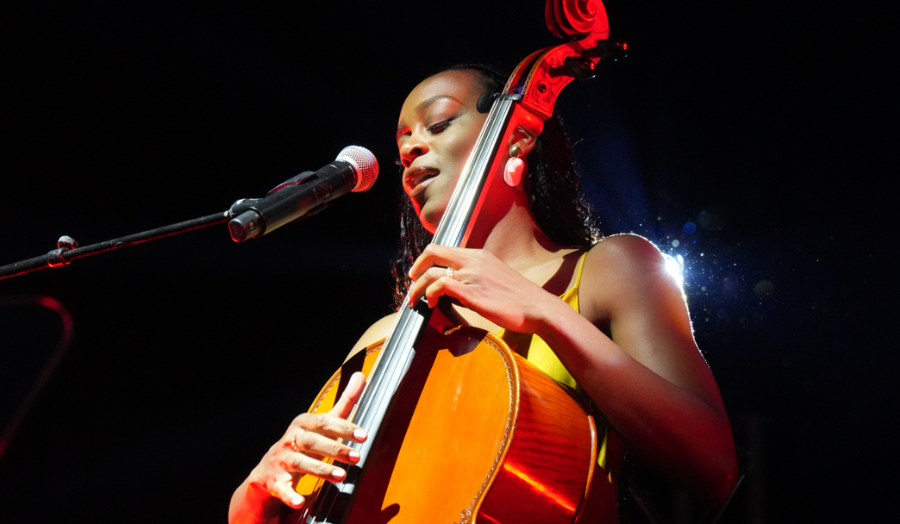
Image: Ayanna Witter-Johnson performing on stage
Ayanna's live shows begin this week. Check her website for more information about her music and tour dates.
Read more about the Rising Star Scholarships.