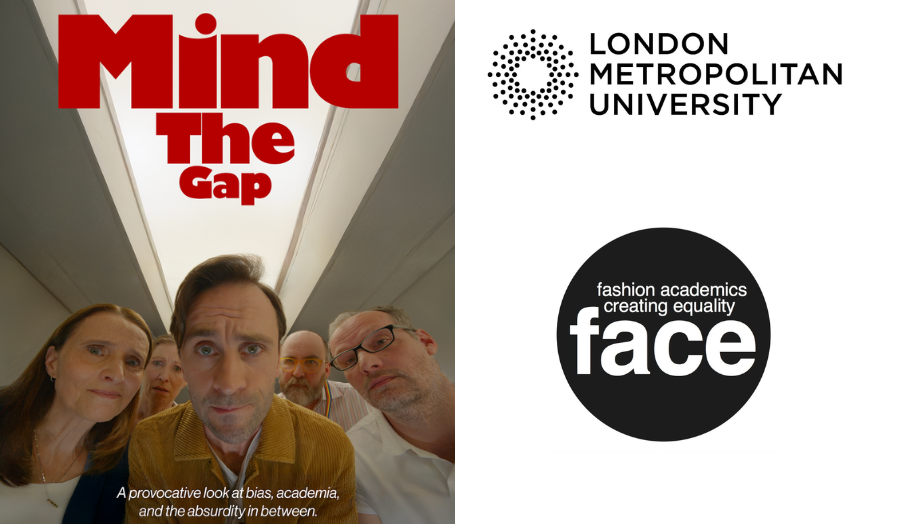
Interview with Associate Professor Ricardo Barker – Director of new film Mind The Gap
Date: 17 November 2025
Last month, London Met’s Centre for Equity and Inclusion partnered with FACE (Fashion and the Arts Creating Equity) to host award-winning film-maker Ricardo Barker’s latest film, Mind the Gap.
The 80-minute feature film, created by award-winning film maker Ricardo Barker, is aimed at white educators. The film aims to spark conversations around the Awarding Gap bias, and was aired via a screening event last month.
Associate Professor Ricardo Barker, filmmaker and Director of Mind The Gap, shared insights into how his approach to storytelling has evolved and how the project aims to spark meaningful conversations about inequality in higher education.
Barker, whose earlier work focused on spectacle and entertainment, said his practice has shifted significantly over time. Projects such as Re:Tension and Where Is The Line marked a turning point, encouraging him to explore social issues with greater nuance.
“I’ve become much more interested in subtlety – letting silence, visual language and framing carry as much meaning as dialogue,” he explained. Central to this shift has been a move toward co-creation, with students and staff playing an active role in shaping his films. “Collaboration has changed how I tell stories. It allows us to move beyond simply showing inequality and instead understand it through multiple, authentic perspectives.”
That collaborative approach was essential in Mind The Gap, a film that examines the awarding gap and unconscious bias in higher education. Barker acknowledged the challenges of representing sensitive, personal issues without reinforcing stereotypes or simplifying complex experiences.
“I didn’t want to create a film that was patronising or predictable,” he said. By presenting the story through the eyes of a well-intentioned white lecturer who begins to recognise his own biases, Barker aimed to highlight how prejudice often operates subtly, through unexamined systems and behaviours. Co-creation sessions with students, staff and actors ensured the film was rooted in lived experience and honest dialogue.
As universities and educators express interest in licensing Mind The Gap, Barker hopes the film will be used as a catalyst for constructive conversation.
“It’s designed to be experienced collectively,” he noted. “When students and staff watch together, it breaks down hierarchy and creates space for honest reflection.” He believes the film can support CPD sessions, curriculum activities and facilitated discussions, helping to reduce the fear that often surrounds conversations about race, bias and privilege.
Ultimately, Barker sees Mind The Gap as a tool for change: “If it can help even a handful of people pause, question their assumptions and begin a genuine dialogue, then it has achieved its purpose.”