
Professor Wessie Ling at London Met leads a partnership project to commemorate the anti-apartheid struggle’s history, highlighting its ongoing relevance and global resonance.
Date: 16 February 2026
London Metropolitan University is working with local residents and members of the South African community to develop a legacy mural for the Anti-Apartheid Legacy Centre in Islington.
The mural will sensitively convey some of the history and legacy of the Anti-Apartheid Movement and be installed at the Centre’s site at 28 Penton Street - the former headquarters of the exiled-African National Congress in London - when it opens in late 2026.
The centre will be the first museum in Europe dedicated to commemorating the Anti-Apartheid Movement.
Drawing on archival research, including the University’s Special Collections on the Anti-Apartheid Movement, London Met's Research Centre for Creative Arts, Cultures and Engagement (CREATURE) has co-delivered six art-based workshops with school pupils, adults, local residents, former Anti-Apartheid activists and members of the Southern African diasporic community.
The workshops invited participants to explore the Anti-Apartheid movement’s history and ongoing relevance through creative activities, discussion and reflection, with a focus on social justice, equality and freedom.
Ideas, images and themes co-created by the workshops’ participants have informed the mural’s concept, ensuring it reflects the voices and experiences of the community. The mural will be created to coincide with the opening of the Centre.
Community involvement is central to the mission of the Anti-Apartheid Legacy Centre, which aims to educate and engage the public with the movement’s legacy. Rather than taking a top-down approach often associated with traditional museums, this work places communities at the centre of how heritage is shared and represented.
The work has been supported by the National Lottery Heritage Fund, which places strong emphasis on community engagement and inclusive heritage. Making the work visible ahead of the Centre’s opening reflects this focus on participation and shared ownership.
Professor Wessie Ling, Founding Director of CREATURE at London Met, who is leading the LMU collaboration on the Anti-Apartheid Murals project, said:
“This work demonstrates an inclusive approach to heritage-making, placing community voices and experiences at its centre and creating lasting impact for both the Anti- Apartheid Legacy Centre and the wider community. Through creative co-creation, it strengthens understanding of the UK’s role in the Anti-Apartheid Movement while generating meaningful social and cultural impact around issues of equality, freedom, and social justice today. The resulting mural embeds these shared histories and perspectives within the future home of the Anti-Apartheid Legacy Centre, ensuring that the community’s ideas and contributions continue to shape its legacy for generations to come.”
Caroline Kamana, Director of the Anti-Apartheid Legacy Centre, said “We are delighted to be collaborating with CREATURE and London Metropolitan University on the mural, and with Creative Director for the project, Ham the Illustrator, whose Southern African heritage and participatory visual storytelling practice to bring depth and authenticity to the work.
The project centres community agency, created through intergenerational engagement with archives and storytelling, lived and contemporary experience of the heritage and its themes, to create a visually arresting, engaging, empowering and inspiring piece of public art for visitors to the Centre.”
The work forms part of London Met’s wider commitment to socially engaged research and creative practice that connects communities, culture and contemporary social issues.
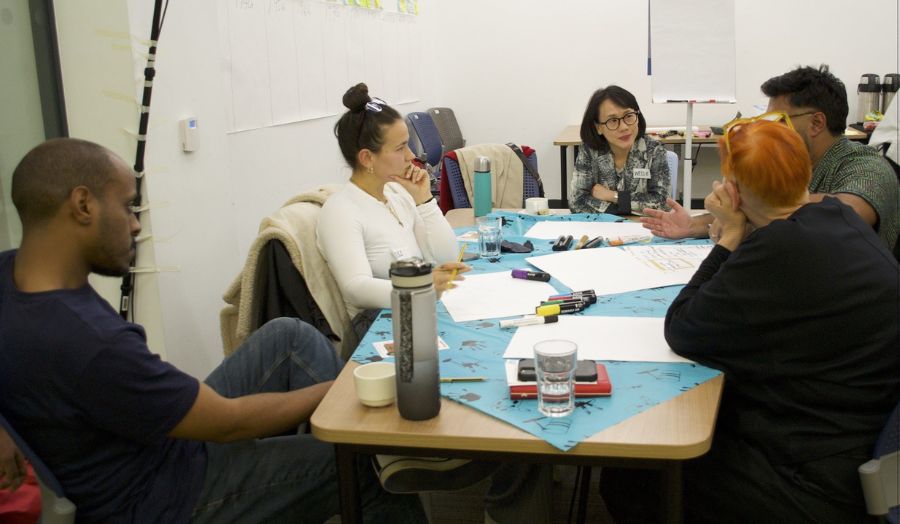
Professor Wessie Ling (middle) co-delivered a community engagement workshop for the Anti-Apartheid Mural project, Oct 2025.
Photo: Alicia Alfonso