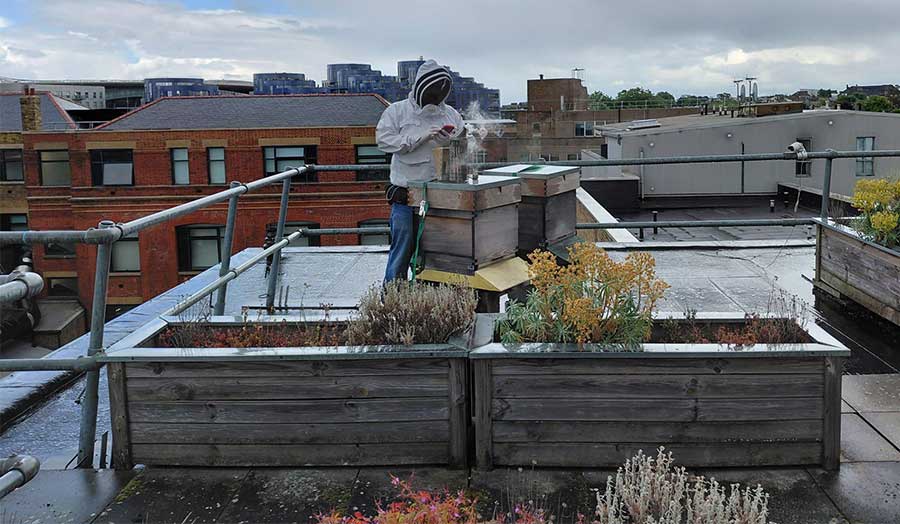
Resident beekeeper Paul Youthed discusses what it's like to look after the University's two thriving bee colonies and the importance of keeping bees in the city.
Date: 26 June 2026
During London Climate Action Week, London Metropolitan University is proudly showcasing one of its smallest, yet most powerful, sustainability initiatives: its thriving on-campus honey bees.
Located on the roof of the Rocket building at London Met, two thriving colonies of Apis mellifera (Western honey bees) are playing a powerful role in supporting biodiversity, strengthening local food systems, and connecting the university community with nature in the heart of the city.
Resident beekeeper Paul Youthed, founder of The London Beekeeper Ltd, shared what beekeeping in the city is really like and why bees should matter to all of us.
What type of bees are at London Met and how many are currently on site?
We have two colonies of Apis Mellifera (the Western Honey Bee) at London Met. The colony size will vary from winter from around 10,000 bees to the peak of summer when there are around 50,000 bees inside. In bee world the individual bee cannot survive by itself and the whole colony is considered a single superorganism. This social structure is referred to as ‘eusocial’ where housekeeping responsibilities are divided into different roles. Queens mate and lay eggs for the whole colony and female workers do all the other housekeeping (brood rearing, cleaning and gathering food) and the only real responsibility of the male drone is to mate with virgin queens and pass on their genetic profile.
Why are bees so important for cities like London?
We know that bees and other pollinators provide pollination for flowering plants. Pollination allows plants to produce seeds that in turn produce fruit or nuts that feed humans and other animals. Honey bees also produce honey, of course, and with the concerns of climate change and global politics it’s increasingly important for countries to be able to produce their own food. Urban agriculture in places like London offers low carbon, high quality, fresh food to locals that is good for local economies and food security.
What does a typical day or season look like as a beekeeper in London?
In the summer we typically spend our days checking that hives have enough room to bring in honey and stop swarming. We gather honey, split colonies and near the end of summer we collect honey and put it in jars.
What are the biggest challenges bees face in urban environments today?
Probably the biggest issue for bees, other pollinators and wildlife is poor land management. All wildlife relies on land owners to maximise and improve the planting and habitat for wildlife on their land. Unfortunately, decades of poor land management has led to a global crisis that thankfully is being addressed now by the 17 United Nations Sustainable Development Goals. Huge positive steps are being made all around the world and billions will be spent over the next century addressing these issues.
If London lost its bees, what would we notice first?
If London lost its bees this would have a devastating impact on the nature, wildlife and food production of the city. Seeds, berries, fruits and the next generation of plants wouldn't be pollinated. Thankfully, I don't think this will happen as long as we all continue to improve on how we manage land and strive towards the UN goals.
What simple actions can students or city residents take to support bees right now, and as we head into summer?
The simplest thing you can do to help bees is plant flowers or trees to provide them with the food they require. If you don't have a garden you can join a community garden or one of the many wildlife projects in London that rely on volunteers. You may gain experience and insights into a whole world of career opportunities in this sector. The turning and beginning of the century saw a revolution in computer technology. The century ahead will see a revolution in land and sea management and energy technology.
What’s one common misconception that people have about bees and beekeeping?
A common misconception about bees is that male bees defend the hive. In fact they don't have stingers so they can’t sting attackers. They also don't have pollen baskets to collect pollen or honey stomachs to collect honey so they are pretty much only good for one thing – mating.
What do you enjoy most about being an urban beekeeper?
Being with bees all day is really calming, the honey is a good perk, and seeing all the changes to the structure of the city where buildings and streets are gaining more and more plants and trees is really positive. I'm really optimistic about a sustainable future for London but there is lots and lots of hard work that needs doing to get really good, nutritious land management happening across the board. Playing a small part of that feels exciting.