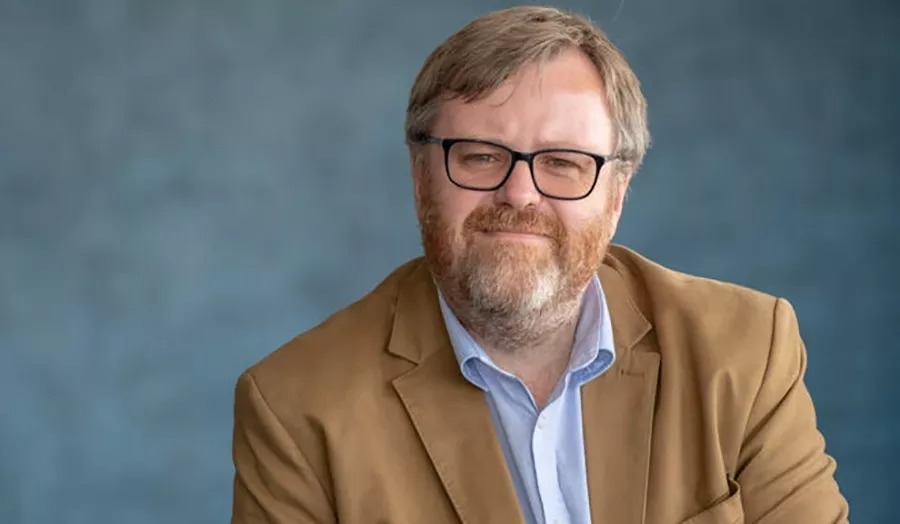
The University is deeply saddened to share the news that Professor Don MacRaild has died.
Date: 26 May 2026
Don joined London Met in June 2019 as Pro Vice-Chancellor for Research and Knowledge Exchange, a role he held until stepping down at the end of 2024. He remained with the University as a fractional professor and was working on several writing projects at the time of his death.
A historian of international standing
A historian by training, Don was a leading scholar of modern British and Irish history, with particular expertise in the history of the British and Irish diasporas.
Born in Barrow-in-Furness, with family roots on the Isle of Skye, he studied at Liverpool Polytechnic and Sheffield University before beginning his academic career at Sunderland in 1993. Over nearly three decades in higher education, he held chairs at Northumbria, Ulster, and Victoria University of Wellington, and was Head of Humanities at Roehampton before joining London Met. He was also an Honorary Fellow at Ulster University and the University of Edinburgh.
Don wrote or edited more than a dozen books and over fifty papers and chapters, with major funding from the Leverhulme Trust, the AHRC and the ESRC. He was a visiting fellow at the Australian National University, contributed to the Australian and New Zealand equivalents of the REF, and reviewed regularly for research councils and learned societies around the world.
He was best known among historians for his books on the Irish in Britain. But his textbook Studying History, co-written with Jeremy Black, ran to four editions and shaped the thinking of a generation of undergraduates.
Leadership at London Met
At London Met, Don was part of the senior leadership team that helped transform the University, driving the revitalisation of its research culture and the re-establishment of the Research Office.
Don inherited a research function that needed significant work. The REF 2021 results, achieved in a tight window and with much to put right, were the product of long hours, hard conversations, and a refusal to accept that London Met couldn't compete.
The result was excellent, with 86% of the University's research rated as internationally recognised and 60% as world-leading or internationally excellent. The impact of London Met's mathematics research was ranked joint top in the UK. Don built a research environment that, in his own words, ‘gave everyone a chance’.
In an interview shortly after his retirement, he described his approach to work as "collegial and supportive", preferring to be "personally engaged, not remote or distant". Colleagues remember him as a hugely passionate and straight-talking presence, generous with his time and unafraid to say what he thought. He cared deeply about the people around him and about the work itself.
Maeva Khachfe, London Met’s Director of Research, Knowledge Exchange & Enterprise Operations worked closely with Don during his time at London Met:
Don was a great boss, leader and friend. Straight-talking, open and honest. He was incredibly knowledgeable and knew how to bring the best out of people. His leadership style has been, and will continue to be, a great inspiration to me. I take the continuation of the legacy he built for research at London Met with great pride and hope that I can honour his work in doing so. More than anything he was kind and funny, a big personality with a big heart. It was an honour and a pleasure to work with Don. He will be greatly missed by me and so many others who were lucky enough to work with him over the years.
The next generation
When he stepped down last year, Don reflected on what mattered most to him. "I've always held the view that the next generation is more important than the current one," he said. He had supervised fifteen PhD students to completion, alongside several postdocs, and spoke with quiet pride of where they had gone on to: professors, lecturers, civil servants, and at least one Deputy Vice-Chancellor.
That was the legacy he chose to highlight, and it is the one many colleagues will remember him for.
London Met's Vice-Chancellor, Professor Julie Hall, who worked closely with Don, commented:
“This news has been a real shock to all who worked with Don. His legacy at London Met is strong and we won't forget his impact, commitment to research and his passion for higher education. We have lost a wonderful scholar and great colleague.”
Don is survived by his wife, Connie MacRaild, a journalist; his children, Michael, Andrew and Katie; his mother, Wendy and his sister, Margaret.