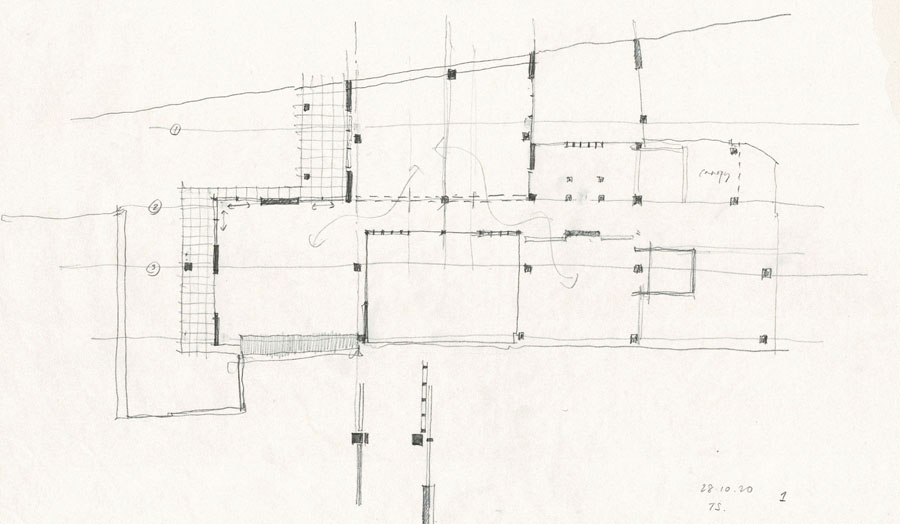
Unit brief
The central thesis of Ernst Friedrich Schumacher’s book ‘Small is Beautiful ’ : A study of economics As If people Mattered (1973) is that modern economics with its focus on growth, large-scale production and consumption is fundamentally flawed because it ignores human well-being, ecological sustainability and ethical values.
Schumacher talks about appropriate technologies that are affordable, environmentally friendly and suited to the needs of smaller communities. The book goes on to criticize unsustainable exploitation of natural resources and emphasizes the need for an economy that respects ecological limits, it values simplicity and meaningful work over profit and material consumption.
In Previous years Unit 9 has talked about these issues together with the growing shift from large urban centers, particularly during the Covid years but also in response to the growing capacity of technology in facilitating remote working patterns and the positive effect this can have on smaller towns and villages or indeed more isolated rural communities.
Continuity and Coherence: Lessons from Moulin de Croisance
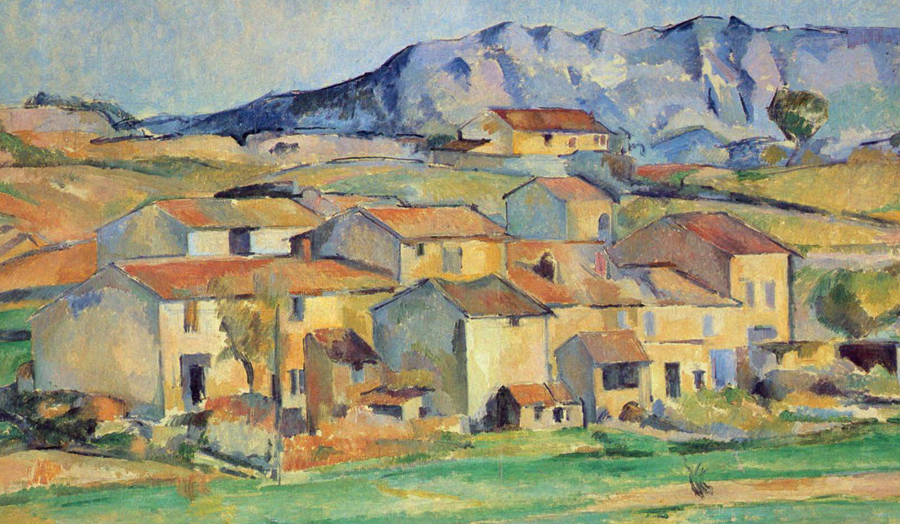
In 1886, Paul Cézanne painted a landscape of the hamlet of Meyreuil, lying quietly in the foothills of Mont Sainte-Victoire in southern France. Within this modest scene, a profound unity reveals itself: the repeated use of a single material for walls and roofs, the sympathetic proportions of buildings, the soft folding angles of the roofs. All these elements coalesce into a single architectural body, breathing and growing together. Though tones shift subtly across the canvas, Cézanne’s palette speaks of a remarkable homogeneity, suggesting that over generations, through the work of many hands and across the slow passage of time, a culture of construction quietly evolved.
Good solutions were discovered and passed on. Each generation made small, thoughtful adjustments. Certain characteristics — the depth of buildings dictated by available timber lengths, the shallow roof pitches suited to the gentle climate — remained constant. Others — such as window details and decorative flourishes — evolved as techniques improved and distant materials slowly entered the region.
The people who built Meyreuil had time on their side. Villages grew gradually, absorbing the lessons of predecessors with each passing year. This was a “slow architecture,” shaped not
by speed or spectacle but by necessity, frugality, and deep local
- Materials were sourced locally because they had to be; proximity governed choice. Within these constraints, coherence was not a style to be applied, but an inevitable outgrowth of circumstance. Continuity and economy moved hand in hand.
The Challenge of Contemporary Construction
Today, construction operates at a very different rhythm. Global sourcing has placed an overwhelming range of materials and techniques at our fingertips. A thousand options compete for every detail. Architects, builders, and clients now face dilemmas not only of taste and function, but of morality, sustainability, and cultural meaning.
How do we build meaningfully in a world where the concept of place is increasingly diluted? How can we pursue sustainable, economical architecture — or indeed, should we be building anew at all?
These questions loom large over the project at the Moulin de Croisance, deep within the remote mountains of the Cévennes National Park. Scheduled for completion in 2026, this restored and expanded hamlet will host a range of social, cultural, and educational activities. It will be energy-independent, drawing power from the sun, food from its terraced landscapes, and clean water from its own systems. In every gesture, it seeks not just to preserve, but to renew.
The work at Moulin de Croisance reminds us that the most resonant architecture is not that which strives for novelty, but that which listens — to place, to history, and to the slow intelligence of craft.
In an age of acceleration, it offers a gentler lesson: that beauty lies not in invention alone, but in the deep, patient work of care.
This year Unit 9 will focus on the small community, of the hamlet of the Moulin de Croisance located in the remote
mountains of the Cévenol National Park in the south of France.
Amongst the buildings and landscape of this ancient hamlet, we will design and build 10 new interventions that range in scale from small buildings to furniture, functional elements whose material fabric, form and presence should chime with the weighty medieval presence of their context and whose purpose will contribute to its slow but ongoing rehabilitation, community provision and philosophical ambitions.
Throughout both semesters and the design objectives within, we will explore ideas that can be rooted within the landscapes and physical fabric of their setting, just as Cezanne amalgamated landscape and buildings through colour and form in his painting of Mayreuil.
With Schumacher in mind, we will focus on making things simply, economically, and using appropriate technologies. Where possible we will reuse elements and materials with a past life; doors beams, windows, stone, just as, has been the way for centuries when availability of materials was scarce. We will embrace a spirit of ‘mend and make do’ while working with care, thoughtfulness and beauty.
Details
| Course | |
|---|---|
| Tutors |
Stephen Taylor |
| Where | Goulston Street |
| When | Monday and Thursday |