Powerful evening which focused on racism, radicalisation, and the difficult, yet necessary, path from hate to change.
Date: 19 November 2025
On 4 November, London Metropolitan University hosted a powerful evening of film, discussion and reflection. At the event’s heart was That Boy: a conversation about hate and healing, a documentary grounded in London Met research exploring racism, radicalisation and the possibility of change. The film is the product of a wider academic project led by the University’s Global Diversities and Inequalities Research Centre.
Held in the Great Hall on the Holloway Campus, the event brought together personal testimony, academic insight and grassroots activism. It was organised by the Centre for Equity and Inclusion, the Global Diversities and Inequalities Research Centre and Stand Up To Racism.
The evening opened with a speech by Vice-Chancellor Professor Julie Hall. Reflecting on recent anti-refugee marches, Hall described the current political climate, her words setting the tone: “These developments are not abstract or distant. They are present. They are real. They demand our attention,” she said.
That Boy
A screening of That Boy followed. The documentary, based on research led by Professor Michał P. Garapich with his team Dr Anna Jochymek and Dr Rafal Soborski, captures a raw, unscripted conversation between a former Polish neo-Nazi and Roma refugee Toby Gorniak MBE. The film explores identity, ideology and the possibility of change, challenging viewers to think deeply about the roots of extremism.
"The film is a powerful exploration of the choices people make in their lives and the possibility of transformation," Commented Professor Hall. "It is a testament to dialogue and the courage to confront extremism with empathy and truth."
From the Screen to the Stage: A Panel in Action
After the screening, the conversation continued with a panel discussion featuring Professor Garapich, Toby Gorniak MBE – one of the film’s subjects -, Stand Up To Racism campaigners Eva Colwell and Paul Holborow, and journalist Gary McFarland. The event was facilitated by Mia Nembhard from London Met’s Centre for Equity and Inclusion and the panel built on the film’s themes with personal reflections, historical insight, and calls to action.
Toby, reflecting on his lived experience, spoke with deep emotion: “My story wasn’t told for 37 years. But it reflects millions of people, and some of them are in this room today.” He described the pressure to adapt his behaviour and appearance in order to feel safe. “I have to now watch how I move, how I walk, how I look… so I don’t seem threatening.”
Despite the trauma, his message was one of hope. “I’m building a platform for the next generation. We need more positive voices. This film is a tool to create change.”
Paul Holborow, founding member of the Anti-Nazi League in the 1980s, drew a stark comparison with today’s political climate. “This is the biggest crisis of my life,” he warned. “We could face a future where our curriculum is censored, where critical histories are erased. We need a mass movement to say ‘no’.”
Eva Colwell spoke from the frontlines of grassroots activism thanks to her role with Islington Stand Up To Racism. “Racism doesn’t spring up in a vacuum,” she said. “It’s rooted in a system of inequality; in austerity, housing injustice, job precarity. We need to confront these structures and challenge racist ideas where they grow.”
Gary McFarland brought a media perspective, warning of the legitimisation of hate. “These ideas are being mainstreamed. But we’ve been here before. The question now is: what will we do?
The difficult ethics of dialogue was a recurring theme: “Proper research creates spaces where we can challenge things but also understand,” Michal said. “The university is a space where these risky, necessary conversations can happen.” He spoke of the complex relationship between victim and perpetrator, stressing the importance of empathy and curiosity: “If we don’t try to find spaces to talk, we lose. Dialogue may be painful, but it’s the only way forward.” Toby echoed this, noting: “When people don’t know people, myths grow. But even one real connection can change everything.”
A shared purpose
After the panel discussion, facilitator Mia opened the floor to questions from the audience. Throughout the evening, it was clear that listening, understanding and collective action remain essential in confronting the challenges ahead. As guests left, there was a real sense of purpose, no illusions about the scale of the task, but a shared conviction that they were not alone in standing up and pushing back against racism and the far right.
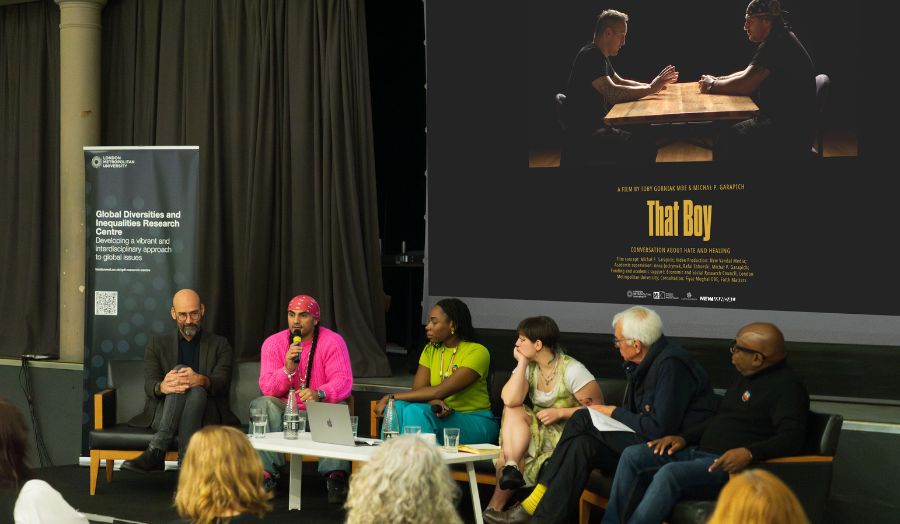
Panel L to R: Professor Michal P Garapich, Toby Gorniak MBE, Mia Nembhard, Stand Up To Racism campaigners Eva Colwell and Paul Holborow, and journalist Gary McFarland.
------
That Boy is an output from “Everyday Transnationalism of the Right,” a pioneering UKRI-funded research project led by Professor Garapich. The project explores why and how some immigrants, particularly Polish migrants and their descendants, become involved in right-wing or far-right politics, including anti-immigrant movements. It sheds light on the transnational nature of radicalisation and the shifting ideologies within these groups, offering crucial insights into contemporary extremism across borders.
Related news: That Boy was also recently screened at the European Parliament, sparking international dialogue on reconciliation and resistance.
That Boy wins Audience Choice Award at the AKE DIKHEA 9th International Festival of Romani Film