
Professor Short shares her professional fight to make online harm visible and the personal experience that shaped her career.
Date: 25 February 2026
Content warning: This article contains references to stalking, coercive control and digital abuse.
Professor Emma Short delivered her inaugural lecture at London Met's Roding Building last week, tracing nearly two decades of research, advocacy and legislative reform in the field of cyberstalking and tech-facilitated abuse.
Speaking to a full theatre of family, friends, collaborators, colleagues and survivors, Professor Short reflected on the work that has shaped national policy on online harm and helped build a legal and evidential language for experiences that were, for a long time, dismissed or invisible.
From the outset, she framed the evening as a collective achievement rather than an individual one. "There is a community of people behind this work who have trusted one another and worked together over many years," she said. "Some of those people are here tonight."
Throughout her lecture she shone a light on the people who throughout her career had supported her professionally and personally, encouraging the audience to give them a round of applause each time, which they did enthusiastically.
Building a language for digital harm
Professor Short's research took shape at a moment when digital spaces were, in her words, "slower, smaller, and largely unregulated." Policy and policing frameworks of the time treated online harassment as a lesser concern than physical violence, and victims who sought help frequently found the system unprepared to respond.
Her own experience as a survivor stalking and tech-facilitated abuse formed the foundation of that work. In a moment that silenced the room, she disclosed it publicly for the first time. The harm had unfolded largely through digital channels at a time when no framework existed to name it, and when she sought help, she was met with disbelief. "One officer said, 'I can't see the problem… there's no blood on the floor.'"
It was that absence of recognition, she explained, that gave her research its direction. "My motive had found its cue. Distress became purpose."
Working alongside advocates including the Network for Surviving Stalking, and drawing on early research by Lorraine Sheridan, Professor Short designed the first targeted cyberstalking studies. The Electronic Communications and Harassment Observation Study (ECHO), launched in 2009, produced findings that challenged the prevailing assumption that online harm was trivial.
"There was evidence that these experiences produced trauma patterns comparable to post-traumatic stress disorder."
Only around half of those surveyed had reported their experiences to the police, and many described chronic isolation and fear of being disbelieved. "Policy and policing frameworks treated online harassment as trivial, something less serious than 'real-world' violence. Our data demonstrated the opposite."
That evidence was presented to parliamentary committees and contributed to the Independent Parliamentary Inquiry into stalking law reform in 2012. "In hindsight, those early surveys were more than research instruments. They were a form of social recognition a way of saying, 'you are not imagining this; it matters, and we can measure it.'"
The work led to the founding of the National Centre for Cyberstalking Research and an expanding interdisciplinary team drawing on psychology, computing, policing and advocacy.
Challenging systems and sharing accountability
Professor Short's argument extended well beyond criminal justice. She contended that harmful behaviour is amplified, not created, by technology, and that responsibility for tackling it must be more widely shared.
"Technology doesn't create harmful behaviour; it amplifies what already exists; the need to control, to pursue, to dominate."
She was direct about a structural problem: the technology sector "rarely sits at the same table" as police and policymakers, leaving victims to manage their own risk and evidence while officers are "expected to contain environments they did not design and cannot control."
London Met and what comes next
Professor Short joined London Met in 2022, since arriving, she has grown the cyberpsychology module from 18 students to over 70, and has secured the University a presence in national policy conversations on online harm through advisory and governance roles across charities, policing bodies and violence reduction initiatives.
A collective project
As she closed, Professor Short drew together the personal and the professional. "What began as a private experience of victimisation has become a collective project through research, collaboration, and advocacy."
The lecture ended with a statement of purpose rather than conclusion. "The pursuit of knowledge about abuse matters… it carries responsibility, and when we share what we discover, sensitively, critically and generously, it enables greater understanding… and through that, has the potential to make people safer."
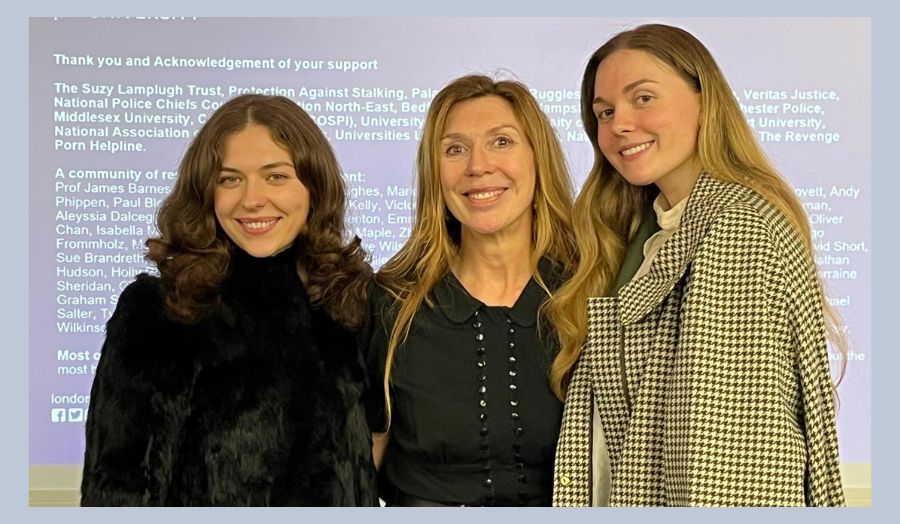
Photo: Professor Emma Short with her daughters who were among the supporters, collaborators and colleagues in attendance at her inaugural lecture.
"The pursuit of knowledge about abuse matters… it carries responsibility, and when we share what we discover, sensitively, critically and generously, it enables greater understanding… and through that, has the potential to make people safer."