By Kim Tran and Molly Madden, third-year Fashion Marketing and Journalism students
Date: 12 February 2026
Since the pandemic, over 3,000 nightlife venues across London have shut down, begging the question of whether London’s nightlife is struggling. The city’s night economy is under pressure from rising costs, tighter security rules, and shrinking public transport options – but industry insiders say London’s nightlife is not dying so much as being reshaped, often in ways that leave venues and young people behind.
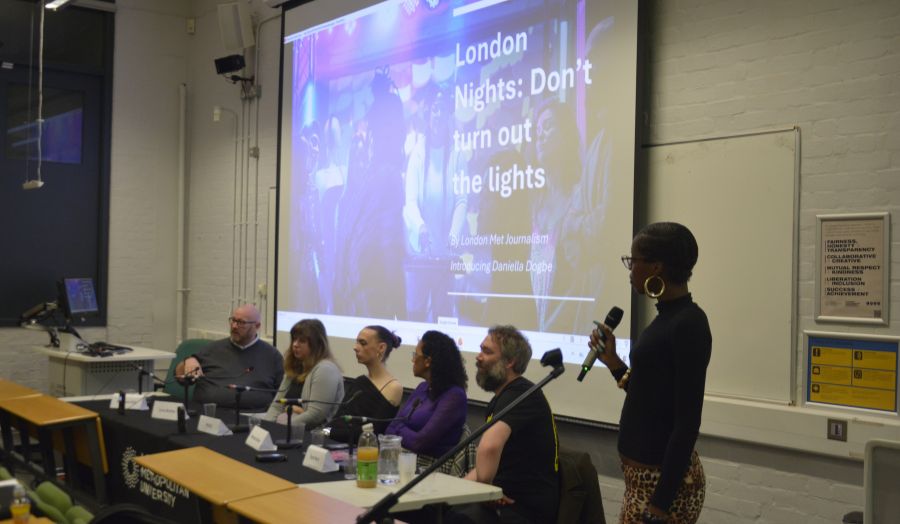
The question “Is London nightlife dying?” was put to a packed audience at London Metropolitan University, where a panel of artists, promoters, and venue managers gathered under the banner “London Nights: Don’t Turn Out the Lights”. The discussion was chaired by third-year journalism student Daniella Dogbe, and opened by BA Journalism and Fashion Marketing and Journalism course leader Wendy Sloane.
Panellists included Michael Kill, CEO of the Night Time Industries Association (NTIA); Lara Bothe, tour manager for Live Nation; MDZA, a drum & bass DJ and London Met graduate; Rhoda Dakar, musician and lead singer of The Bodysnatchers; and Tom Nutt, deputy manager of The Garage in Islington.
The conversation quickly turned to whether Londoners are being priced out of going out. Bothe said headline ticket prices are often inflated by extra fees beyond promoters’ control, suggesting smaller shows remain one of the last truly affordable options.
Dakar called current prices “outrageous” and questioned where the money is going, insisting it is not flowing back to most artists. Kill pointed to the Department for Digital, Culture, Media & Sport’s interest in fan‑based reviews to scrutinise experiences and prices under dynamic pricing models.
Dakar was blunt: “The people who agreed to dynamic pricing should be ashamed,” she said, while Nutt argued that discovering emerging bands will increasingly be the only way many fans can afford live music.
The panel also turned its attention to the Treasury’s new £80‑million‑a‑year support package for pubs and live music venues, questioning how far it would really stretch. Kill warned it would do little to revive London nightlife, noting that seventy percent of live music venues have barely broken even since 2020 and accusing ministers of “taking £1 in tax and giving back 50p.” He argued that venues are already heavily taxed and branded the package “smoke and mirrors,” describing it as “a bit of a slap in the face by the government.”
Dakar struck a more cautious tone, saying she was grateful the outcome was “not a complete disaster” but warned that the Treasury appears not to be listening to DCMS, suggesting two arms of government are failing to speak to each other.
The panel discussed how safety remains a major concern within nightlife, particularly for women. MDZA and Nutt described the crucial role that venue staff play as first responders to drink spiking – recognising symptoms and knowing how to escalate or de‑escalate situations. MDZA stressed that early education is the best way to enhance safety, specifically referencing the importance of teaching boys about consent.
Nutt said managers need to enforce policies such as banning drinks beyond certain points and removing unattended glasses to ensure customers’ safety. In addition, Bothe criticised TfL’s decision to reduce Night Tube services after the pandemic, pushing people to either leave venues early or seek out other late‑night transport options, which can be especially risky for women.
The discussion highlighted the urgent support and collaborative action from the government to aid with the decline of late night businesses with rising costs, calling for policies that actually protect venues, workers, and the culture that gives the city its after‑dark scene.