
We sat down with poet and rapper Dan Whitlam to talk about the Rising Star Scholarship, how university supported his dreams to write and perform, and his new book and upcoming tour.
Date: 21 October 2025
Dan Whitlam is blazing trails. Recently referred to as ‘Gen Z’s poet laureate’, he is making his mark in the world of poetry and music – using spoken word and rap to connect to and inspire young people navigating the highs and lows of modern life.
With a new book out, an upcoming European and US tour and a debut album just announced, there’s no sign of slowing down just yet, but he’s enjoying the ride and gratitude exudes out of him.
During the summer, London Met announced its Rising Star Scholarships, designed to support and empower talented and creative individuals under 21. Each scholarship is named in honour of six notable figures who have contributed to their fields – and Dan Whitlam is one of them.
London Met sat down with Dan to talk about the Rising Star Scholarship and what it means to him, his inspiration and influences, how university supported his dreams to write and perform, his new book and upcoming tour and his hopes for young people.
The Rising Star Scholarships are designed to support and empower talented individuals under 21, with a focus on those from underrepresented and disadvantaged backgrounds. What does it mean to you to have your name attached to this scholarship? And what do you hope it gives the students who receive it?
It's the greatest honour. I feel so overwhelmed that an institution like London Met, that I've looked up to as champions of young people, especially those from underprivileged backgrounds, has thought that I could somehow come in and help.
I really want to be at the forefront of the university in the future, helping anyone who is in that literature and poetry sector. So, yeah, it's overwhelming. It's a really beautiful thing and I'm honoured to have my name attached to it. I hope it will help young adults who want to study and further their understanding, but may not have the means. I'm excited for where it could go and how I can get more involved. It's honestly the biggest blessing.
How has where you're from and your upbringing influenced your work?
I grew up in a few different countries, I grew up in Russia and Turkey before moving back to London, and I was raised by my dad. My mum passed away when I was quite little and I think the idea of 'home' has always been one that's quite big for me, and I think that might be mirrored with many of the students at London Met – the idea of either moving to a new place or potentially growing up in homes where someone may have one or no biological parents.
The idea of home for me was moving around, I was searching for that ‘home’, and then losing a parent quite young, the idea of having a home got lost in my mum and I really struggled for a while.
When it came to my work and writing, I very much wrote about what I know and my work really centres around loss, love, mental health, and where I’m from – which is South London. I tend to look for themes that are around home, whether it's family or childhood, quite nostalgic sort of themes. It’s also very relatable, and I always hope that someone can find something in my work that they can see themselves in.
Your work covers a number of themes and captures the highs and lows of modern life. Why is this important to you and what do you hope people get out of your work?
I released a book recently called ‘I Don’t Want to Settle: Words for a Lost Generation’ and I think the idea about a lost generation is that I hope people who read my book or listen to my poetry or music will know that they too are not alone in their feelings.
I think it's really common now, especially in this world of comparison, and looking at your phone, constantly seeing people who are ‘doing better than you’, ‘look better than you’, or seemingly so, it's easy to think ‘I don't know where I am … I'm lost … I'm different to that’. If someone can look at my work and know that they too are not alone in their mental health troubles or their worries about the future, then I think that would be a really, really positive thing for me.
What does not settling mean to you, and has that meaning changed over time?
The title from a first glance, you can think ‘Oh, he must be talking romantically’, because the name originally came from a poem that I wrote about not settling in love, not reducing yourself to something you're not, but I think for me, stemmed into everything else – not settling for a future that's less than what you're worth, not settling for a job, not settling for things that will be bad for your mental health and pushing on for the best out of yourself, whatever you can get.
I think in the past when I spoke about not settling, I thought in terms of these big, grand pictures of potentially what success means, you know, glam and glitz and this ‘Hollywood life’. But I think now, the amazing thing is that I'm able to support myself, my full time job and being able to rent is purely from my writing, which for me, is incredible. I'm so grateful that I've been given that opportunity, and I think that's how it's changed for me in that regard.
Throughout history, the lost generation has been used to refer to a number of groups; 1920s writers living in Paris to, more recently, young people living through the pandemic. Who are you referring to, and why is it important that your words reach them?
I think the lost generation for me is people in their 20s and 30s, and those who have been subject to this idea that I call option paralysis, where because of social media, potential parental pressures, peer pressures, and societal pressures, and the state of things currently – it’s virtually impossible to buy a house now, inflation is going up and food is so expensive. Everything's pretty difficult for young people at the moment, and I think the idea of that lost generation for me is very much, those who are around me, and I've written the book for them. You can be made to feel so alone by looking on social media, and like I said earlier, I want them to know that they're not alone.
I've read that you find writing cathartic. That's the same for a lot of people using writing as a form of mindfulness, catharsis or creativity. Now that you're a professional writer, has writing changed for you, and how do you retain that passion or motivation for it?
That’s a great question. I think at the beginning I absolutely wrote to understand myself better, in many ways, sort of as a poetic journal, but I think as my writing has allowed me to live, and I've attached something to it in a slightly different regard, I’ve found that sometimes, if I'm doing something for social media, I'm almost writing because I know something might work.
It's a shame that social media now needs to capture our imagination within three seconds, otherwise we get rid of it. It’s led artists, videographers, writers, into creating this hook within three seconds. Sometimes now I write with big blanket statements, such as ‘I don't want to settle’, ‘I don't want quick intimacy’, or ‘she's married now’, and it's a lovely way into a poem, but I’m also very aware that I'm writing to keep someone in the conversation, to keep the viewer watching.
But also, at the same time, it’s an amazing thing sitting at my desk in South London, writing all this stuff, and knowing that I'm writing it for an album that's coming out or I'll be performing it on stage one day, and hopefully have people connect with it and sing my lyrics back to me. The journey of my writing has been incredible, and quite surreal.
You have a lot going on at the moment with your book, the tour and your album launching soon. How are you feeling about it all?
Yeah, it's a lot. I think like any job, when you've got a lot going on, it’s stressful, but I'm so grateful that this is my full time career. It's what I've wanted to do for such a long time. Being on stage and performing, starting from doing theatre when I was at school – it's always been when I’ve felt the most self-worth. It's an amazing feeling to be able to do this as a career, that people are into it and that I’ve found a fanbase. It takes many hands to make something work so I'm really grateful for my team.
What was your experience like at university, what extent did studying develop your career and has your work taken a particular path because of study?
I always struggled with the idea of what subject I'd study at university. I had friends going off to uni, and I took a year out. I applied for drama school, and I didn't get in so I took another year out – some of my friends were already coming back from studying all together and I was like, ‘God, what am I doing with my life?’ I liked acting and I felt this idea of self-worth on stage, that I spoke about, so I applied for drama school again and luckily got in to the Guildhall School of Music and Drama in London.
I'm often asked ‘What's the main thing I got from drama school?’ I was lucky to get an acting agent, that was a big thing, but I think the main thing I learned was confidence. I was quite a shy kid, I'd use comedy or being a class clown as a way to have a voice, but when it came to intellectual thoughts, I was a bit scared to voice my opinions. I think drama school taught me confidence in that regard, which I'm so grateful for, and it's also how I found spoken word, poetry and rap.
There's something called ‘Creative Evening’ at Guildhall which was started by a man called Ken Rea (Professor of Theatre at Guildhall). It’s where amazing actor and writer, Michaela Cole, wrote and performed a 10 minute segment which went onto become the award-winning series ‘Chewing Gum’. And I did that too – I wrote a poem for the ‘Creative Evening’ and it sparked everything for me. I’m immensely grateful for the path I found at university.
Who were your biggest musical and poetic influences growing up, and more broadly, what or who has been your biggest influence?
I think it came from two strands. My dad introduced me to Leonard Cohen, Billy Joel, Elton John and classic singer-songwriters, so I’ve always loved stripped back guitar and voice or piano and voice, and then, I had this rap outlet, which started off with American rap, artists like A Tribe Called Quest, and then English rap with Fliptrix, Jam Baxter and people like that.
The real champions I’ve always loved and very much stand on the shoulders of, are Loyal Carner, Kofi Stone, Frankie Stew and Harvey Gunn, and amazing pioneers of this underground pocket of rap, which we now see at Glastonbury. It's very much becoming more mainstream, which is amazing.
These people are my poetry influences too. When I was at school, I found the poetry we did quite unrelatable and I just couldn't get my teeth into it. Then I found these people who are a little bit older than me, but speaking about things I can relate to, and that’s when I thought: ‘This is something I want to do as well’.
And do you think the musical element, like performing on stage and rap makes poetry more accessible?
Absolutely yeah. Poetry is incredible – and the community has got so much bigger! We've seen that online, in different countries, and nights in London popping off and getting bigger.
The arts is a very difficult sector to crack and be successful in. Now that you have some level of success, what advice would you give to young aspiring artists or students who want to make a difference or a mark through their art?
I still very much feel at the beginning of my journey, but the few words I do have are… when I first started, I messaged my heroes – on email or Instagram, whatever I could do, I asked if I could have a minute of their time for some advice. Reach out to your idols, because you don’t know what they might say. I reached out to George the Poet, a brilliant artist, and he replied – he told me to throw everything at the wall and see what sticks.
As a modern day artist, you sadly need to be good at the whole social media thing, you need to be an actor, writer, rapper… so I’d say, the more strings you can add to your bow, the more opportunities can come your way.
And the main thing – just keep at it! Some say if you fail at the first hurdle then it’s not worth doing but that’s just not the case. Dig deep and keep pushing through. If you love what you do, you’ll make your own success – whatever success is to you, it will become clear.
Your new book ‘I Don’t Want to Settle: Words for a Lost Generation’ is out now. If someone’s thinking about buying it, for themselves or somebody else, what can they look forward to? And what's your favourite part about it?
People can look forward to four chapters of poetry, in my own kind of style. I think it's very relatable and based around things that happen to someone in their young adult life. What's slightly different about it though, is that it's got anecdotes about my life, stories about me growing up in different countries and without my mum, and life in your 20s.
What I say at the beginning of the book, is that it's by no means perfect, it's just an honest account of where I'm sort of at, and beautifully illustrated by Natti Shiner. Whether it's a gift for yourself or a gift for someone else, I think it would be a really nice present for your mind.
And your live shows start this week – what can people look forward to? What are you looking forward to?
A lot of new music. I've got this album coming out so I'll be playing some of the new tracks from the album, which is exciting. I’ve got my whole band on stage, so it's me, and then a powerhouse of these other amazing musicians behind me. To play in the Roundhouse, in this iconic venue where some of my heroes have played – I just can't wait to start. I’m also going to America for the first time, which is so cool, a really cool thing to do. I'm really excited.
And finally, our unofficial motto at London Met is ‘The Real London’. What does the real London mean to you?
The ‘Real London’ for me is, it's the culture and it's the heartbeat of what this city is and what it's always been. It's multicultural, beautifully so, it's different ages, again, beautifully so. And it's people, coming together for a greater London. I think the more everyone can come together and be understanding, the better London will be. That's what the real London is to me.
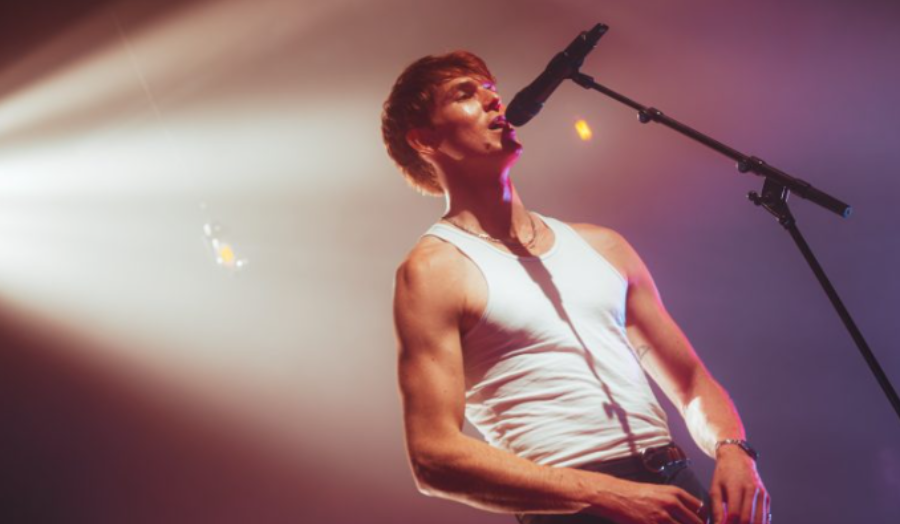
Image: Dan Whitlam performing on stage
Dan's book 'I Don't Want to Settle: Words for a Lost Generation' is out now. Check out his website for more information.
Read more about the Rising Star Scholarships.