
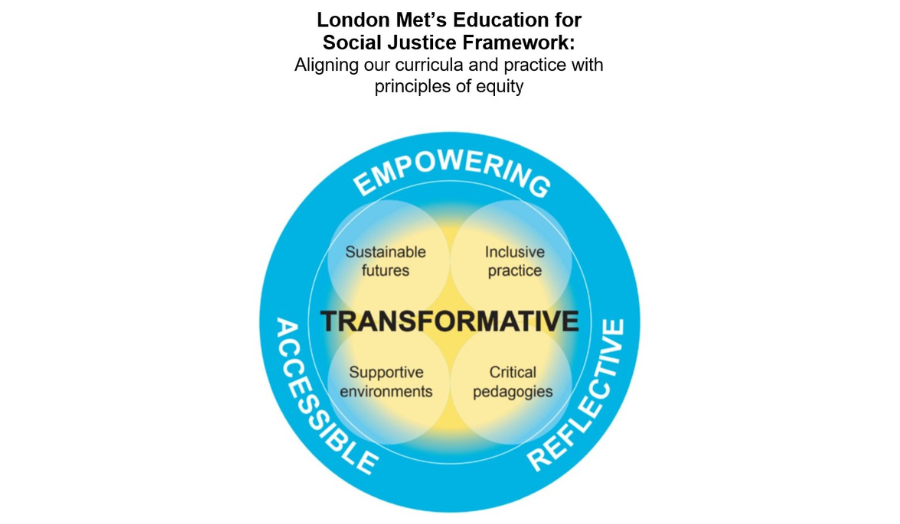
Education for Social Justice Framework (ESJF)
The Higher Education sector continues to grapple with the wicked problem of differential outcomes between student groups at key points in the lifecycle: continuation, degree award and graduate destinations. The most prominent gaps are those between White and Black as well as minoritised students. There are also gaps between the most and least advantaged students – and between young and mature learners.
Inspired by the success of an inclusive curriculum framework at other diverse institutions, our original Framework was designed in 2019 by a group of 30 staff, students and the Students’ Union as a values-led framework which combines principles of inclusive pedagogy (drawing on the 2015 Mountford-Zimdars et al HEFCE publication) with a values-based vision of a curriculum which reflects the mission of London Met. Five years on, the Framework has been refreshed and relaunched as ESJF 2.0, following extensive staff and student consultation.
The refreshed Framework reaffirms London Met’s sustained commitment to inclusion, social justice, and transformative education, with an ambitious goal: All provision will be underpinned by the ESJF, ensuring that inclusive, empowering, joyful and socially just pedagogy is a defining feature of the learning experience at London Met.
Our overriding motivation and commitment to the Framework is that we believe our institution, curricula and practice must align with principles of equity, with who our students are, and the challenges facing London and its communities.
In his seminal work Pedagogy of the Oppressed, Paolo Freire spoke of liberation through a praxis that invites continual reflection at both the individual and institutional level – our Framework will focus our pedagogy for a wider purpose – far removed from a deficit, or banking model of education where information is deposited into the minds of students – instead we undertake an unlearning and relearning of the world we live in, reimagining an equitable future together in partnership with our students.
The impact of our ESJF
- Significant reductions in awarding gaps over a two-year period:
OfS access and participation data for 2025 shows we are ahead of the sector in closing the BAME awarding gap (top 15 nationally), we have halved the awarding gap between Black and White students (half of the sector average) and are ahead of the sector in closing the IMD awarding gap. We have eradicated the BAME highly skilled employment gap.
- Structured Framework for delivering change:
The TEF 2023 panel commended London Met’s ESJF as an “outstanding strategic teaching, assessment and feedback framework” that demonstrably improves student outcomes.
- A new generation of social justice champions who shape London Met and beyond:
Our academics are inspired through and by the ESJF, leading to six National Teaching Fellowships and Collaborative Awards for Teaching Excellence focus on social justice pedagogy, and numerous journals, publications and conference presentations from our academic community. 95% of our substantive academic staff have engaged with the Framework, directly shaping the teaching and learning experience of our students
- Sector leading recognition:
London Met was shortlisted for University of the Year and EDI Initiative of the Year at the 2024 Times Higher Education Awards based on our work in social justice and EDI. The Framework has also supported London Met’s position as first for Student Value Added in the Guardian University Guide 2026, runner up for University of the Year for Social Inclusion in The Times & Sunday Times Good University Guide 2026.
The Centre for Teaching Enhancement works across London Met to ensure the ESJF is having an impact in all areas relating to learning, teaching and assessment, and works closely with the Centre for Equity and Inclusion in maintaining the social justice focus of our mission to transform lives through the power of education. More information about the ESJF can be found on the Teaching Success Hub.
Check our Centre for Teaching Enhancement (CTE) pages:
-
Student Engagement (including student surveys)
-
Personal Academic Tutor