|
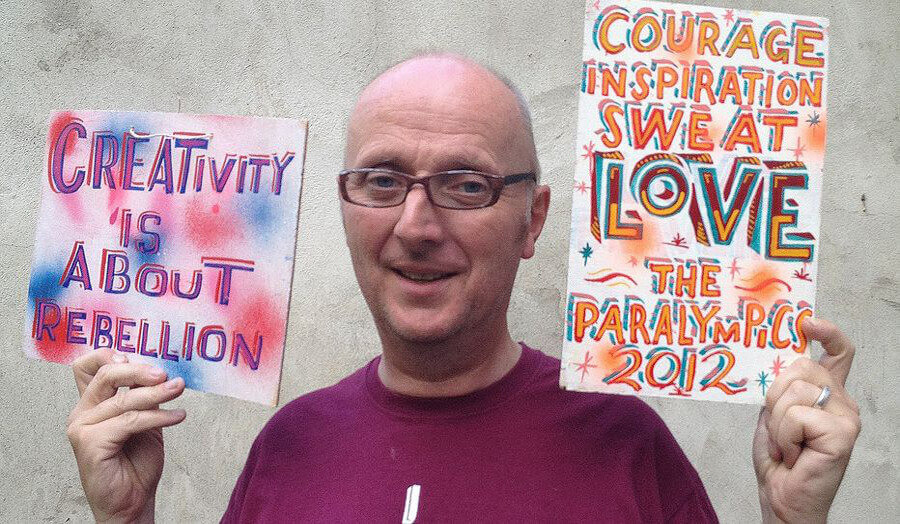
Patrick Brill (a.k.a. Bob and Roberta Smith)
Fine art studio practice, including painting, video, music, sculpture and performance; art and democracy; art as public provocation.
Email: p.brill@londonmet.ac.uk
Ben Cain
Production of installations, performances and printed matter that deal with the convergence of theatre and documentary information, with a particular interest in facilitating and highlighting the viewers’ role in the development of subject.
Keywords: agency, history, performance.
Email: b.cain@londonmet.ac.uk
Professor Brian Falconbridge PRBS
Studio-based sculptural practice; twentieth-century Western sculpture; the use of bronze; Japanese art and culture; the cross-cultural in relation to Euro-Asian thought, process and artefact.
Email: b.falconbridge@londonmet.ac.uk
Neil Ferguson
Developing personal "art systems", rules, methods and strategies to track imagining through image.
Recording imaging through use of the series; using drawings and paintings as thinking tools; capturing momentary experiences; emphasising the obsessive in making; highlighting "internal detail" in situations and objects and promoting "almost nothings" and "wee thoughts".
Structuring art events, art projects and essayistic approaches to art production.
Email: n.ferguson@londonmet.ac.uk
David Howells
(i) How is the future visualised? This follows from my MA dissertation on the Reconstruction of the Berlin Stadtschloss as an Historical Projection. I am pursuing further research in this area with a view to a PhD proposal, possibly under Adrian Rifkin as supervisor. In the mean time, I am writing an article (provisional title: Crystal Palace: Archaeology of the Future) for Activate magazine.
(ii) A cognitive approach to drawing. In particular, a generic approach to graphic practices which might encompass drawing and writing equally. This follows from my teaching on the Drawing Systems modules and editorial role in Knight's Move journal.
Email: d.r.howells@londonmet.ac.uk
Chris Jennings
The representation and "embodiment" of that which may otherwise be considered "invisible" or "intangible" but nonetheless may be experienced as having "real" presence; the physicality of oil paint coupled with the paradoxical use of steel or wood panels to embody absence; making work which, by virtue of its specificity, its physical weight and attention to detail, will "dissolve" into itself; the power of saturated colour to hover in space and remain as an after-image, a visual memory, to reconstitute itself on top of another form; the immanent or numinous; connection, fracture and "wholeness".
Email: c.jennings@londonmet.ac.uk
John Keefe
Physical Theatres: physical acting and physical performance; total theatre; theatre-performance-theory; Text-Body-Sites-Spaces; mask and theatre; Theatre-Film-Performance Dramaturgy; Greek and modern theatre, including Brecht and Beckett.
Email: j.keefe@londonmet.ac.uk
Dr Mike King
The intersection of art, science and the spiritual; the refraction of the spiritual into contemporary culture, and its location in the development of the Western mind; the digital art including image and application, practice, theory and development.
Email: mike.king@londonmet.ac.uk
Nico De Oliveira
The practice, theory and dissemination of contemporary fine art; installation art; artists' writings; contemporary fine art as a collaborative process; the extension of the role of the visual artist beyond its traditional remit; inter-disciplinary crossover links generated with non-art activities.
Email: n.deoliveira@londonmet.ac.uk
Nici Oxley
Contemporary fine art studio practice through the use of the object, installation and film; scale and its mnemonic relationship including the familiar, the uncanny, miniaturisation, measurement and comparison between physical objects; the 'new' artwork and prior experience by the viewer.
Email: n.oxley@londonmet.ac.uk
Clare Qualmann
Walking as a mode of art practice; collaborative practice; repetitive acts of making; domesticity, the ordinary and the everyday; processes and their relationship with the generation of ideas; the language of display; materials and meaning.
Email: c.qualmann@londonmet.ac.uk
Linden Reilly
Art and applied art practice; the nature and operation of tastes; epistemology and research methods for the arts; theories of language, imagination, creativity, perception, and cognition pertaining to art.
Email: l.reilly@londonmet.ac.uk
Ian Robertson
Fine art studio practice; art and epistemology; the relationship between subjectivity and social context; drawing and photography and considerations of place, space and event.
Email: i.robertson@londonmet.ac.uk
David Skingle
Studio-based printmaking including photography, mark making, etching, screen-printing and book making; printmaking and Zen; Japanese art and culture; the cross-cultural in relation to Western artistic visual practice.
Email: d.skingle@londonmet.ac.uk
Susan Skingle
Fine Art Studio practice sculpture, drawing and printmaking; how materials might be chosen and used to depict ephemeral subjects or to represent everyday adages; the construction process, in particular the repetition of fragments as a demonstration of the investment of time; historical art collections as source material; collecting and methods of display, re-scaling and containment.
Email: s.skingle@londonmet.ac.uk
Chris Smith
Research methods in art and design; rules and reflective practice in art and design; the nature of the sociocultural role of artworks; art and social contexts.
Email: c.d.smith@londonmet.ac.uk
Paul St George
Investigating the interplay between time and movement in events, recordings and presentations in fine art. The aim is to make works and to develop a medium through which contemporary artists can continue the aims of the Chronophotographers and through which contemporary viewers can gain a deeper experiential understanding of time and movement. Email: p.stgeorge@londonmet.ac.uk
Camilla Wilson
Painting; painting’s relationship to photography and film, to interiors and architecture; the use of light, shadows and projections in painting; doubling, the uncanny, and reflexivity in representation.
Email: c.wilson@londonmet.ac.uk
|