HTTP://WWW.LONDONMET.AC.UK/FMS/MRSITE/ACAD/HALE/IFP/IFPMAINMONTAGE-TEMPLATE.GIF HTTP://WWW.LONDONMET.AC.UK/LONDONMET/FMS/MRSITE/ACAD/DASS/GENERAL/MINI-HAL.JPG


Sciences International Foundation Programme (including Biology, Chemistry & Psychology)


This pathway has a September start date.  Most classes are held at North Campus. 

A Mathematics GCSE Grade C or above or equivalent is required to be admitted for this course.

This pathway is for students who are interested in studying for a BSc (Hons) degree offered by the University’s Faculty of Life Sciences, housed in the Science Centre.

Successful students can go on to choose from a broad range of BSc degrees including (where running):

Applied Biomedical Science BSc Hons
Biochemistry BSc Hons
Biological Sciences BSc Hons
Biomedical Science BSc Hons
Biomedical Sciences leading to MD BSc Hons
Biotechnology BSc Hons
Chemistry BSc Hons
Dietetics and Nutrition BSc Hons
Forensic Science BSc Hons
Human Nutrition BSc Hons
Medical Bioscience BSc Hons
Pharmaceutical Science BSc Hons
Pharmacology BSc Hons
Psychology BSc Hons
Psychology and Sociology BSc Hons
Sport Psychology and Coaching BSc Hons
Sports and Dance Therapy BSc Hons
Sports Science BSc Hons
Sports Science and Physical Education BSc Hons
Sports Therapy BSc Hons

Please note: the above courses may not be running, or may have additional entrance requirements, so please check beforehand. 

"For my designate module, I chose Consumer Health and Nutrition in preparation for my degree.  All the lectures are well prepared and interesting.  This module has given me some idea of what I will be doing for the next 3 or 4 years."  Tenzin Dhaze, IFP Biology & Chemistry student.

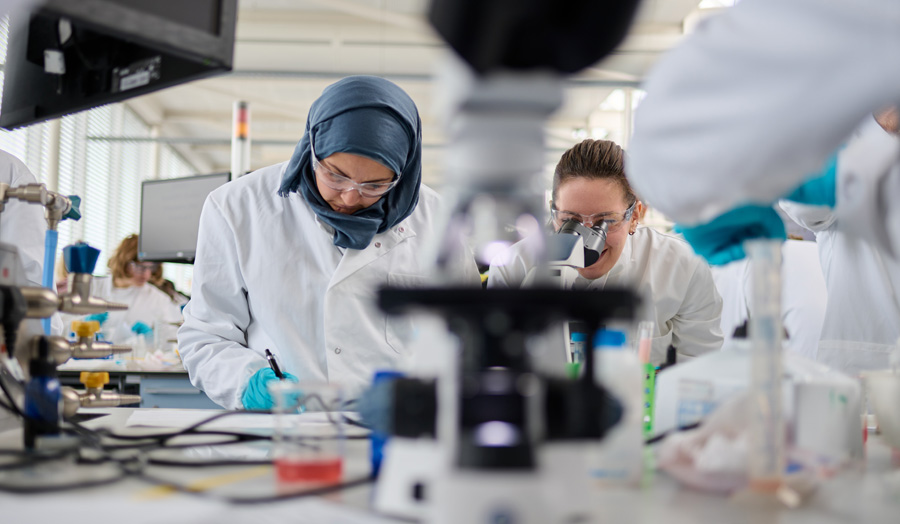
Below: Students at work in the Super lab.


Students study modules from the following, depending on language level:

Foundation English: Writing; listening; reading and speaking skills for university study; Presentations; Relevant vocabulary and grammar; evaluation and analysis; writing for research purposes; essay construction and debate; language for your subject.

Biology: The key aims and objectives of this module are to enable students to achieve a fundamental knowledge base of biology which will underpin studies at higher levels. An introduction will be given to the structure of cells and the concept of the cell as the basic unit of life. A range of cell types will be discussed.  Following an appreciation of the role of cells in the structure and function of tissues and organs, students will be introduced to the anatomy and physiology of key organ systems in the body.

Chemistry: The module aims to develop students’ understanding of fundamental concepts key to subjects involving the molecular sciences. In addition, skills relevant to the chemical sciences including numeracy, logical argument, research, referencing and the utilisation of abstract models will be developed so that they can be utilized further at higher levels.

Introduction to the Chemistry of Biological Molecules: The aim of this module is to give students the necessary background to appreciate the structure and function of the key molecules that cells are made of such as proteins, nucleic acids, lipids and carbohydrates.  An introduction to the principles of cellular energetics and metabolism will be given, and the maintenance of biological pH buffering systems will be discussed. This will provide suitable grounding for the study of life science subjects at higher levels.

Introduction to Psychology and Research Methods: The module is an introduction to psychology and research methods. It intends to provide a general introduction to and overview of the core areas of psychology, and provide an outline of ethical issues and research methods within psychology. The module will demonstrate the role of psychology not just within the academic setting but its role in today’s society and the world. This module will be understandable to a person with no or little sciences background

Nutrition and Sports Science:  The module will provide an introduction to nutrition and health which includes the role of energy and nutrients in human health. It introduces the role of diet in health for adults and children.   It introduces a wide variety of concepts within the field of sports science providing a basis for future study.

Scientific Studies: This module will introduce basic laboratory techniques related to life science modules, designed to support and re-inforce theoretical syllabus content, and reinforce safe practice in the laboratory environment and introduce laboratory record keeping.

Foundation Studies:  Study skills; Reading and research strategies; Essay and report writing; giving seminars; reflection on learning.


  Page last updated : : 23 Apr 2012